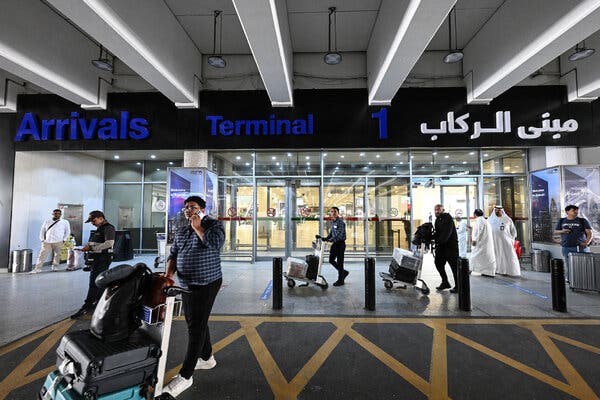
Airports across the Gulf region, including Kuwait, Iraq, Bahrain, the U.A.E., and Iran, have faced attacks in recent months, with both civilian and military facilities affected.
Incident at Kuwait International Airport
On Wednesday, Iranian forces launched an attack on Kuwait’s primary airport using drones. This assault resulted in one fatality and injuries to over 60 people, comprising passengers and airport staff, as reported by Kuwaiti authorities.
The attack damaged Terminal 1 substantially, which had recently reopened after a prolonged closure due to the ongoing conflict. Following the attack, Kuwaiti military officials confirmed the damage caused by Iranian drones, emphasizing the strategic importance of the facility, which serves both civilian and military functions.
Kuwaiti health officials announced a major emergency response at the site, deploying more than 25 ambulances and conducting seven emergency surgeries. Video evidence showed flames and smoke inside the terminal, verified by The New York Times.
Efforts are underway to maintain airport operations, with different terminals being prepared to accommodate passengers.
Wider Impact Across the Region
The war has intensified attacks on airports in the Middle East. Iranian forces targeted Erbil International Airport in Iraq earlier in the year, impacting a base hosting U.S. forces. Moreover, airports in Baghdad, Iraq, Bahrain, and the UAE’s Dubai and Abu Dhabi have experienced similar disruptions.
Tehran’s Mehrabad Airport, a major international hub, was targeted by Israeli airstrikes in March, as reported by Iranian state media.
These attacks have created significant challenges for travelers in the Gulf. Airlines have reduced flight schedules, suspended certain routes, and increased ticket prices. The rise in jet fuel costs due to shipping route closures, notably the Strait of Hormuz, further compounds the issue.
Aviation Adjustments
British Airways recently extended the suspension of flights to several cities in the region, including Dubai and Tel Aviv, until late October. This reflects the broader impact and uncertainty caused by the ongoing conflict.
Leo Sands, a correspondent for The New York Times Breaking News Hub in London, provided coverage of this developing situation.
 Largest Seizure of Illegal Cockroaches in Australia
  New Threat to U.S. Cattle Industry: The Screwworm Infestation
  Military Training Exercises Cause Stir in California Cities
  Manhunt Underway After Reported Shooting in Lansing, Illinois
  New World Screwworm Fly Returns to Texas, Poses Threat to Cattle Industry
  DOJ Investigates Arizona State University’s DEI Practices