China’s Missile Capabilities and Strategic Implications
China is expanding its long-range missile arsenal, potentially enabling strikes on Australian territory. The Lowy Institute warns in a new report that China already holds significant economic leverage that could be detrimental in the event of a regional conflict involving the United States. The rapid military advancement by China’s People’s Liberation Army (PLA) is identified as a factor undermining U.S. dominance in the Indo-Pacific, exerting pressure on other countries to align more closely with Beijing’s preferences.
The report emphasizes that a possible altercation concerning Taiwan remains a primary focus for the PLA. Despite acknowledging U.S. security pledges toward Taiwan, China is actively enhancing its capabilities to project military might over extended distances using missiles, aircraft, and naval vessels that can reach Australian shores.
PLA’s Comprehensive Threat Assessment
The evaluation of potential threats from various PLA divisions, such as its rocket and cyber units, marks China’s military growth as a pivotal shift impacting Australia beyond the direct threat to its territory. On Monday, the Chinese government responded by reaffirming its commitment to peaceful development. China’s Foreign Ministry spokesperson, Lin, emphasized that the enhancement of defense capabilities is intended solely for the protection of sovereignty, security, and developmental interests; they are not aimed at any specific country. Lin asserted that China’s military strength contributes positively to global peace.
Missile Capabilities
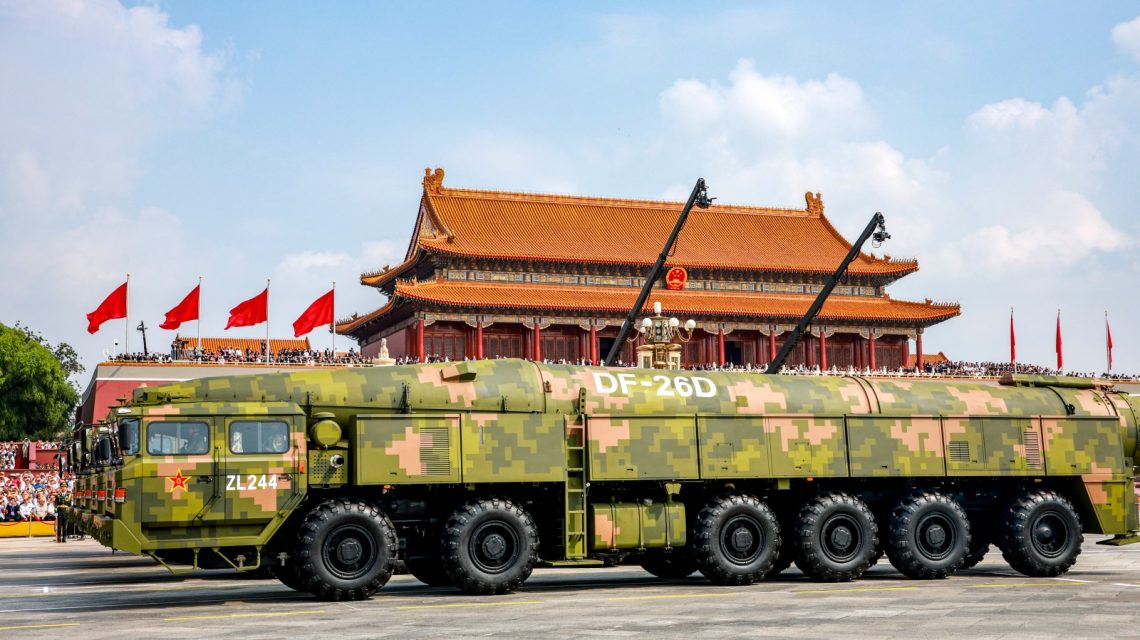
Current Chinese missiles can already strike Australian targets when deployed from maritime or aerial platforms. The DF-26 intermediate-range ballistic missile can reach northern Australia when launched from China’s artificial bases in the South China Sea. More concerning is the prospect of the DF-27 missile, purportedly capable of reaching up to 5,000 miles, fully covering the Australian mainland from China’s territory, according to the Lowy report. This newer missile may already be in operational status, as noted by the U.S. Defense Department.
The report highlights scenarios where China, influenced by strategic objectives, might target offshore oil installations, public infrastructure, or government facilities in a conflict scenario, such as during Australian support for U.S. military efforts. Nuclear options, while excluded from detailed examination, are relevant due to predictions of China’s nuclear stockpile potentially tripling by 2035, with its defense budget estimated to be much higher than disclosed public figures.
Naval Considerations and Economic Vulnerabilities
Australia’s reliance on maritime trade routes underscores its economic vulnerability, as identified in the Lowy report. These vital routes, including essential subsea cables, are seen as susceptible to disruption. Ports Australia’s study serving as an economic impact reference, reveals that 99 percent of Australia’s international trade, equivalent to 1.6 billion tons or $460 billion, in volume in 2024 passed through seaports. Imports predominantly comprised oil, gas, and fuel at 50 percent, followed by construction materials and chemicals.
The possibility of maritime trade restrictions by China ranges from quarantines to demonstrations of force or blockades against Australian trade. The report notes a noticeable escalation with China’s naval exercises encircling Australia in March 2025, exemplifying increased aggressive military posturing without prior notice, which Australia and New Zealand viewed as provocative. Such operations are expected to become more habitual in the future.
Australia’s Strategic Response and Regional Dynamics
Australia has counteracted these developments by increasing its defense funding and aligning more deeply with the United States. This includes acquiring nuclear-powered submarines through the AUKUS pact and hosting U.S. military forces. These actions might exacerbate China’s security concerns, potentially creating a vicious cycle in the region.
Australian Defense Minister Richard Marles has characterized China’s military expansion as the largest since World War II. The U.S. has similarly expressed apprehension due to China’s reluctance to participate in arms control talks, raising questions about its intentions beyond the Indo-Pacific. However, an immediate invasion, like that of Taiwan, is deemed improbable by American officials.
While China accuses the report of misinterpreting its strategic intentions, claiming the assumption that a major power inevitably seeks dominance to be fundamentally misguided. Authors of the Lowy Institute stressed plans must consider China’s capacity for aggression rather than speculating its potential motives. Preparation should focus on definitive capabilities and not on dynamic intentions.
 Vice President JD Vance Prefers Pope Francis’s Directness
  U.K. to Ban Under-16s From Social Media
  Cape Verde’s Remarkable Upset Against Spain in World Cup
  Potential Impact of Inflation on Social Security Benefits Due to Iran Conflict
  2026 FIFA World Cup Kicks Off with Exciting Matches and Anticipation for Erling Haaland’s Debut
  Putin’s Obsession and Psychological Projection