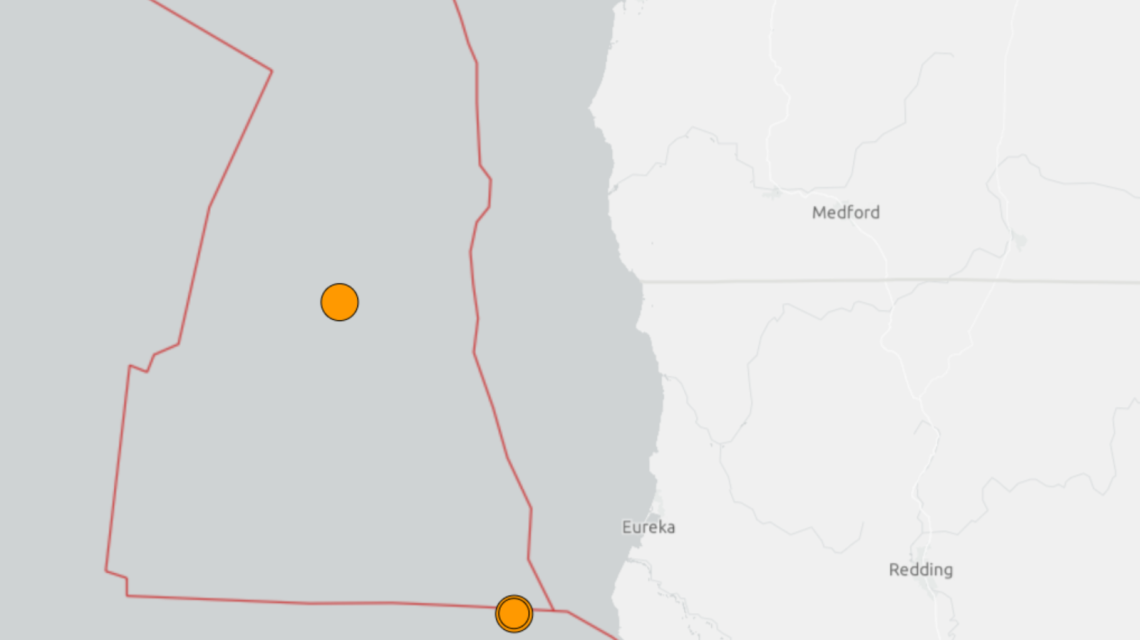
A series of offshore earthquakes shook the Pacific Ocean off Northern California early Wednesday, according to the U.S. Geological Survey (USGS). This sequence included two powerful tremors measuring magnitude 5.0 or stronger.
The earthquakes occurred in rapid succession along a seismically active zone near the California–Oregon border. This event heightened concerns in coastal areas already cautious after a 5.7 magnitude quake earlier that morning off the Oregon coast.
Earthquake Locations
Data from USGS reveals a 5.7 magnitude earthquake struck earlier off the Oregon coast, approximately 100 miles west-southwest of Pistol River. Subsequently, a 5.1 magnitude quake happened about 40 miles (64 kilometers) west of Petrolia, California, at a very shallow depth of around 0.12 miles (633.6 feet).
Following this, the same area experienced additional quakes, measuring magnitudes of 4.5 and 2.8. A smaller, 1.8 magnitude quake was also recorded, located 11 miles west of Petrolia. Due to the shallow depth, these earthquakes had the potential to be felt along the coast. However, initial reports confirmed limited impact.
No tsunami warning or threat was issued, and authorities reported no significant damage or injuries.
Numerous Smaller Earthquakes
Recently, California has recorded a series of smaller tremors. USGS data indicates a total of 82 quakes have occurred across the state. In Northern California alone, at least 35 quakes ranging from magnitudes 0.03 to 3.6 were reported, primarily north of Santa Rosa, near Mercuryville. This area has seen activity increase in recent months.
Additionally, 47 smaller earthquakes, with magnitudes between 0.3 and 2.5, were noted from Parkfield in the north to Imperial in the south.
Reasons for Frequent Earthquakes
Earthquakes are prevalent in California because the state lies along a significant tectonic plate boundary. This boundary is one of the world’s most active.
California is positioned on the boundary between the Pacific Plate and the North American Plate. These enormous crustal plates move past each other continuously along faults like the San Andreas Fault. Their movement is often impeded by friction, causing stress to accumulate beneath the Earth’s surface. When released, this stress triggers earthquakes.
California’s seismic activity is further complicated by a large network of faults, including the well-known San Andreas Fault and numerous smaller ones. This complex fault network means earthquakes can occur in various regions across the state.
 Limited Interest in Arctic National Wildlife Refuge Oil Auction
  Confronting the Truth Behind Sustainability Buzzwords in the Food Industry
  The Aftermath of Santa Rosa Island’s Fire
  Largest Seizure of Illegal Cockroaches in Australia
  Flesh-Eating Fly Returns to the United States Causing Concern
  Australia’s Largest Seizure of Exotic Invertebrates: Over 100,000 Cockroaches Confiscated