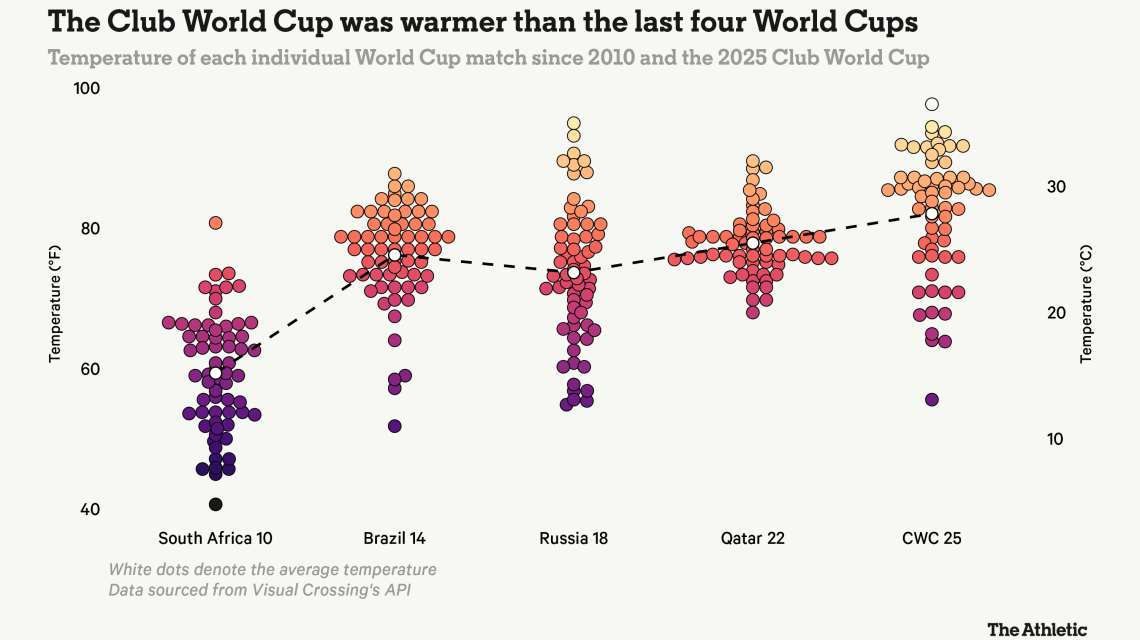
The upcoming World Cup promises to be a sweltering event, with numerous matches expected to be played in temperatures exceeding 90F (32C). This edition is likely to rival the 1994 tournament in North America, renowned for its exhausting conditions, exemplified by Mexico’s 2-1 win over the Republic of Ireland in Orlando at a pitch-level temperature of 117F.
Many matches during the 1994 World Cup were held before 5 pm local time under a relentless sun. This year’s tournament might see similar conditions, especially given the Club World Cup hosted in the U.S. last summer, which saw warmer temperatures than the previous four World Cups.
While only five of those stadiums will host matches during this event, games will also take place in Mexico and Canada. The Athletic conducted an analysis using hourly weather data over the last decade to predict the conditions for each fixture, considering the scheduled kick-off time plus an hour either side within a seven-day window around each match date.
AT&T Stadium in Dallas is projected to have the highest average temperature with 90F (32C), followed by Monterrey’s Estadio BBVA. Dallas will host a semi-final on July 14, estimated at 93F (34C). Fortunately, Dallas, Atlanta, and Houston venues will operate with closed roofs and air conditioning, easing the conditions for players.
Open-air stadiums will be less forgiving, with temperatures exceeding 100F during kick-off around the week of the game in six of the 16 venues at least once in the past decade. Chief Meteorologist Aaron Mentkowski notes the field’s exposure to solar radiation leads to intense conditions, especially with light winds and full sunshine, while shaded stands protect the field from wind, causing heat to stagnate.
“The fields are mostly open while the stands are shaded. A breeze would carry some of that heat away, but instead it just stagnates.” — Aaron Mentkowski
Mentkowski will provide daily forecasts and insights during the World Cup, spotlighting significant weather events affecting teams and matches in The Athletic’s live coverage.
Extreme heat is set to impact performance, challenging players to maintain high-energy playing styles. Germany’s Jurgen Klinsmann, recalling the 1994 tournament, described the difficulty in sustaining rhythm amid such challenging conditions. To adapt, teams like Norway have begun training in warmer climates, practices observed in North Carolina last Friday as players trained in the sun at 90F temperatures, starkly contrasting with the cooler Nordic weather.
However, Mentkowski believes acclimation is possible within a week or two. Many players compete internationally, adapting to similar conditions throughout the year.
Beyond extreme heat, thunderstorms pose logistical challenges. Matches must be suspended if electrical activity is detected within an eight-mile radius, requiring a 30-minute countdown before resumption if lightning strikes reoccur, evidenced by Chelsea’s Club World Cup game prolonged by repeated delays.
Mentkowski has identified Miami, Mexico City, Kansas City, Boston, Philadelphia, and New York as venues susceptible to severe weather events like storms and heat spikes.
Such disruptions can affect team momentum and complicate nutrition and hydration strategies, highlighting the importance of adaptability in World Cup success, alongside player quality and tactical preparation.
 World Cup Matchday 5: Surprises and Performances
  Iran’s World Cup Journey After Politically Charged Match
  Exciting World Cup Day of Draws: Winners and Losers
  Exciting Day 5 at the World Cup: Ties and Surprises
  Joe Burrow Eyes NFL MVP Amidst Challenges
  Spurs Reflect on NBA Finals Loss as Knicks Celebrate Victory