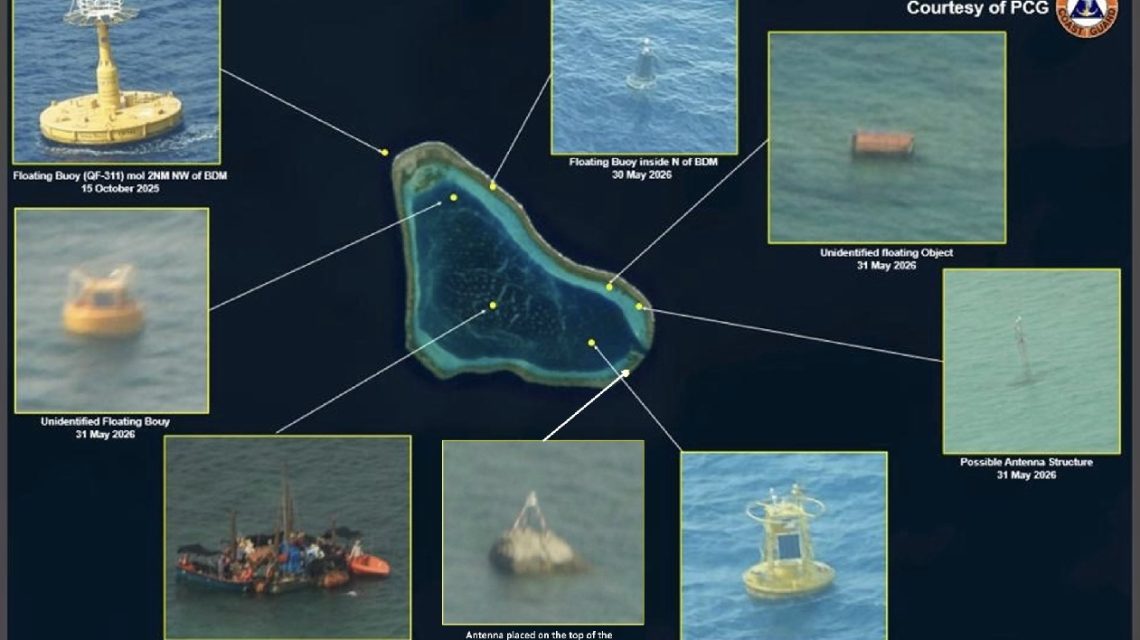
The Philippine government has released images showing structures at the disputed Scarborough Shoal, which they suspect were erected by China. Since the first structure was reported on May 30 within Scarborough Shoal’s lagoon, the number of identified foreign objects has increased to six, according to a Philippine coast guard spokesperson. Scarborough Shoal is a key area in the South China Sea dispute, controlled by China since a standoff in 2012, but not physically occupied until now.
Philippine military chief Romeo Brawner Jr. stated that planes have been deployed over Scarborough Shoal, or Bajo de Masinloc, to identify whether the structures are floating or fixed. The Philippines also plans to send ships to investigate. The structures include an antenna on a rock near the lagoon’s entrance, a second suspected antenna, a floating structure, an unidentified cylindrical object, and three buoys that add to two previously discovered.
Additionally, a mobile, temporary structure measuring around 20 by 20 feet with six occupants is under observation. This development follows previous incidents where China deployed barriers to block Filipino fishermen from accessing the lagoon’s fishing grounds. The increase in structures, especially those with personnel, could escalate the territorial conflict between Manila and Beijing.
The Philippine Foreign Affairs Department has undertaken diplomatic actions against China’s “illegal presence” of structures at Scarborough Shoal. This area, termed the West Philippine Sea by Manila, lies within the Philippines’ exclusive economic zone, which allows a country exclusive rights to exploit marine resources within 230 miles from its coastline.
While Beijing has not disputed Manila’s claims about the origin of these structures, it has reiterated its long-standing claim to Scarborough Shoal. Chinese Foreign Ministry spokesperson Lin Jian stated, “China has indisputable sovereignty over Huangyan Dao and its adjacent waters.” China claims these activities are part of its sovereign rights, including scientific research.
Tensions heightened last summer when a Chinese navy destroyer and a China coast guard vessel collided with a Philippine government vessel attempting to aid local fishermen. The incident caused damage to the coast guard ship, and Philippine officials claimed it resulted in Chinese casualties, though this was not publicly confirmed by Beijing.
Subsequent to this, China declared a national nature reserve over roughly a third of the shoal, prompting protests from Manila and Washington. The discovery of new structures has raised concerns about China’s intentions to strengthen its control over the area.
Collin Koh, a senior fellow at the Institute of Defense and Strategic Studies in Singapore, commented that China’s actions reflect a pattern seen in other regions like the East China Sea and Yellow Sea. Koh warned that the floating structure could signal further aggressive moves to cement China’s control.
China’s extensive claims over the South China Sea are based on “historic rights,” making China responsible for much of the $3 trillion maritime trade that passes annually. These claims have been protested by neighboring nations, including Vietnam, Taiwan, Malaysia, Brunei, and Indonesia.
The Philippines challenged China’s claims at the Permanent Court of Arbitration in The Hague, which ruled against China in 2016. Despite the verdict, Beijing continues to deny the ruling and proceeds with its activities.
 Progress in Iran War Negotiations as Key Players Signal Imminent Deal
  Peruvian Police Use World Cup Mascots to Arrest Suspected Drug Dealer
  Former General Likens Trump’s Iran Strategy to Nixon’s Vietnam Bombing Campaign
  Protestas en Kinshasa por Propuesta de Cambio Constitucional
  Alexis Lalas Stirs Controversy During 2026 World Cup Broadcast
  U.S. and Iran Edge Closer to Agreement on Middle East Conflict