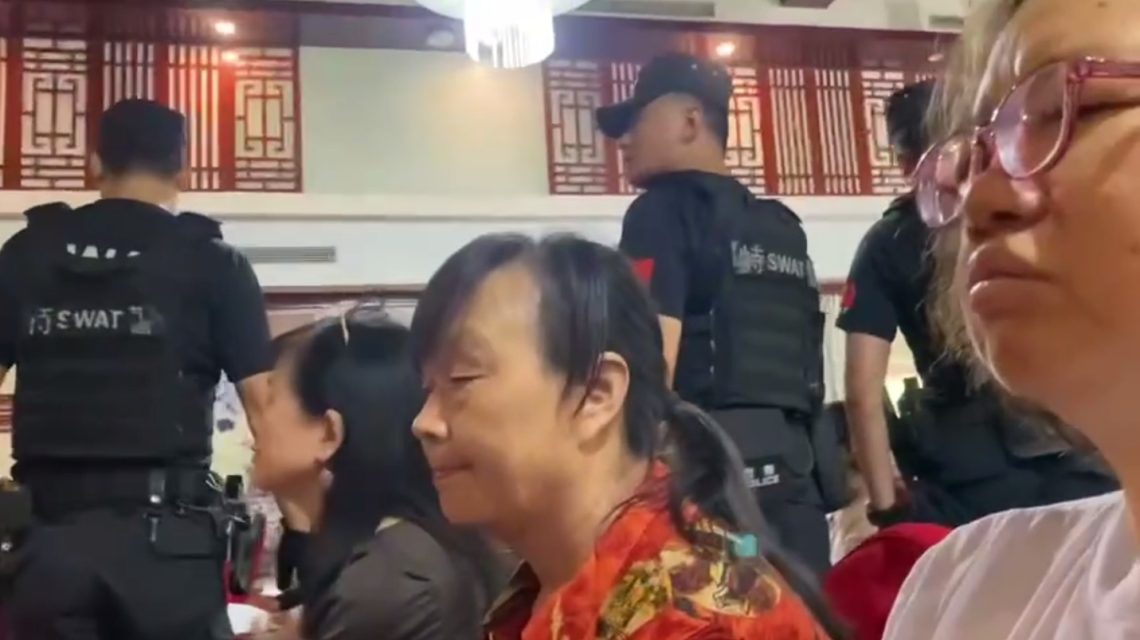
On Sunday morning, a worship service at a prominent church in Jiangyou, a city in southwestern China, was disrupted by a raid conducted by numerous police officers. According to congregation members, the incident resulted in the detention of two senior church leaders.
Videos from the church’s Telegram channel captured the raid as it began at the Sichuan Province church, located approximately 100 miles north of Chengdu, the provincial capital. The channel’s administrator, believed to be outside China, reported that 60 to 70 personnel from different agencies, including local police, officials from the Religious Affairs Bureau, and state security officers, were involved in the operation.
The officers surrounded the congregation, including young children, during the service as hymns were sung in quiet defiance. Thirty-one individuals were subsequently taken to a detention center for questioning. Officials attempted to coerce them into signing statements without prior disclosure of the contents; however, most attendees refused to comply.
By 11 p.m., most detainees were released, except for two church elders named Yan Hong and Wu Wuqing. Newsweek contacted China’s National Religious Affairs Administration for comment.
According to the Chinese General Social Survey (CGSS) by Renmin University, about 1 to 2 percent of Chinese adults identify as Christian. While Christianity is not officially banned in China, the government maintains strict control over religious activities and imposes significant restrictions on organized faith groups. Public worship is forbidden outside state-sanctioned venues, and places of worship must register with authorities. Religious groups face extensive oversight concerning teaching, publishing, and online activities.
Beijing’s Response to Religious Affairs
On Monday, the Chinese Foreign Ministry defended its management of religious affairs. It dismissed external criticism as interference in the country’s internal matters. Lin Jian, a spokesperson for the Foreign Ministry, stated, “The Chinese government manages religious affairs in accordance with the law and protects people’s freedom of religious belief and normal religious activities. We firmly oppose interference in China’s internal affairs under the pretext of so-called religious issues.”
The Early Rain Covenant Church symbolizes the struggles faced by China’s independent Christian congregations amidst what rights groups describe as an escalating crackdown on unregistered religious activity. In December 2018, the Presbyterian church faced a significant crackdown when founding pastor Wang Yi and over 100 congregants were arrested. Wang was later sentenced to nine years in prison on charges, including “inciting subversion of state power.” He had refused to register the church with the state and openly criticized President Xi Jinping’s efforts to “Sinicize” religion by aligning religious practices and doctrines with Communist Party policies.
The recent raid represents another action targeting unregistered churches, similar to the nationwide crackdown on a network of house churches known as Zion Church late last year.
 Iran’s Struggle for Independence and Global Realignment
  Oil Flow and Global Economy: The Path to Recovery After Conflict
  Venezuela Signs Energy Agreement with General Electric
  Russia’s Cautious Support for U.S.-Iran Agreement Signals Hope and Skepticism
  Israeli Political Spectrum Reacts to US-Iran Agreement
  New Details Emerge in Arson Attacks Linked to UK Prime Minister