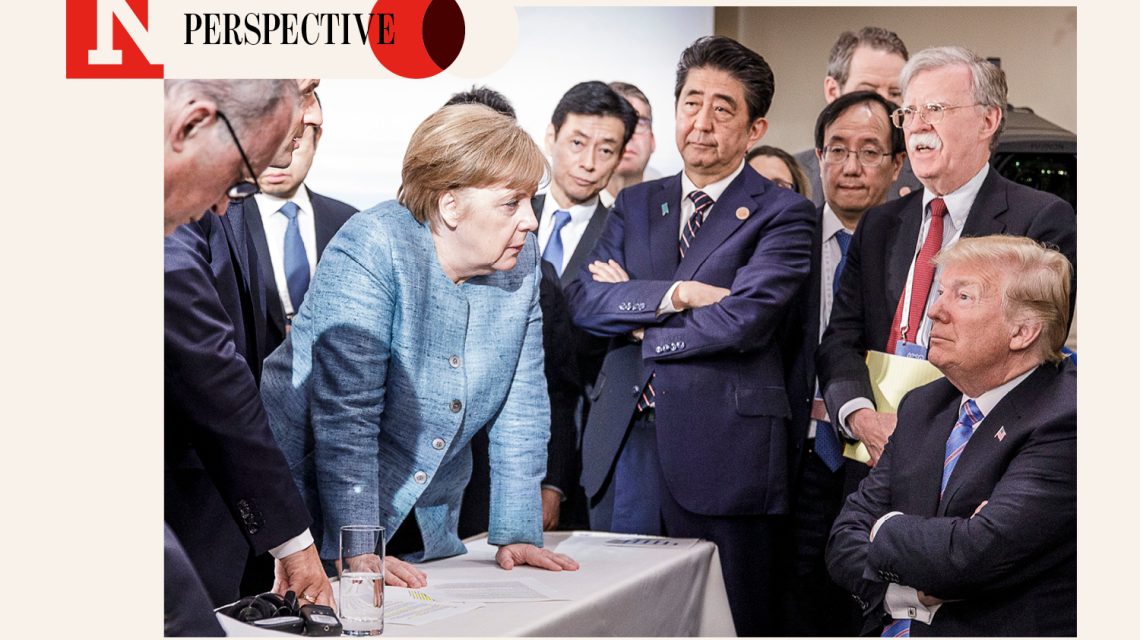
The iconic photograph from June 9, 2018, in Charlevoix, Quebec, captured a significant moment in Trump-era diplomacy. German Chancellor Angela Merkel leaned over a table, displaying determination, alongside other world leaders, while President Donald Trump sat with arms crossed. This image symbolized the struggle to keep the American president engaged in the global system established by America itself.
After that summit, Trump refused to endorse the joint statement, withdrawing support from commitments on trade, security, and democracy. Merkel later described the experience as “sobering and a bit depressing.” Fast forward to 2026, at Évian-les-Bains, France, a new understanding has emerged for the G7. Relying solely on diplomatic posturing proved ineffective. Thus, the group expanded the table.
The 2026 summit, hosted by France, included the traditional G7 members—France, the United States, Britain, Germany, Italy, Japan, Canada, along with the European Union. New participants included India, Brazil, South Korea, Kenya, Egypt, Qatar, Ukraine, and the United Arab Emirates, alongside the World Bank, IMF, OECD, and African Development Bank.
This expansion wasn’t mere outreach; it represented a shift towards a more inclusive G7. Officially, the summit focused on geopolitical challenges, economic growth, and cooperation. A significant video call on June 11 with countries like China and India highlighted a strategic engagement beyond traditional allies.
The need for inclusivity stems from shifting global dynamics. The G7, while still powerful, constitutes only 28.4% of global GDP and 9.6% of world population. The expanding guest list reflects an acknowledgment of changing power structures.
The G7’s strategy involves reducing reliance on America as a single point of failure.
The invitees served distinct roles:
- Qatar: As a major LNG exporter, Qatar’s role is in energy diplomacy.
- UAE: Involved in both hydrocarbons and finance, the UAE plays a crucial economic role.
- Egypt: Strategic for its control of the Suez Canal, crucial for global trade.
- Kenya: Represents African legitimacy and environmental diplomacy.
- Ukraine: Central as a moral and civilizational participant.
- South Korea: Essential for technology and industrial contributions.
- Brazil: Provides food security and links to the Global South through BRICS.
- India: Holds potential as a swing state with significant economic and geopolitical influence.
The Charlevoix photograph captured leaders trying to engage an unyielding U.S. president. Today’s Évian summit acknowledges a multipolar approach, inviting various nations to ensure resilience and adaptability. Canada’s Prime Minister Mark Carney emphasized the need for middle powers to collaborate actively on the global stage.
 US Sanctions Lead to Shutdown of Key Cuban Remittance Platforms
  Challenges and Opportunities in Iran’s Uranium Deal
  Trump Shifts Focus to Ending Russia-Ukraine Conflict After Iran Deal
  Ukraine Drone Strike Targets Moscow Oil Refinery Amid Ongoing Conflict
  Ukraine Strikes Moscow Oil Refinery in Drone Attack
  Resurfacing of World War II ‘Death Railway’ Remains in Thailand