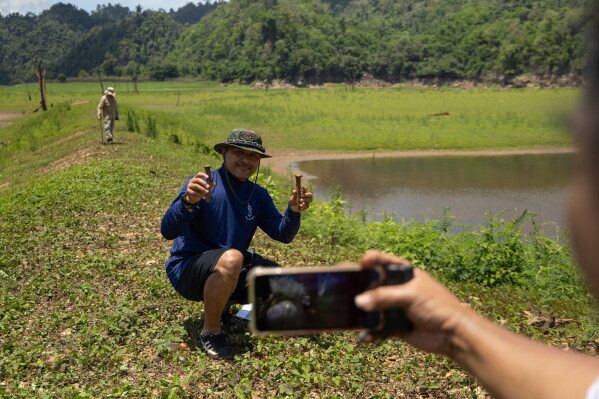
A key portion of World War II’s infamous ‘Death Railway’ has emerged from beneath the waters of a reservoir in Kanchanaburi, Thailand, offering researchers a rare chance to study it. Nithe Station, a critical depot along the railway, has become visible after the Electricity Generating Authority of Thailand drained the Vajiralongkorn Dam for maintenance.
The ‘Death Railway’ served as a supply route for the Japanese forces occupying Southeast Asia, constructed by thousands of Allied prisoners of war (POWs) and Asian laborers. Over 12,500 POWs and 75,000 laborers lost their lives during its construction. This tragic history inspired the films ‘The Bridge on the River Kwai’ and ‘The Railway Man,’ as well as the novel ‘The Narrow Road to the Deep North.’
Unique Research Opportunity
With the station exposed, historians and researchers are flocking to Nithe Station to examine its remnants before the reservoir is refilled with the onset of the rainy season in August. Martyn Fryer, an independent researcher from Australia, aims to learn more about his grandfather’s experiences working on the railway as a POW by exploring the area.
Fryer, who has written a book on his grandfather’s regiment, is scanning the area for historical artifacts. Meanwhile, Andrew Snow from the Thailand-Burma Railway Centre is using wartime aerial photographs and personal maps to locate POW camps near the station.
Public Interest and Historical Legacy
Interest from the public is also growing. A local resident, Kitti Laokham, reports that over 32 million people have viewed his social media posts about Nithe Station. Visitors from across Thailand, including Channarong Noimala from Bangkok, are traveling to witness this pivotal historical site.
About 100 kilometers southwest of Nithe lies Hellfire Pass, a brutal section of the railway where numerous POWs died. The Hellfire Pass Interpretive Centre, funded by the Australian government, is a vital site for preserving war history and welcomed a record 169,000 visitors last year.
Mick Clarke, an Australian Army veteran who manages the center, emphasizes the importance of these sites. For many Australians, they represent a personal connection to the past, honoring the memory of those who suffered during the war.
 Ukraine Drone Strike Targets Moscow Oil Refinery Amid Ongoing Conflict
  The Changing Dynamics at the G7: A Shift Towards Inclusivity
  Ukraine Strikes Moscow Oil Refinery in Drone Attack
  The Ongoing Struggle Against Nuclear Threats: Historical Parallels
  Vozinha Shines in Cape Verde’s World Cup Debut
  Iran’s Mohebi Stirs Debate with Controversial Celebration at World Cup