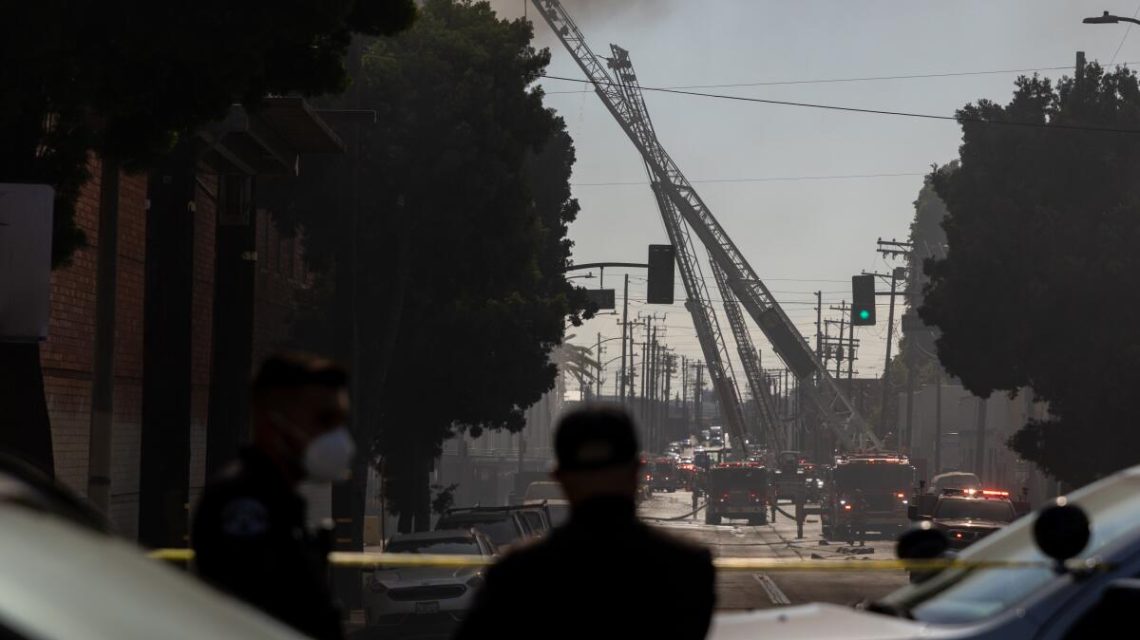
Thick black smoke continues to fill the air as emergency crews work to contain a warehouse fire in Boyle Heights, Los Angeles. The fire has been active since Wednesday, affecting air quality over a wide area and impacting residents miles away.
The Latest Advisories
The South Coast Air Quality Management District has extended the Particle Pollution Advisory until 12:30 p.m. on Sunday. A change in wind direction on Sunday morning might push smoke towards Southeast LA County. If the fire continues to produce smoke, Central and East Los Angeles may be impacted more.
Health and Safety Precautions
Officials advise those with lung issues or sensitivity to smoke to stay indoors and avoid outdoor activities. Although crews have reduced hazardous materials at the site, spoiled food remains a potential biohazard. The 500,000-square-foot warehouse contains 85 million pounds of frozen food, such as bread, poultry, pork, and beef.
L.A. County Health Officer Muntu Davis highlighted the public health concerns related to smoke and fine particles, which may irritate ears, nose, throat, lungs, and worsen heart and lung conditions. Sensitive individuals are encouraged to wear N95 or P100 masks and to subscribe to emergency notifications at alertla.org.
Will Barrett from the American Lung Association emphasized avoiding smoke exposure. He noted that smoke composition could include toxic chemicals and fine particles, posing health risks based on fire conditions.
Dealing with Smoke: Tips
- If you smell or see smoke or ash at ground level, avoid vigorous physical activity and stay indoors with doors and windows closed.
- Run an air purifier if accessible.
- Avoid using whole-house fans or swamp coolers as they may introduce polluted air indoors.
- If smoke, particles, or ash are noticeable outside, stay indoors to minimize exposure, especially if you have health conditions, are elderly, or have children.
- Wear N95 or P100 masks if you need to be outside for extended periods in areas with heavy smoke or ash.
- In case of excessive heat indoors, seek refuge in public places like libraries or shopping centers.
- Avoid using fireplaces, candles, or vacuums. Clean dusty surfaces with a damp cloth and refrain from smoking.
- Contact a doctor or urgent care if you experience severe coughing, shortness of breath, wheezing, chest pain, palpitations, nausea, or unusual fatigue. Call 911 for life-threatening symptoms.
Expert Advice
Michael Kleinman from UC Irvine’s Wen School of Population and Public Health stated that the smoke impact zone depends heavily on the wind’s speed and direction. He warned that indicators such as irritation, stinging or watering eyes, or a runny nose are signs of more serious conditions.
Kleinman raised concerns about the biohazard risk from spoiling food, noting that while harmful bacteria and odors may develop, burning these materials can introduce additional biological dangers.
Available Resources
The city has opened a smoke respite shelter at Pecan Recreation Center at 145 S. Pecan St.; the county provides another at City Terrace Park, 1126 N. Hazard Ave.
The state is ready to deploy technical experts and distribute 5.5 million respirator masks, commercial-grade air purifiers, bottled water, and enhanced air-quality monitors.
The information was contributed by Laurence Darmiento and Shelby Grad, with additional insights from environment reporter Hayley Smith, who focuses on climate policy and technology at the Los Angeles Times.
 FAA Investigates Delta Flight Go-Around at Boston Logan
  The Rising Challenge of Childhood Obesity
  Return to Normalcy After Hantavirus Quarantine
  Europe Braces for Intense Heatwave with Emergency Measures
  Controversy Surrounds Renovation of Lincoln Memorial Reflecting Pool
  Heat-Related Deaths at Grand Canyon Amid Extreme Temperatures