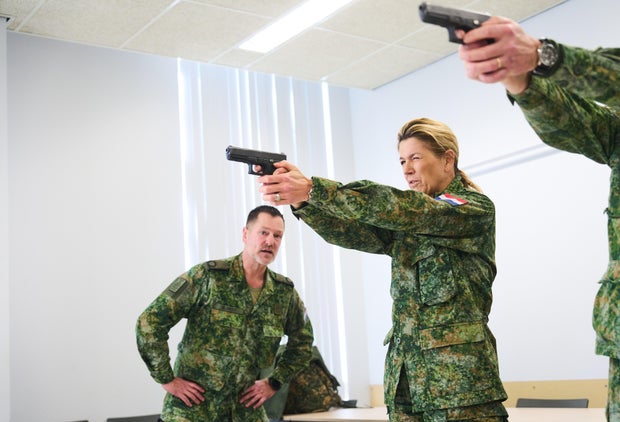
In February 2026, Queen Maxima of the Netherlands took a significant step by enlisting in her country’s army reserves, highlighting concerns about national security. At 54, Queen Maxima has decided to become a reservist, driven by the belief that safety can no longer be presumed, according to a statement from the Dutch royal family. “She, like many others, wishes to contribute to that safety,” the statement added.
After her training with the Royal Netherlands Army, Queen Maxima, originally from Argentina, will be promoted to the rank of Lieutenant Colonel. The royal family noted that, like other reservists, she will be deployed as needed. Her training began on February 4, 2025, at the Royal Military Academy in Breda.
Images shared by the family depict Queen Maxima engaged in “Mental Skills” training at the academy, participating in various exercises, including one where she is seen handling a handgun. A video released features Queen Maxima wearing green army fatigues, smiling as she dives into a pool and later participates in rock climbing while wearing a helmet.
The involvement of royals in military service is not uncommon in Europe. Queen Maxima’s daughter, Princess Catharina-Amalia, recently completed her military training and holds the rank of corporal. Additionally, last year, Princess Ingrid Alexandra of Norway finished her 15-month stint in an engineering battalion, while Princess Leonor of Spain is in her final year of army, navy, and air force training.
Numerous members of the British royal family have had military careers, including the late King Charles II, and his sons, Prince William and Prince Harry. Harry notably served two tours in Afghanistan.
“We refuse to remain dependent on others for our protection,”
The geopolitical climate in Europe has shifted following Russia’s invasion of Ukraine and concerns over the reliability of the U.S. as a steadfast NATO ally. Former President Trump had urged European nations to increase their defense spending and decrease reliance on U.S. military forces. Trump’s actions, including attempts to acquire Greenland from Denmark and threats of tariffs, have sometimes strained NATO relationships.
Amidst these concerns, European Union Defense Commissioner Andrius Kubilius suggested in January the formation of a 100,000-strong EU military force, distinct from NATO. “We need to start to invest our money in such a way that we would be able to fight as Europe, not just as a collection of 27 national ‘bonsai armies,'” he stated.
Several European countries are examining conscription policies as a part of national defense strategies. Nine NATO member states, including Denmark, Estonia, and Finland, have maintained some form of mandatory military service. Croatia intends to reinstate compulsory military service this year for men aged 19 to 29. Other countries like France and Germany have introduced incentives to encourage young people to serve.
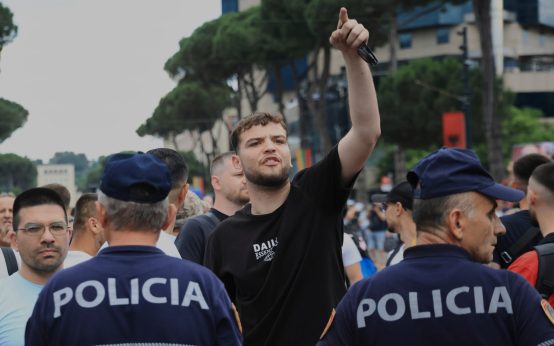 Protests Erupt in Albania Over Resort Development
 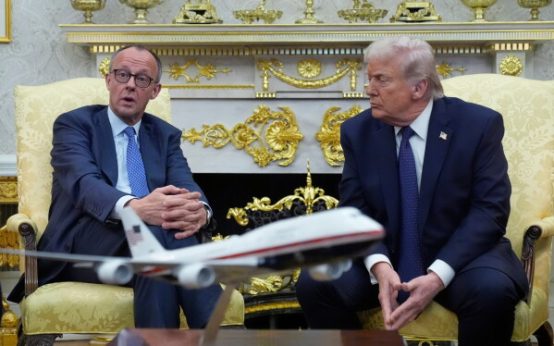 Clarity Sought on U.S. Troop Levels in Europe Amid Policy Changes
 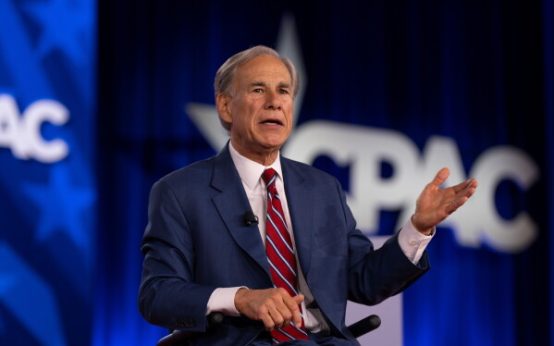 U.S. Military Awaits Pentagon’s Clarification on Troop Levels in Europe
  Potential Ebola Outbreak in Central Africa Raises Concerns of Rapid Spread
  U.S. and Allies Condemn Efforts to Overthrow Bolivian Government
  Pamela Hicks: Cousin, Bridesmaid, and Witness to History