You are reading a preview of an upcoming newsletter from The Indicator by Planet Money, which will provide you with a curated selection of stories and insights about business, finance, and economics. You can subscribe to receive the newsletter in your inbox every Friday.
Today’s Indicator: Over $400,000
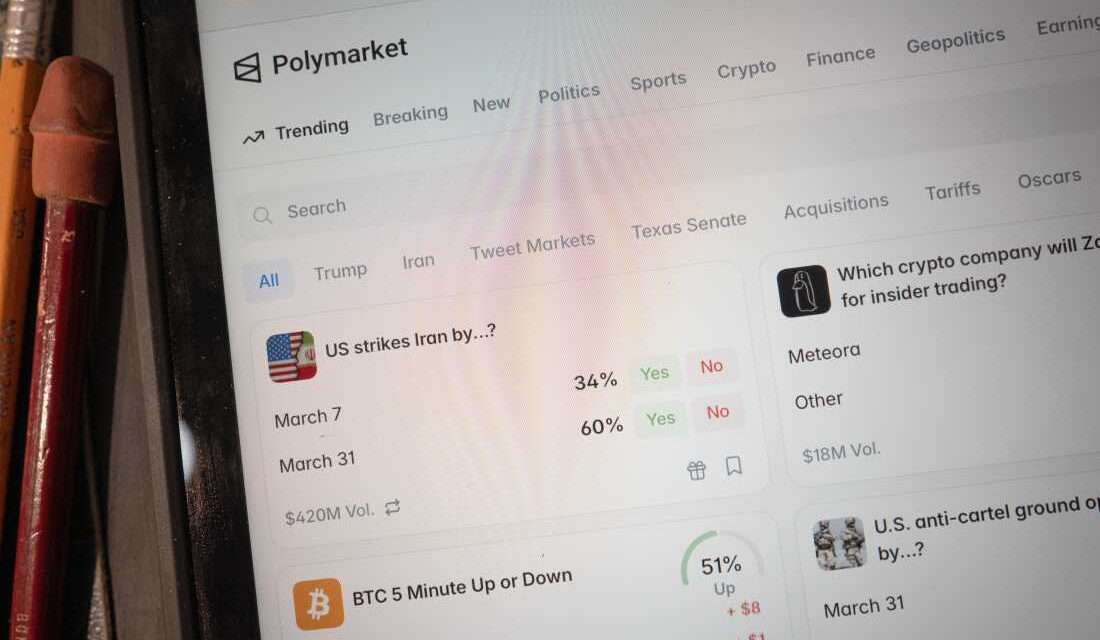
Insider trading poses a significant problem. It becomes particularly concerning when individuals access privileged information. For example, an American soldier allegedly leveraged classified details to transform $33,000 into over $400,000. Additionally, hefty profits have been made via precision-timed bets on prediction markets such as Polymarket, anticipating events like U.S. actions against Iran or the capture of Venezuela’s Nicolás Maduro.
Despite apparent illegalities, it’s challenging to enforce restrictions on Congress members who partake in such betting due to the structure of these platforms. Polymarket’s front-end is regulated in the U.S., yet the real transactions occur on a largely anonymous, crypto-based international back-end, complicating the tracking of participants.
Senator Richard Blumenthal seeks to align prediction markets with regulated sportsbooks. He introduced legislation intended to reduce anonymity and counter potential insider trading. Although cryptocurrency facilitates anonymity, transactions remain permanently recorded on blockchain. The full podcast episode delves further into these topics.
Weekly Insights
Anthropic’s Claude Mythos
Anthropic declared their Claude Mythos model too potent to release, pointing to other similarly capable large language models (LLMs).
NATO’s Status
There’s a deep exploration into whether NATO is weakening.
Federal Electricity Demand
An executive from Oncor, a major Texas utility, revealed a staggering electricity demand forecast for the next five years, amounting to 122 GW, much higher than the Texas primary grid, ERCOT, which delivers up to 85 GW at any single time. This marks a potential 143% energy increase requirement, vastly outpacing typical year-over-year demand growth rates of less than 2%.
Former FERC Chairman Jon Wellinghoff highlighted that expanding grid capacity to meet such escalated demands would be profoundly challenging, with feasible increases generally under 20%. He predicts many proposed projects might not materialize due to competitive and community resistance, evidenced by developers canceling 20-plus data centers amidst local opposition just this year.
Impact of School Start Times on Student Performance
California enacted a law in 2022 to delay the start times for middle and high schools. Researchers explored this change’s effects on mental health, sleep, and academic performance, observing improved sleep overall. Boys, particularly, showed significant mental health gains. The alteration also positively affected students’ math and English scores with notable improvements among Hispanic and economically disadvantaged students.
The reality of early school starts shocked several team members, hinting at the potential simplicity of solving educational challenges. Adjusting start times rather than investing in new educational methods seems effective in enhancing student outcomes.
Statistics from the U.S. Department of Education’s National Center for Education Statistics illustrate public high school start times and distribution during 2017–2018. Source: U.S. Department of Education, National Center for Education Statistics, National Teacher and Principal Survey (NTPS), 2017–18.
In the email version of this newsletter, we will answer queries and share personal team activities. Subscribe for full access and reach out to [email protected] with your feedback!