
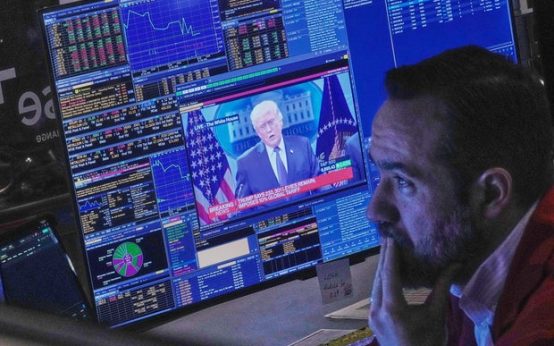
On Wednesday, a significant sell-off in artificial intelligence stocks pushed the U.S. market sharply downward. The past superstars of Wall Street are now under intense scrutiny. The S&P 500 fell by 1.6%, marking its first consecutive drop in three weeks, bringing it back to May levels. The Dow Jones Industrial Average plunged 953 points, or 1.9%, while the Nasdaq composite slumped by 2%.
The market’s recent instability began last week when AI stocks, which had been soaring, suddenly took a downturn. Concerns have emerged that their prices surged too rapidly due to AI hype. Investors question if the recent decline has cleared any excessive optimism in their stock prices or if a more extended downturn is underway.
Super Micro Computer, an AI server vendor, saw its shares plummet by 28% following its announcement of a plan to raise $7 billion by issuing new shares and convertible preferred stock. Such actions typically generate maximum funds when stock prices are high but can dilute existing shareholders’ ownership stakes.
Micron Technology’s stock exhibited wild fluctuations, starting with a nearly 4% loss, moving to a modest gain, and then ending with a 4.7% drop. Despite the volatility, Micron’s stock has soared by 212.5% this year.
Nvidia, valued at nearly $4.9 trillion due to the AI boom, significantly dragged the S&P 500 down with a 3.7% fall. Broadcom, another AI leader, experienced a 5.1% drop. Investor reallocations in anticipation of high-profile market debuts, such as SpaceX’s potential IPO, may also be impacting AI stocks.
Additionally, challenges faced by companies with substantial fuel expenses further impacted the market. United Airlines decreased by 6.2%, and Carnival saw a 6.3% drop as oil prices rose amid ongoing conflict involving Iran.
The price of Brent crude oil increased by 1.8% to $93.10 per barrel after President Trump issued a warning to Iran regarding stalled negotiations related to the war.
The market implications include global oil delivery disruptions, driving inflation up. In May, consumer prices surged at the fastest rate in three years in the U.S. Nevertheless, Treasury yields maintained relative stability. A slight increase brought the yield on the 10-year Treasury to 4.54% from 4.53% on Tuesday. The two-year Treasury yield remained at 4.13%, closely following expectations regarding Federal Reserve rate adjustments due to high inflation and a robust job market. The latest inflation report did little to alter these expectations.
Higher yields can slow economies and depress investment prices, hitting expensive stocks and cryptocurrencies hardest. The S&P 500 dropped 119.66 points to 7,266.99. The Dow Jones Industrial Average fell 953.33 to 49,918.78, and the Nasdaq composite sank 509.32 to 25,169.50.
Internationally, European markets were mixed, while Asian indexes faced sharper declines. South Korea’s Kospi dropped 4.5%, impacted by falls in tech firms Samsung Electronics and SK Hynix. Tokyo’s Nikkei 225 decreased by 1.9% after reports showed a rapid rise in Japan’s May producer price index. SoftBank Group, with an AI focus, lost 8.3% in its share value.
 President Trump’s Extensive Stock Trades Raise Ethical Concerns
  SpaceX’s Historic Stock Market Debut
  U.S. Stocks Surge as Trump Calls Off Iran Strike
  SpaceX IPO and Its Implications for Retail Investors
  Wall Street Faces Roller Coaster as AI Stocks Hit Turbulence
  S&P 500 Maintains Index Inclusion Criteria Amid IPO Surge