On Sunday, millions of Colombians will vote in a pivotal presidential election expected to lead to a runoff between distinctly different candidates. A new president may be elected, but reaching the 50% threshold necessary for a first-round win is unlikely. A runoff is almost guaranteed on June 21.
Among the 14 candidates, the contest has effectively narrowed to three. On the far left stands Senator Iván Cepeda from the ruling Pacto Histórico party, closely aligning with current President Gustavo Petro’s policies. On the far right is Abbasardo de la Espriella, a lawyer emulating the rhetoric of President Trump and El Salvador’s Nayib Bukele. Center-right candidate Paloma Valencia, backed by former President Álvaro Uribe, completes the trio.
Recent polls by AtlasIntel, based on 4,531 interviews, show Cepeda barely leading the first round with 38.7%. De la Espriella follows closely at 37.3%, while Valencia trails with 14.3%. Moderate candidate Sergio Fajardo lags far behind. The poll indicates each of the three would surpass Cepeda in a potential runoff.
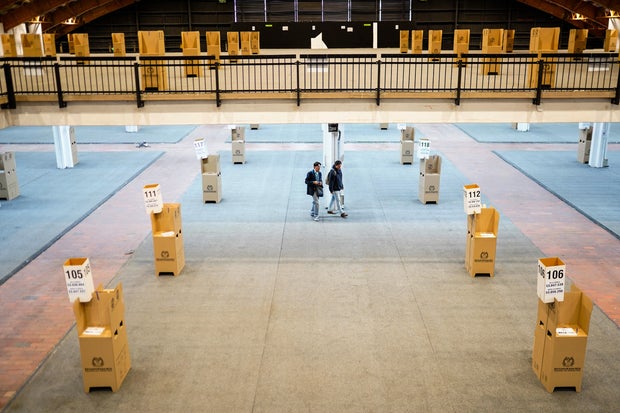
A polling station in Bogota prepares for the upcoming election. (Sergio Acero/AFP via Getty Images)
Colombia’s Search for Change
In a highly polarized environment, Colombians seek new approaches as low-income families near coca fields endure the impact of unsuccessful peace talks. Over 50 massacres have been reported this year, highlighting escalating violence. Studies show Petro’s negotiation policies have allowed criminal groups to grow in power and size.
The campaign season has been marred by major incidents, including a candidate’s assassination, bombings, and kidnappings. Security ranks high on voters’ list of concerns, second only to healthcare.
Each of the leading candidates offers contrasting solutions to Colombia’s security issues. De la Espriella’s far-right approach favors drastic measures like bombing traffickers’ camps and building ten private megaprisons similar to El Salvador’s CECOT. His fiery campaign style and dismissive attitude towards human rights concerns mirror those of Trump.
De la Espriella speaks behind bulletproof glass at a rally in Medellin. (Jaime Saldarriaga/AFP via Getty Images)
Diverging Approaches to Security
While De la Espriella proposes harsh tactics, Cepeda promotes negotiations with guerilla factions, following Petro’s policies. Accusations of ties to FARC shadow Cepeda’s campaign, but he denies them. Mejía, a drug policy expert, suggests Cepeda’s leniency extends to cultivating coca and managing criminal groups.
Valencia, the center-right candidate, advocates stronger military presence and resuming aerial fumigation of coca crops. She criticizes De la Espriella’s campaign tactics as circus-like. Mejía views Valencia’s approach as balanced, combining leniency for farmers with a tough stance on trafficking organizations.
Valencia addresses supporters in Bogota. (Raul Arboleda/AFP via Getty Images)
Business and Security Concerns
Business owners are also keenly observing the election, concerned about potential changes to the minimum wage. Voting security remains a critical issue, with reports of voter intimidation by armed groups in rural areas. These groups threaten violence if the election doesn’t meet their expectations.
Last week, Cepeda condemned any attempts by armed factions to sway voters towards or against his campaign. The election holds significant implications for the Trump administration, which may find either a strong ally or adversarial leader in Colombia.
Cepeda speaks at a press conference in Bogota. (Juancho Torres/Anadolu via Getty Images)
International Relations
The U.S. administration continues its rigorous counternarcotics operations in the Caribbean and eastern Pacific, often collaborating with regional allies. Colombia has traditionally stood by the U.S. in these efforts, but relations strained under Petro’s government due to conflicting approaches to drug policy.
With Colombia producing more cocaine than ever, tensions temporarily eased following a meeting with Petro and President Trump. This election could redefine Colombian policy and its partnership with the U.S. A shift to the right would align with current U.S. geopolitical strategies.
Republican Senator Bernie Moreno, originally from Colombia, emphasized the election’s critical nature. “This is where Colombians decide their future,” Moreno stated, warning against potential spillover of undesirable influences from neighboring regions.
 Justice Department Withdraws Plan for $1.8 Billion Fund
  Democratic Concerns Grow Ahead of Maine Senate Primary
  Latin American Deportees in Congo: Return to Home Countries Amid Challenges
  Federal Judge Invalidates Trump-Era Immigration Policy
  Debate Over White House Ballroom Construction
  Scrutiny Surrounds Graham Platner Amid Maine Senate Primary