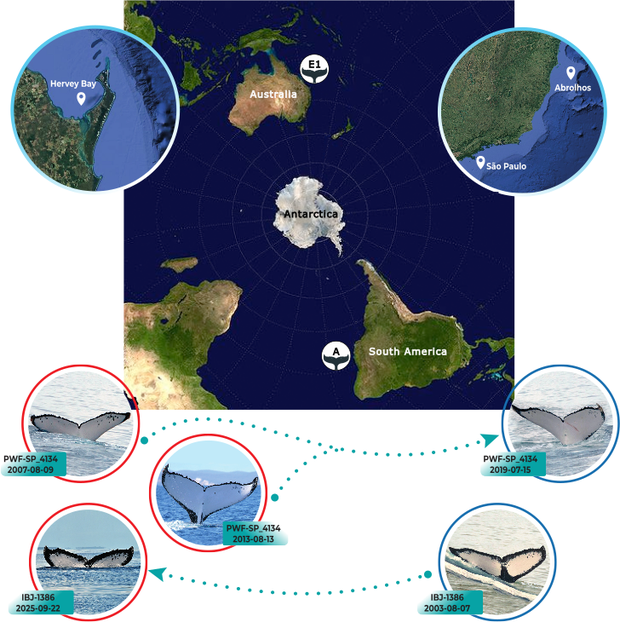
On May 20, 2026, a groundbreaking study revealed that two humpback whales traveled unprecedented distances between Australia and Brazil. This research, led by a team of international scientists, identified the whales through images of their tails, showing their remarkable journey across the globe.
One whale was photographed in Queensland in 2007 and later near Sao Paulo, Brazil, in 2019, covering approximately 8,823 miles. Another whale was spotted off Bahia, Brazil, and seen 22 years later in Hervey Bay, Australia, a distance of about 9,383 miles. These travels mark the longest recorded migration for humpback whales.
Humpback whales, which can reach up to 55 feet in length, rarely undertake such expansive journeys. According to Stephanie Stack, a PhD researcher at Griffith University, these movements are crucial for the genetic diversity of whale populations. She noted that the whales might carry new song styles between regions, much like human music trends.
The study analyzed nearly 20,000 photographs collected from 1984 to 2025 by both scientists and citizen scientists from eastern Australia and Latin America. Using an automated image-recognition algorithm, the team identified two whales photographed in both regions.
“This kind of research highlights the value of citizen science,” said Dr. Cristina Castro of Pacific Whale Foundation. “Every photo contributes to our understanding of whale biology and, in this case, helped uncover one of the most extreme movements ever recorded.”
The findings strengthen the “Southern Ocean Exchange” theory, which suggests humpback whales occasionally traverse Antarctic feeding grounds, returning along a different path to new breeding areas. Climate changes in the Southern Ocean, such as shifts in sea ice and krill distribution, might encourage these crossings.
Due to commercial whaling, humpback whales were classified as endangered in the U.S. in the 1970s. A moratorium on commercial whaling was enacted in 1985. Today, four out of 14 distinct population segments remain endangered, while one is listed as threatened, according to NOAA.
 Latin American Deportees in Congo: Return to Home Countries Amid Challenges
  Controversy Surrounds Stabbing Incident of British Student
  Royal Cottages and Controversies: Financial and Legal Revelations
  Oak Lawn Librarian Supports Library Projects in Zimbabwe
  World Cup Anticipation: US Men’s National Team and Norway’s Viking-Themed Campaign
  Family Searches for Missing Auburn Student in Japan After Disagreement Over AI