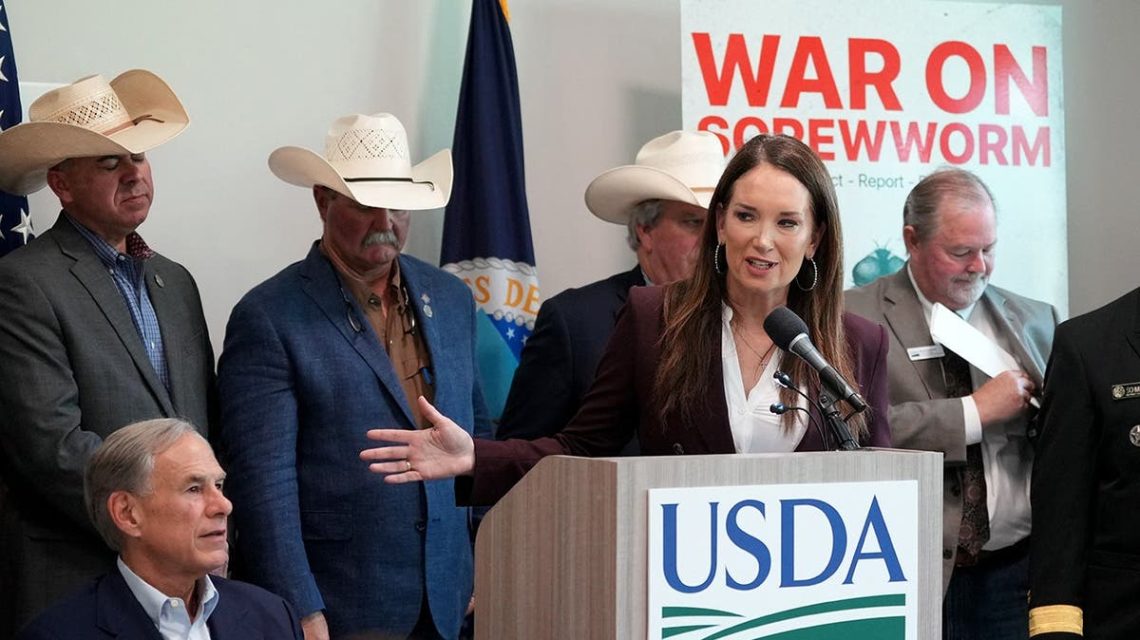
The New World Screwworm (NWS), a parasitic fly that targets the flesh of livestock and other warm-blooded animals, has reached South Texas. The USDA Animal and Plant Health Inspection Service (APHIS) confirmed on June 3 that NWS larvae were discovered in the umbilical area of a young calf in Zavala County, Texas. By June 11, six cases had been verified.
The USDA describes NWS as a significant pest affecting livestock, pets, wildlife, and occasionally humans and birds. NWS larvae, or maggots, burrow into living animals, causing extensive damage and economic losses. Although screwworms don’t render meat unsafe, they can drive up already high beef prices.
On May 11, 2025, U.S. Secretary of Agriculture Brooke Rollins announced the suspension of live cattle, horse, and bison imports through U.S. ports along the southern border due to the NWS’s spread in Mexico. U.S. Agriculture Secretary Brooke Rollins and Texas Governor Greg Abbott discussed the situation with ranchers and officials on June 8, 2026.
Dudley Hoskins, USDA Under Secretary for Marketing and Regulatory Programs, mentioned that projections initially placed the NWS’s arrival in the U.S. in 2025. Preparations bought crucial time for this moment. The USDA invested significantly in eradication tools since incidents increased in Central America and Mexico. Hoskins stated, “The U.S. has defeated this pest before and will do so again.” An APHIS strike team has been deployed to Texas, implementing a rapid response that includes releasing sterile male flies and creating a movement control zone to contain livestock.
USDA’s NWS eradication efforts date back to the 1920s and 1930s. The Screwworm Adult Suppression System (SWASS) uses insecticide-laden bait to kill flies before reproduction. Females reproduce only once, making the release of sterile males an effective strategy. In 1966, Agricultural Research Magazine announced that the screwworm had been eradicated from the U.S.
Texas Agriculture Commissioner Sid Miller criticized the USDA’s current response. He pointed out that despite USDA’s efforts, screwworms advanced over 1,100 miles from southern Mexico to Texas. USDA’s strategy was deemed insufficient. Miller called on President Trump to streamline the response using SWASS and federal resources to prevent an agricultural crisis.
Texas Land Commissioner Dawn Buckingham oversees extensive state lands and has offered them for worker housing, sterile fly growing, and trap setup. Buckingham highlighted the broader impact of screwworms on livestock, wildlife, and domestic animals. She assured that, with medication and effective propagation control, NWS could be managed efficiently.
She noted the ease with which insects travel today due to global mobility, mentioning the past success against NWS and expressing confidence in effective containment.
 Tyler Mane Raises Awareness with Male Breast Cancer Diagnosis
  Elevated Mortality Risks for Divorcees and Widows
  Patagonia vs Pattie Gonia: The Trademark Dispute Explained
  Hantavirus Outbreak on Cruise Ship Raises Concerns: A Closer Look
  Tornado Destruction in Illinois and Indiana: Efforts and Responses
  Efforts to Develop Treatments for Bundibugyo Virus