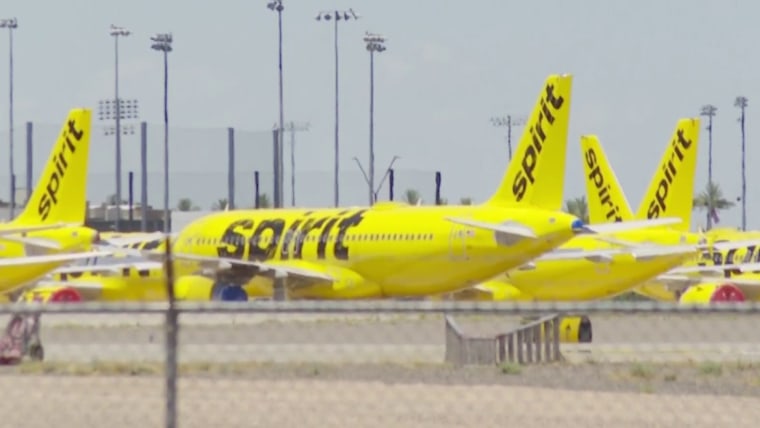
Spirit Airlines, once known for its budget-friendly flights, has become a focal point of a viral crowdfunding campaign following its closure. Hunter Peterson, a 32-year-old voice actor and content creator, initiated the campaign to revive the defunct airline.
Upon learning about Spirit Airlines’ closure on May 2, Peterson proposed a unique idea on social media. He suggested that if a fifth of Americans pitched in $45 each — the cost of a cheap Spirit flight — the airline could be bought. Borrowing a concept from the Green Bay Packers, who have a public ownership model with over 530,000 shareholders, Peterson’s proposal turned into a movement.
Despite joking initially, Peterson’s campaign attracted $337 million in pledges from over 370,000 verified supporters on his website. Although he’s not currently accepting money, Peterson is consulting with lawyers to explore the regulatory boundaries of his plan.
Hurdles in the Path
Public enthusiasm for the crowdfunding effort highlights a desire for change in the airline industry. However, experts warn that regulatory challenges could hinder progress. Charles Elson, a retired finance professor, indicated that operating an airline involves complex financial and logistical considerations — including lenders, aircraft, facilities, and union contracts.
“An airline is a very complicated financial enterprise. There’s a lot of players.” — Charles Elson, Retired Finance Professor
Elson compared the idea’s feasibility to reaching Mars, suggesting significant barriers. John Coffee Jr., a law professor from Columbia University, also mentioned the costly and lengthy process of registering an airline with the Securities and Exchange Commission (SEC).
While SEC exemptions exist for crowdfunding, they cap at $5 million annually, falling short of the required amount to purchase an airline. Private placement offerings can surpass this limit but require investors with a net worth of $1 million, excluding average citizens.
Financial Struggles Over Time
Spirit Airlines faced financial turmoil long before its closure. The airline filed for bankruptcy twice, in 2024 and 2025, and accumulated approximately $8.1 billion in debt. Failed mergers with Frontier and JetBlue, coupled with rising oil prices due to geopolitical tensions, further strained the company.
CEO Dave Davis remarked that challenges such as oil price spikes significantly impacted the airline’s finances. Major airlines typically rely on revenue streams like branded credit cards and frequent-flyer programs, not just ticket sales, for profitability. Spirit 2.0 would require additional sources of income to thrive.
A Community Effort with Uncertain Outcomes
Participation in the Spirit 2.0 campaign reflects a collective desire to impact the industry. Despite site crashes due to high traffic, some supporters, like Abigail Hartman, expressed enthusiasm about being part of something from the start.
“I pledged. Why not? If this works, doesn’t that prove we can do anything?” — Abigail Hartman, Radiologic Technologist
Peterson, who began this quest after creating a Spirit Airlines-related YouTube video, has pushed forward to secure a legal fund for a bid. The campaign even garnered support from Spirit’s 5,500-member flight attendant union.
Though Peterson remains unsure of what lies ahead, he is pursuing angel investments from high-net-worth individuals. He is actively seeking help from prominent figures like Mark Cuban.
Pending the campaign’s success, operational decisions at Spirit 2.0 would be member-driven according to Peterson’s website. Despite uncertainty, Peterson stated they are closer to the goal of collective ownership of Spirit 2.0.