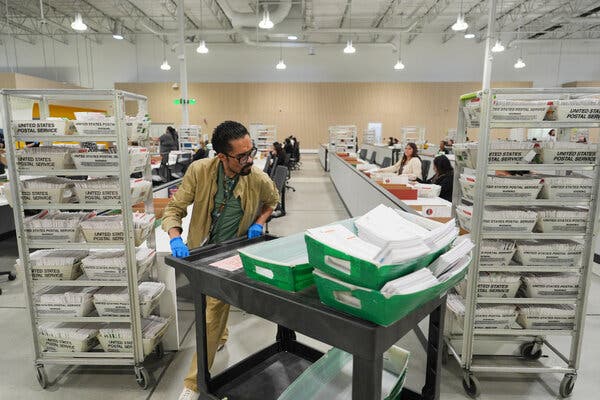
In California, four days after the primary election, officials have counted only about two-thirds of the votes. The results for the California governor and Los Angeles mayor remain undecided. This situation can confuse Americans in other states and opens the Democratic-led state to unproven Republican claims of fraud.
Reasons for the Slow Tally
California’s reliance on mail balloting is a primary reason for the slower vote count. The process of verifying signatures, opening envelopes, and reviewing ballots takes time. State leaders focus on ensuring the voting process is easy and secure, which adds to the time required.
Furthermore, when voters submit or mail their ballots close to Election Day, election offices face a surge in envelopes that require attention. Kim Alexander, president of the nonpartisan California Voter Foundation, describes this as the ‘pig-in-the-python’ effect due to the sheer volume of vote-by-mail ballots received on Election Day.
Comparison with Other States
Other states with significant mail voting, like Colorado, Arizona, and Washington, have developed methods to process ballots more quickly while maintaining security. This raises the question of why California cannot achieve similar results speedily.
Possible Solutions
Experts suggest that accelerating California’s vote counting would require more resources and may also involve adjusting rules that currently expand voting access. The scenario presents a challenge of balancing fast results with the goal of ensuring a secure and accessible voting process.
 Trump Appoints Bill Pulte as Acting Director of National Intelligence
  Graham Platner and the Role of Morality in Politics
  Texas Attorney General’s Campaign Against Latino Groups
  President Trump’s Call for Mass Firings in National Intelligence
  Trump Pardons Former Indiana Congressman Convicted of Insider Trading