An interstellar comet, named 3I/ATLAS, that passed by the sun and Earth last year could be nearly three times older than our solar system. Astronomers reported that it is unlike anything previously observed in our cosmic vicinity. This discovery presents an unparalleled opportunity to study an object originating from elsewhere in the galaxy.
After the comet’s discovery in July last year, it sparked online excitement. A well-known Harvard researcher speculated it might be an alien spacecraft. However, NASA swiftly dismissed this theory. Recent observations using powerful telescopes are uncovering more details about this unique comet.
According to new research published in the journal Nature, 3I/ATLAS could be up to 12 million years old. This age contrasts with the solar system, believed to have formed about 4.5 billion years ago. Martin Cordiner from NASA’s Goddard Space Flight Center described maybe it’s the oldest object to have been observed in our solar system.
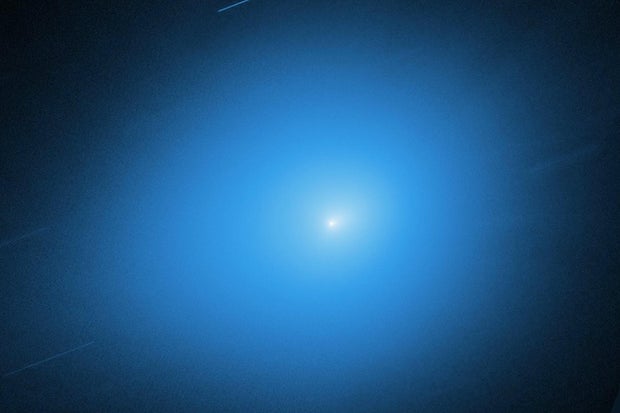
This image from NASA shows comet 3I/ATLAS captured by the Hubble Space Telescope on November 30, 2025, when it was approximately 178 million miles from Earth. However, Cordiner acknowledged the presence of edge-case scenarios
that might account for the comet’s unusual chemical makeup.
The new study examined the comet’s isotopes, as detected by the James Webb Space Telescope and the ALMA Observatory in Chile. These findings indicate an elemental composition unlike any Solar System bodies.
Possibility of a Relic from Cosmic Noon
Compared to solar system comets, 3I/ATLAS contains ten times more deuterium, a form of hydrogen prevalent in heavy water. Cordiner explained, That high abundance of heavy water can only happen, according to our understanding of astrochemistry, in a very cold environment.
This implies that the comet may be one of the coldest objects seen in our solar system, potentially originating in an environment of minus 243 degrees Celsius.
Determining the exact location of this comet’s origin within the Milky Way remains unclear. Interstellar objects are believed to form similarly to solar system comets, being ejected during the tumultuous formation of new planets.
Without ties to any star, 3I/ATLAS likely traversed vast trajectories around our galaxy for billions of years. Observations reveal a peculiar lack of chemical enrichment on the comet, hinting at its formation near nascent stars.
The comet might be a relic
from the period known as cosmic noon, when many stars formed roughly 10 billion years ago.
Earlier interstellar objects, such as 1I/’Oumuamua and 2I/Borisov, were not bright enough for isotopic analysis. NASA released several images of 3I/ATLAS, including one in November capturing it about 180 million miles from Earth.
In October, images from Mars orbiters showed the comet as a bright, fuzzy white dot moving against distant stars, approximately 18,641,135 miles from Mars. In another earlier image, the growing tail of 3I/ATLAS appeared streaking across our solar system.
Harvard professor Avi Loeb previously stirred debate, suggesting ‘Oumuamua might be an alien craft and similarly posited 3I/ATLAS could have extraterrestrial origins. We should consider all possibilities that it’s a rock, a comet, or something else until we get the data that will clarify its nature,
Loeb commented during a CBS Boston interview.
NASA dismisses alien life potential. The Search for Extraterrestrial Intelligence Institute (SETI) reported no signs of extraterrestrial technology
on the comet.
A Starting Point for New Discoveries
Astronomers analyzing 3I/ATLAS, though not involved in this study, praised its unprecedented results. Darryl Seligman of Michigan State University highlighted its transformative potential. Until these measurements, we could only dream about so much detail on interstellar objects,
Seligman noted. He considered the comet’s age uncertain but labeled it a safe bet
that it’s older than anything formed in the solar system.
Peter Veres from the International Astronomical Union’s Minor Planet Center said the research on 3I/ATLAS is exciting.
As the comet leaves the solar system, future observations will grow more difficult, Veres added.
Astronomers anticipate discovering more interstellar objects soon, especially with the new Vera C. Rubin Observatory in Chile. Cordiner emphasized, This marks the beginning of a fascinating new study field, with much to learn about these objects and their insights into our galaxy.
 Legacy of François Englert: Higgs Boson Discovery
  The Impact of Funding Cuts on Medical Innovations
  Ancient Plague Evidence Unearthed by Scientists
  African and Commonwealth Nations Push for High Seas Treaty Implementation
  Seismic Stress Reaches Millennium Highs on San Andreas and San Jacinto Faults
  The Empire State Building’s Airship Ambitions