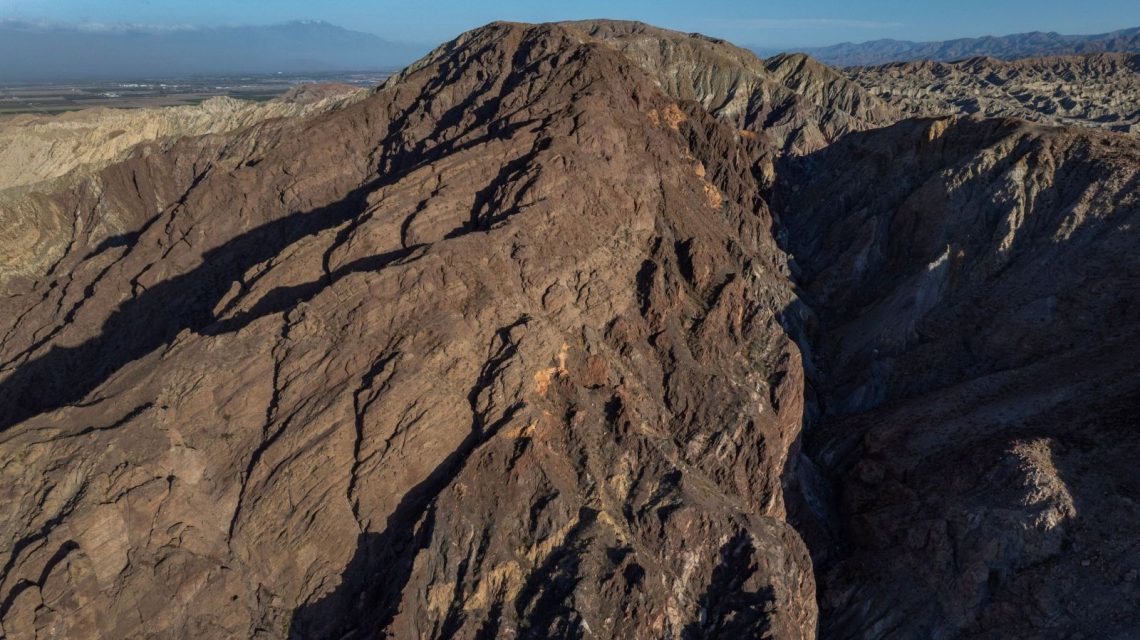
Research from the University of Hawaiʻi at Mānoa reveals that tectonic stress along the San Andreas and San Jacinto fault systems in Southern California has reached the highest levels in the last 1,000 years. This finding intensifies concerns about seismic risks in the area.
Key Findings
The study indicates that several fault segments are experiencing peak stress levels, with some even surpassing these thresholds. This suggests the system is in a ‘critically loaded state.’
According to researchers, Cajon Pass, a crucial junction between these fault systems, can act as an ‘earthquake gate.’ This means it sometimes stops a rupture from spreading between the two networks, and other times it allows a rupture to pass through both systems. A combined rupture could cause more severe damage than if only one fault was involved, impacting areas like Los Angeles and the Coachella Valley.
Research Insights
The study, published in the Journal of Geophysical Research: Solid Earth, used a physics-based earthquake cycle model to simulate stress buildup and release over approximately 1,000 years. The model utilized geological records, including radiocarbon-dated sediments and tree-ring evidence, to construct a millennium-long earthquake history. These data inputs allowed researchers to project the present-day stress levels.
Lead author Liliane Burkhard remarked that stress levels on many fault segments have reached or exceeded historical highs. Burkhard emphasized that Cajon Pass plays a crucial role in managing how ruptures might progress through the fault systems.
“The critical thing is that this isn’t a distant, theoretical risk,” Burkhard told Newsweek. “Stress driving large earthquakes has accumulated since 1857, exceeding anything recorded in a thousand years. While an earthquake may not occur tomorrow, the system is as stressed as it has ever been.”
Burkhard advises everyone in Southern California to prepare by knowing evacuation routes, staying in contact with loved ones, and having emergency supplies like water and medication on hand.
Future Implications
The modeling approach outlined in this study offers potential improvements for seismic hazard assessments. It can guide infrastructure design, emergency planning, and building standards. This new method can also be used to analyze other complex fault systems around the globe.
 Trump’s Request to Dismiss NAACP Pollution Suit Against xAI
  Solar-Powered Cold Storage Transforms Agriculture in Africa
  The Empire State Building’s Airship Ambitions
  Positive Developments for Coral Reefs Amid Global Warming
  El Niño’s Potential Impact Looms Large Globally
  Ukraine Strikes Moscow Oil Refinery in Drone Attack