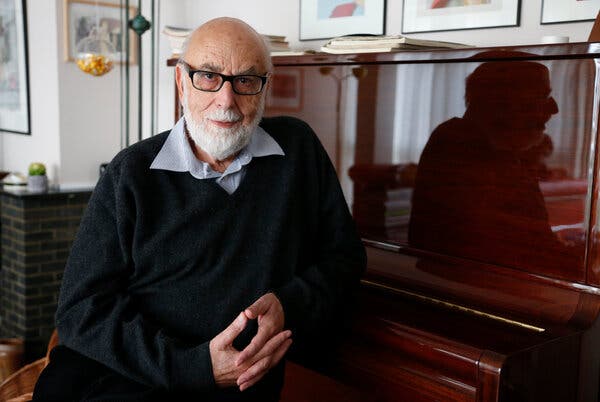
François Englert played a key role in the discovery of the Higgs boson, which explained how particles acquire mass, addressing fundamental questions in physics.
On July 4, 2012, scientists gathered at CERN, the European Organization for Nuclear Research, for the results of crucial experiments aimed at detecting the Higgs boson. Known as the “God particle,” this elusive component would confirm the existence of a field granting mass to all other particles, like electrons and quarks.
Rolf-Dieter Heuer, CERN’s then-director general, announced, “I think we have it,” to overwhelming applause.
Peter Higgs, the English scientist who lent his name to the particle, sat in the audience, wiping away tears. Next to him was François Englert, a Belgian physicist instrumental in developing the theory behind the Higgs field. Their work was crucial for the Standard Model of particle physics, a significant scientific framework categorizing all known fundamental particles and forces.
In 2013, Higgs and Englert were awarded the Nobel Prize in Physics for their theoretical mechanism improving the understanding of subatomic particle mass origin.
Englert’s passing was announced recently by CERN. He died at 93 in Uccle, Belgium, near Brussels.
In the late 1950s, Englert worked as a research associate at Cornell University with Robert Brout, a theoretical physicist. They explored Yoichiro Nambu’s work, a Japanese American physicist. Nambu addressed a problem troubling physicists: symmetry breaking in subatomic reactions.
 The Impact of Funding Cuts on Medical Innovations
  Ancient Plague Evidence Unearthed by Scientists
  African and Commonwealth Nations Push for High Seas Treaty Implementation
  Seismic Stress Reaches Millennium Highs on San Andreas and San Jacinto Faults
  The Empire State Building’s Airship Ambitions
  Positive Developments for Coral Reefs Amid Global Warming