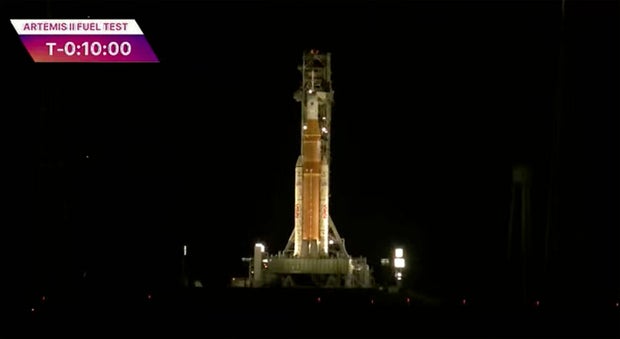
A recent wet dress rehearsal for NASA’s Artemis II moon rocket encountered several setbacks, ultimately leading to a delay in the launch previously planned for February. The issues culminated in a hydrogen leak, prompting NASA to postpone the mission to at least March, with hopes of resolving these challenges before committing to a new launch date.
NASA Administrator Jared Isaacman commented on the situation, stating, With the conclusion of the wet dress rehearsal today, we are moving off the February launch window and targeting March for the earliest possible launch of Artemis II.
He emphasized the purpose of these tests is to identify and resolve issues to ensure a successful launch day.
The Artemis II crew, comprising Commander Reid Wiseman, Victor Glover, Christina Koch, and Canadian astronaut Jeremy Hansen, had been preparing for their journey. They stayed at the Johnson Space Center in Houston, where they underwent pre-flight quarantine, anticipating a trip to Florida for final launch setups. With the delay, they returned to Houston to spend time with their families and colleagues.
The countdown for the practice session kicked off Saturday evening, although the start was delayed due to cold weather along Florida’s Space Coast. After assessing conditions and the team’s preparedness on Monday morning, Launch Director Charlie Blackwell-Thompson permitted the start of the remotely-controlled fueling process for NASA’s Space Launch System (SLS) rocket at Kennedy Space Center’s launch pad 39B.
Despite beginning slightly behind schedule, the process initially proceeded as planned. Supercold liquid oxygen and hydrogen fuel were transferred into the SLS rocket’s first stage. Soon after, hydrogen began filling the upper stage, but a hydrogen leak was detected at 55 percent capacity of the first stage tank. The fueling stopped, resumed, and halted again at 77 percent due to the persistent leak.
NASA reported that engineers decided to stop the hydrogen flow, allowing the seals to warm and reseat, and adjusted the propellant flow to continue with the test after another shot at filling the tanks. The team dispatched a closeout crew to prepare the Orion crew capsule for a simulated crew entry and shut the spacecraft’s hatches for testing.
The test plan included a simulated launch at 9 p.m. EST, but troubleshooting efforts extended the test run. By 10 p.m., the countdown halted at the T-minus 10-minute mark and resumed after midnight, only to stop again at T-minus 5 minutes and 15 seconds when the recurring leak prompted a complete stop.
Isaacman assured the public of NASA’s commitment to thoroughly reviewing the data, addressing each issue, and conducting another dress rehearsal before attempting a March launch. The next launch window spans from March 6 to March 11.
The SLS rocket, pivotal for Artemis moon missions, is heralded as the world’s most powerful operational launcher. Standing 332 feet tall, it features two solid fuel boosters and four main engines fueled by liquid oxygen and hydrogen, generating 8.8 million pounds of thrust.
The SLS completed its inaugural mission in 2022 as an unpiloted test flight, overcoming various technical challenges. Enhancements aimed at optimizing Artemis II operations have been ongoing since, with the recent issues highlighting areas for further refinement.
Reflecting on the past experiences and improvements, Blackwell-Thompson expressed optimism, attributing the team’s confidence to the lessons learned from the Artemis I campaign. Enhancements in loading procedures for liquid oxygen and hydrogen into the Artemis II vehicle were some measures indicating progress.
 Blue Origin Recovers from New Glenn Rocket Explosion
  Blue Origin’s Resilient Recovery Post-Explosion
  Blue Origin Rocket Explosion Raises Concerns
  NASA’s Lunar Rover Developments and Future Moon Base Plans
  Setback for Blue Origin and Amazon After Rocket Explosion
  SpaceX’s Revamped Super Heavy-Starship Completes Test Launch