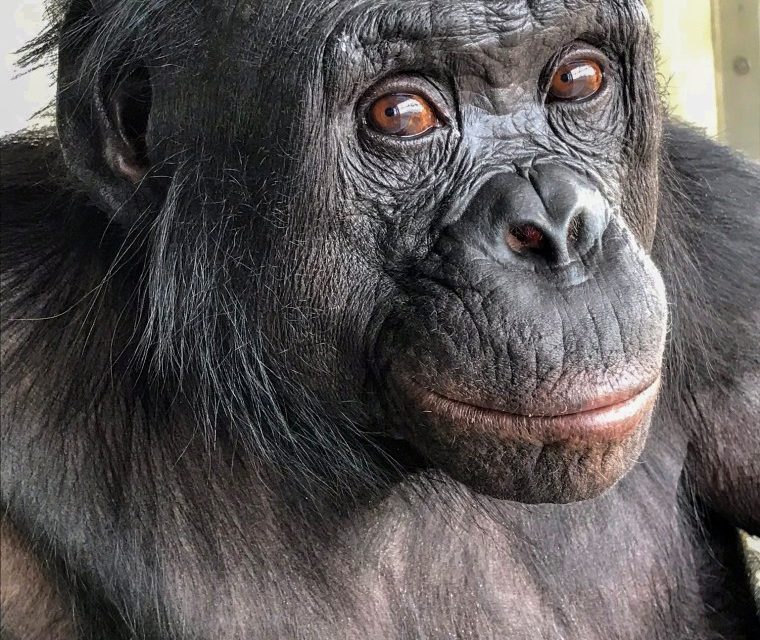
Can animals engage in pretend play? A recent study involving a bonobo named Kanzi suggests they might. Researchers conducted a series of playful experiments with Kanzi, akin to a child’s make-believe tea party, involving invisible juice and grapes. The results, published in Science, revealed that Kanzi could follow along, recognizing the pretend scenarios without confusing them with reality.
Chris Krupenye, study author and assistant professor at Johns Hopkins University, explained that Kanzi exhibited the ability to track the location of a pretend object while understanding it wasn’t physically present. Previously, the ability to pretend and imagine multiple realities was thought to be unique to humans. However, observations of primates displaying similar behaviors, such as young chimpanzees playing with “log dolls,” have challenged that notion. This new study presents controlled evidence of an animal engaging in pretend play.
“We think of our ability to imagine other worlds or other objects, or imagine futures, as one of these rich features of human mental life that are presumed to be unique to our species,” said Krupenye. But apes “might share some of the foundational cognitive machinery that will enable at least some degree of imagination.”
The researchers modeled the experiments after common tests used in childhood development. In the initial experiment, they used an empty pitcher and bottles to ‘pour’ imaginary juice, asking Kanzi to identify where the juice would be. Kanzi’s success rate was 68%, pointing to the correct location 34 times out of 50.
In a second experiment, Kanzi was given a choice between a real cup of juice and a pretend one, which he mostly chose accurately, indicating his understanding of both real and pretend objects. The final experiment replaced juice with imaginary grapes, yielding similar results.
Jan Engelmann, a University of California, Berkeley professor not involved in the study, stated that these results bolster the idea that apes can form complex mental scenarios and engage in intricate thought processes like planning and reasoning.
Kristin Andrews, a professor studying animal cognition, mentioned that these findings mirror conclusions drawn from similar studies on human children using objects like bananas as pretend telephones.
Kanzi, a uniquely intelligent bonobo, was the first of his kind to grasp elements of spoken English using lexigrams—symbols representing words—to communicate with his caretakers. This might suggest that understanding language plays a role in pretend play capabilities. Bonobos are our closest genetic relatives, prompting researchers to theorize that imagination abilities could date back 6 to 9 million years in our evolutionary history.
However, it’s uncertain whether other nonhuman primates or bonobos would exhibit the same abilities as Kanzi. His unique training might have enhanced his cognitive skills. This leads to two possibilities: language training might have unlocked a natural skill all apes possess, or it might have imparted a new capability to Kanzi alone.
Ultimately, this study adds to a growing body of evidence that humans are not as singular as once believed. Rather than individual cognitive superiority, humans’ strength might lie in their social abilities—like the capability to collaborate and think collectively. Language, therefore, becomes a pivotal adaptation that significantly enhances these social interactions.
 Limited Interest in Arctic National Wildlife Refuge Oil Auction
  Confronting the Truth Behind Sustainability Buzzwords in the Food Industry
  The Aftermath of Santa Rosa Island’s Fire
  Largest Seizure of Illegal Cockroaches in Australia
  Flesh-Eating Fly Returns to the United States Causing Concern
 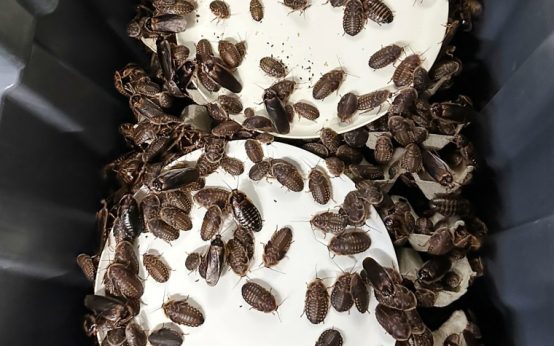 Australia’s Largest Seizure of Exotic Invertebrates: Over 100,000 Cockroaches Confiscated