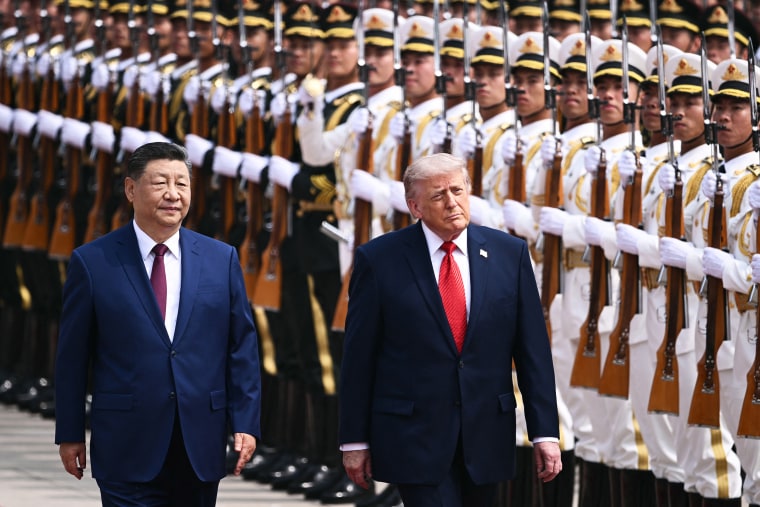
During a summit in Beijing, President Donald Trump engaged in discussions with Chinese President Xi Jinping about the ongoing Iran war and the strategic blockade of the Strait of Hormuz. Secretary of State Marco Rubio revealed in an interview with NBC News that the United States is not seeking support from China concerning Iran. Rubio stated that China opposes the militarization of the Strait and the implementation of a toll system, aligning with the U.S. position.
Rubio traveled to Beijing under Chinese sanctions, marking a unique occurrence for a U.S. Secretary of State. He noted that Trump and Xi also deliberated on the Beijing-claimed island of Taiwan and the situation of Jimmy Lai, a pro-democracy publisher in Hong Kong who has been sentenced to 20 years in prison in a national security trial.
Although Trump was anticipated to request China’s aid in resolving the U.S.-Israeli conflict with Iran and addressing the blockade of the Strait of Hormuz, he refrained from asking for assistance during the discussions. The blockade has significantly affected global energy supplies, causing a surge in gas prices. China had previously facilitated Iran’s engagement in ceasefire negotiations.
Rubio emphasized the impact of global oil prices on the United States, asserting that other nations face higher costs. He refrained from singling out China but highlighted the need for global involvement.
Despite China’s close ties with Iran and its criticism of U.S. and Israeli assaults, Rubio noted that Trump and Xi agreed on opposing Iran’s nuclear ambitions. However, China’s official summary of the talks did not explicitly mention Iran but noted an exchange of views on international and regional issues, including Middle East affairs.
The Taiwan issue remained a critical agenda item during the summit. Xi warned Trump that mishandling tensions could jeopardize U.S.-China relations. While the U.S. lacks formal relations with Taiwan, it remains the island’s largest international backer and arms supplier. The longstanding policy of “strategic ambiguity” regarding Taiwan’s defense commitments continues unchanged.
Concerns have emerged due to Trump’s transactional approach towards Taiwan, and his demand for increased defense spending, as well as his criticisms of Taiwan’s semiconductor industry. Yet, Rubio assured that U.S. arms sales to Taiwan were not a focal point during the summit.
In December, the Trump administration announced a substantial $11 billion arms package for Taiwan, with potentially more to follow. The growing military pressures exerted by China on Taiwan remain a point of concern, with frequent deployments of warplanes and vessels.
Rubio commented on the importance of maintaining the current status quo for both nations, cautioning against forced changes.
Trump also addressed the case of Jimmy Lai, raising it with Xi. Lai’s situation symbolizes the crackdown on dissent in Hong Kong, which has become more intense since the city’s return to Chinese governance in 1997. While Lai remains a contentious figure within China, Trump hopes for a favorable resolution to his case. Rubio expressed openness to arrangements that would grant Lai freedom, although potential relocation to the U.S. remains uncertain.
 U.S. Military Awaits Pentagon’s Clarification on Troop Levels in Europe
  Potential Ebola Outbreak in Central Africa Raises Concerns of Rapid Spread
  U.S. and Allies Condemn Efforts to Overthrow Bolivian Government
  Pamela Hicks: Cousin, Bridesmaid, and Witness to History
  Latin American Deportees in Congo: Return to Home Countries Amid Challenges
  Controversy Surrounds Stabbing Incident of British Student