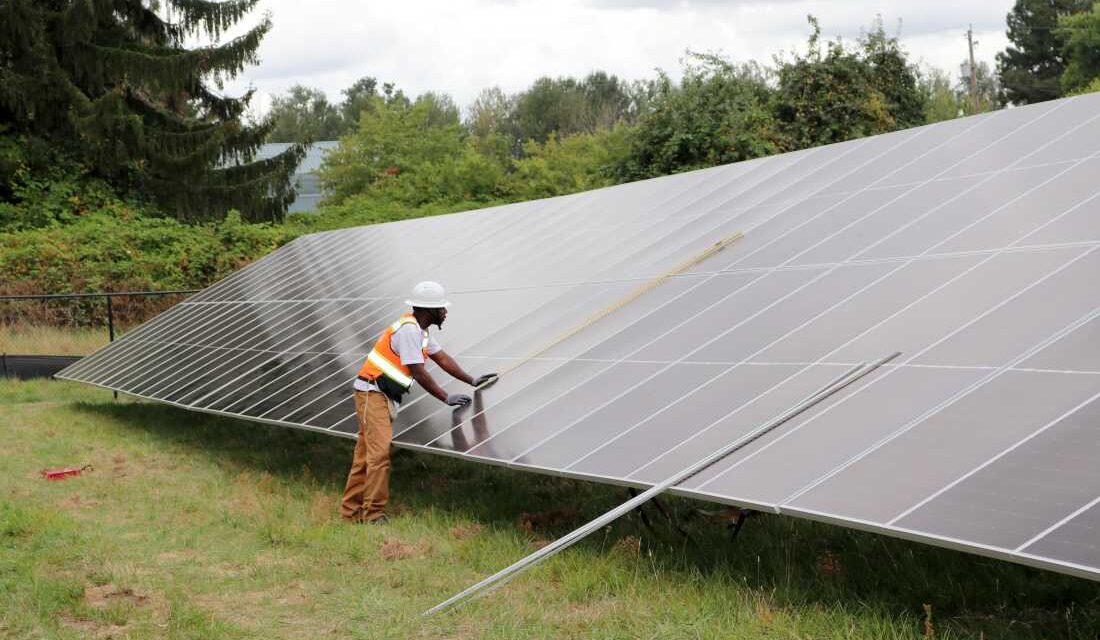
The PDX Community Solar project, backed by over $4 million from the Portland Clean Energy Fund, aims to supply affordable power to low-income residents in Portland, Oregon’s Cully neighborhood. NPR is focusing on community-driven efforts in addressing climate issues despite federal challenges. As national policies stall, local entities strive to mitigate climate pollution and adjust to severe weather conditions.
Community Efforts in Portland
Over the past seven years, Portland, Ore., has developed a community solar initiative to cut emissions and decrease energy expenses for 150 families in need. The city’s proactive measures include distributing more than 20,000 portable air conditioning units to prepare vulnerable households for increasing heat waves, retrofitting 3,100 homes for energy efficiency, and providing training to 2,000 individuals in renewable energy and construction fields. These advancements stem from Portland’s unique billion-dollar climate fund.
The Portland Clean Energy Fund, a pioneering racial, social, and climate justice initiative, targets the support of the city’s most vulnerable residents by enhancing adaptation strategies and minimizing carbon outputs. A decisive 65% voter approval in 2018 led to a 1% retail sales tax on major corporations within Portland city limits, such as Target, Walmart, and REI. This tax, distinct from consumer sales taxes, charges businesses a fraction of each transaction. This innovative approach has accumulated approximately $1 billion, with projections of reaching $1.6 billion by mid-2029.
Sam Baraso, Portland Clean Energy Fund program manager, emphasizes that the fund aims to foster local climate solutions aligned with community resilience and economic strength. Despite nationwide struggles with severe federal funding cuts for climate projects, Portland’s climate fund progresses steadily.
Fund Genesis and Climate Wins
The vision for the climate fund emerged a decade ago when leaders from communities of color discussed strategies to financially support effective climate action. Recognizing a shortage in funding and the necessity to combat climate change impacts, such as extended heat waves and wildfires, community leaders advocated taxing large corporations to initiate a sustainability-focused financial model. According to Baraso, the Portland Clean Energy Community Benefits Fund was envisioned from the experiences of front-line communities who historically bore the brunt of the climate crisis.
Projects underway include:
- 20,000+ portable air conditioning units distributed since 2022
- A community solar initiative aiding 150 low-income families in a primarily Latino neighborhood
- 15,000 trees planted over five years in urban heat islands
- Conversion of six concrete parking lots into urban gardens and community spaces
Since 2021, four rounds of community grants funded by the climate fund have totaled approximately $262 million. These grants range from $8,000 to $10.3 million, contributing significantly to emissions reduction. Completed projects from the initial grant phases are credited with diminishing approximately 25,500 metric tons of carbon emissions, akin to removing 6,000 gas-powered cars from roads annually.
Community Debates and Nationwide Influence
The fund’s success has initiated discussions regarding its allocation as debates rise among elected officials and business entities about spending priorities. Portland Mayor Keith Wilson proposed a $75 million plan for upgrading the Moda Center, the home of the Portland Trail Blazers, with green technology. Critics argue that it diverges from the fund’s primary objective of aiding vulnerable communities.
The Portland Police Association suggests redirecting 25% of the fund’s annual revenue to recruit 400 more police officers, emphasizing the city’s need for law enforcement. Critics advocate maintaining the fund’s original intent focused on climate action.
Other cities, including Ann Arbor, Denver, and Seattle, have taken inspiration from Portland and initiated similar funds. Elizabeth Babcock, from Denver’s Office of Climate Action, highlights Portland’s model as an inspiration. Despite legal barriers, Denver opted for a public 0.25% sales tax excluded from essential items for its Climate Protection Fund, generating $41 million in its first year.
Ann Arbor, unable to mirror Portland’s retail tax, increased property taxes for climate funding. According to Harvard’s Amruta Nori-Sarma, input and local buy-in are crucial for implementing impactful solutions. Smaller towns might face challenges due to fewer large retailers, making community involvement and tailored strategies essential.
The Portland Clean Energy Fund aims to complete its first five-year plan by mid-2029, benefitting the city with $1.6 billion investment.
 Limited Interest in Arctic National Wildlife Refuge Oil Auction
  Confronting the Truth Behind Sustainability Buzzwords in the Food Industry
  The Aftermath of Santa Rosa Island’s Fire
  Largest Seizure of Illegal Cockroaches in Australia
  Flesh-Eating Fly Returns to the United States Causing Concern
  Australia’s Largest Seizure of Exotic Invertebrates: Over 100,000 Cockroaches Confiscated