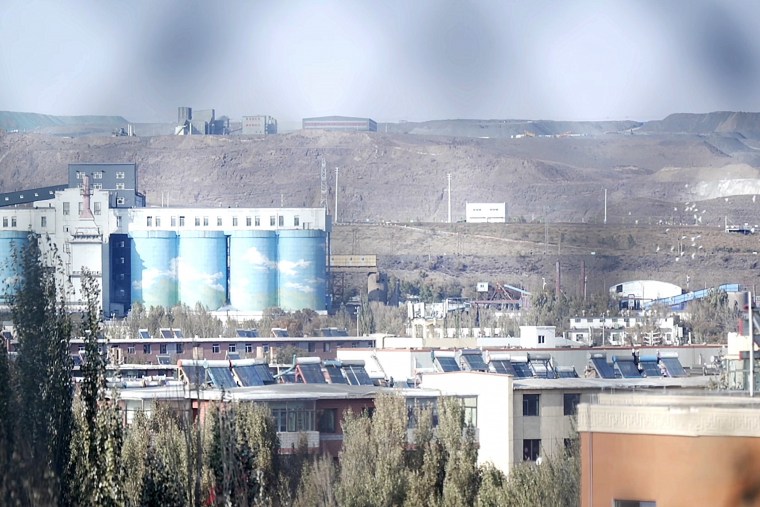
YEONGWOL COUNTY, South Korea — The conflict between the United States and Iran is causing a rapid depletion of advanced weapons and ammunition stocks, including Tomahawk, Patriot, and Precision Strike missiles. To replenish these stockpiles, a crucial metal, tungsten, is needed. China currently holds a significant control over tungsten production and refining, prompting the U.S. to look elsewhere for this critical resource.
Tungsten is essential for manufacturing fighter jets, bunker-busting bombs, armor-piercing ammunition, and missile systems. Despite its importance for national defense, the U.S. has not had any active commercial tungsten mines since 2015. The Trump administration set an objective to reduce reliance on the Chinese supply of tungsten.
A mining district in China’s Inner Mongolia region in October.
Fred Dufour / NBC News
One source for tungsten is a mine operated by a U.S. company in the mountains of eastern South Korea, containing millions of tons of tungsten ore. Lewis Black, CEO of Almonty Industries, noted the scarcity of large-scale tungsten mines globally. Almonty reopened the Sangdong mine after three decades of closure due to competition from China. Black referred to tungsten as both a “war metal” and recently a “backbone metal” for technology, being used widely in semiconductors, batteries, and smartphones.
Steve Allen, COO of Almonty, emphasized the growing demand for tungsten. He highlighted the importance of maintaining a resilient tungsten supply chain over the next decades.
No alternative exists for tungsten, and its global supply has become increasingly strained since the U.S.-Israeli conflict with Iran commenced in February. This adds pressure to military resources, affecting U.S. allies like Japan and South Korea. Taiwan’s U.S. arms package worth $14 billion is also delayed due to the conflict.
Almonty Industries’ Sangdong tungsten mine in South Korea.
Kyle Eppler / NBC News
China has dominated the tungsten industry for years, producing over 80% of the global supply and using more than half of it, aided by government subsidies and lower production costs. The U.S. primarily obtains tungsten through recycling and imports of over 6,000 metric tons annually.
Recently, during a trade dispute, China imposed export restrictions on rare earths and critical minerals, including tungsten, causing prices to surge. A tariff and rare earth agreement between the U.S. and China is set to expire in November.
Tungsten is notably heat-resistant and challenging to extract and process, producing hazardous waste and impacting local ecosystems. “People in America don’t want to do that,” noted Ret. Col. Steve Warren, citing the willingness of Chinese producers to manage these processes at lower costs.
Tungsten.
Sergio Azenha / Alamy file
The U.S. tungsten industry is essentially rebuilding from the ground up due to lost expertise since the 1990s. Black commented on the absence of industry knowledge and human capital, stating that such resources disappeared decades ago.
At the Sangdong mine, engineers are actively extracting tungsten ore that appears electric blue. Equipped with modern safety systems, this mine was once pivotal to South Korea’s economic growth. Almonty projects the mine can operate for another century due to the increasing tungsten demand.
Currently, Almonty plans to process approximately 1.2 million tons of tungsten ore annually at the South Korean site. In alignment with U.S. defense strategies, the company relocated its headquarters from Toronto to Dillon, Montana, and is looking to revive a Montana mine for domestic tungsten availability.
Allen remarked on the vital need to re-establish a tungsten mine within the U.S., crucial both immediately and for future security.
 Limited Interest in Arctic National Wildlife Refuge Oil Auction
  Confronting the Truth Behind Sustainability Buzzwords in the Food Industry
  The Aftermath of Santa Rosa Island’s Fire
  Largest Seizure of Illegal Cockroaches in Australia
  Flesh-Eating Fly Returns to the United States Causing Concern
  Australia’s Largest Seizure of Exotic Invertebrates: Over 100,000 Cockroaches Confiscated