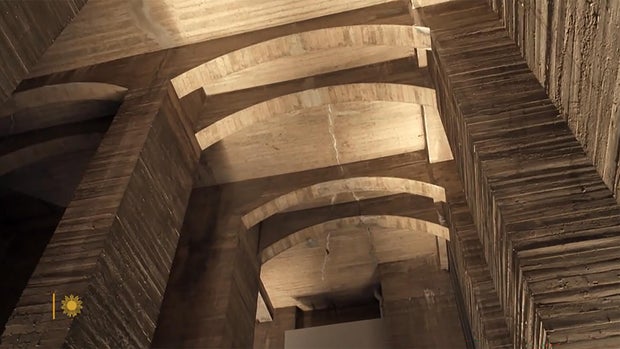
To call Washington a ‘swamp’ serves both as a metaphor and a reality. When the Lincoln Memorial was planned in the early 1910s, builders encountered a significant challenge as the structure faced the risk of sinking. Their innovative solution led to one of Washington’s lesser-known features, now revealed after a century.
The Undercroft: A Structural Marvel
Beneath the Lincoln Memorial lies the Undercroft, a term typically used for vaulted basements in castles or cathedrals. It includes 120 massive concrete pillars that descend 50 feet to bedrock, supporting the weight of the marble monument above.
This space, measuring 50,000 square feet, is nearly double the size of the memorial above. Secretary of the Interior Doug Burgum noted that the public never saw this area before. Stalactites have formed in the Undercroft, with rainwater seeping through granite cracks, accumulating calcium over time.
Unveiling the Undercroft Museum
This June, visitors can explore the newly established museum directly beneath the memorial. Philanthropist David Rubenstein, who contributed a quarter of the $69 million required for its development, believes this initiative expands the Lincoln Memorial’s educational value.
‘A nation cannot excel without honoring and understanding its history,’ Rubenstein stated. He aimed to deepen the comprehension of Lincoln’s life, marked by personal tragedy and complexity. The museum highlights Lincoln’s struggles, depicting him as more than the marble façade suggests.
The Memorial’s Role in Freedom
Some exhibitions focus on the memorial itself. Edna Greene Medford, a historian from Howard University, considers the memorial a stage for evolving ideas about freedom in America. She remarked, ‘Today, it’s about freedom, hope, and inclusion.’ In 1939, contralto Marian Anderson performed at the memorial after being denied access to indoor venues due to segregation, symbolizing the beginning of a civil rights movement.
As Martin Luther King Jr. expressed in his 1963 speech at the memorial, the civil rights movement sought to transition from segregation to justice. Medford observed that various groups view the memorial as a symbol of their interpretations of freedom.
A Historical Debate
The museum emerges amid debates over how slavery and racism are presented in national park sites. The administration advocates for balanced narratives in American history. Secretary Burgum stated, ‘We should celebrate and acknowledge our history, with an understanding of continuous improvement.’
Visitors can see the construction workers’ original graffiti on Undercroft columns, as shown by Burgum. This space offers a comprehensive view of the Lincoln Memorial, acknowledging both the ideal above and the effort below, much like the nation Lincoln served.
For more information, visit the National Park Service’s page on the Lincoln Memorial Undercroft tour.
 NASCAR Community Mourns the Loss of Kyle Busch
  Persistence in Investigations: Encouragement and Challenges
  Support Pours in for Airport Worker After Viral Video
  Challenges of Reentry After Years in Prison
  YouTuber Sparks Debate Over Abortion Rights and Down Syndrome
  Significant Events in Chicago on June 5