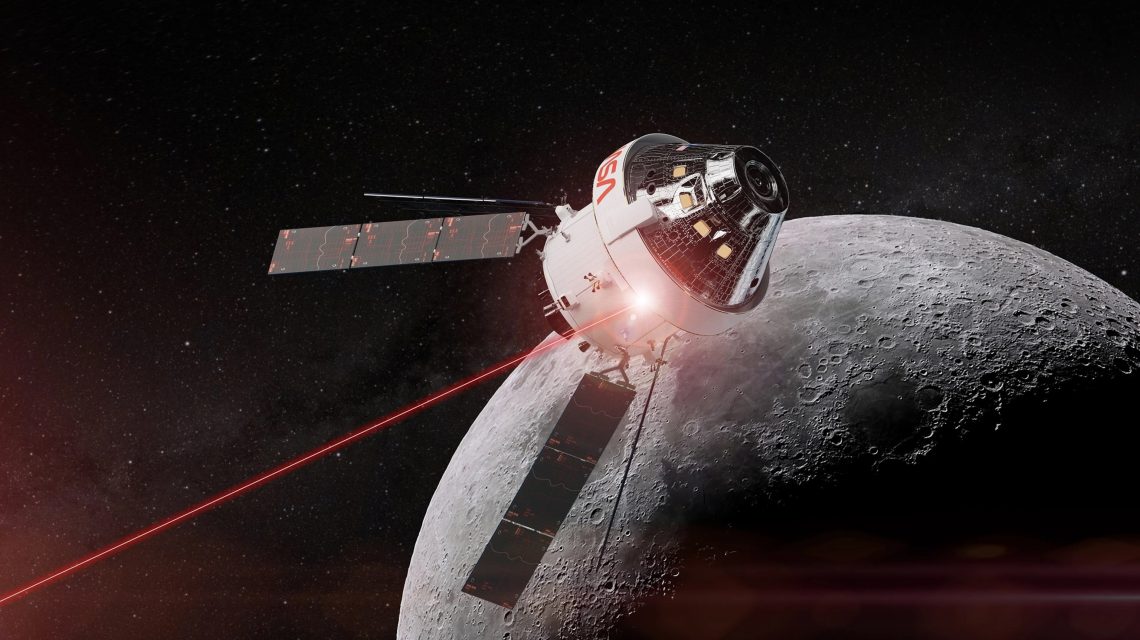
Traveling to the moon presents major communication challenges. Astronauts cannot just use their cell phones to FaceTime with NASA, and the farther they are from Earth, the harder communication becomes, especially with larger data transfers. With ambitious goals for forthcoming moon missions and the potential for establishing human bases on the lunar surface, NASA is preparing to test a novel laser-based communication system. The Orion Artemis II Optical Communication System (O2O) will be evaluated during the upcoming Artemis II mission, which could launch as early as February 6. This test aims to see if O2O can facilitate communication with astronauts and enable efficient data transmission and reception. Additionally, O2O might allow people on Earth to experience the journey alongside the crew.
Artist’s rendering of the O2O payload on Orion. Laser links, though depicted here, are not visible to the human eye.
Alan Willner, a noted professor of electrical and computer engineering at the University of Southern California, suggests that O2O could bridge the communication gap between space-based astronauts and those on Earth. “Artemis II is taking a giant leap forward in realizing that third leg, the ability to genuinely exchange information at a much faster speed to meet the growing demands of the data,” Willner said to ABC News.
Understanding the O2O System
Historically, spacecraft have relied on radio signals for communication with Earth, which travel at the speed of light. This means there’s a round-trip time delay of approximately three seconds to and from the moon. However, these signals have bandwidth limits, meaning that more data, especially in the form of images and videos, slows down transmission.
The O2O system promises to resolve this issue using infrared light lasers to transmit voice, mission data, and high-resolution images and video back to Earth, as explained by NASA. During its ten-day journey, Artemis II will employ a combination of traditional radio networks and the new laser communication system. This mission marks the eighth time NASA has experimented with this technology.
Throughout the Artemis II flight, communication support for the crew and mission control will switch between ground stations and relay satellites within NASA’s Near Space Network and Deep Space Network. These radio antennas, located in Spain, California, and Australia, will help ensure continuous contact with the crew throughout the mission.
The O2O ground terminal at NASA’s White Sands Complex in Las Cruces, New Mexico.
Markus Allgaier, an associate professor of physics and astrophysics at the University of North Dakota, states that laser communication in space isn’t entirely new, but this manned flight test is a rare chance for researchers to witness the technology in action. “This is significant, but it’s also been a decade-long effort,” Allgaier told ABC News. “You never know which tech demos and equipment actually make it onto a flight. So the fact that it’s happening and that there’s a precise timeline is thrilling.”
The Implications of O2O for Earth
NASA hopes that the O2O laser communication system will enable the transmission of much more data from space than has ever been possible. “Demonstrations like the recent Deep Space Optical Communications payload have proven that laser systems can transmit over 100 times more data compared to radio networks, even when positioned millions of miles from Earth,” according to NASA.
Allgaier highlights that using this technology in space flights makes sending live, high-quality footage from deep space more achievable than ever. There are expectations that “we’ll be able to watch live video and truly high-quality events,” Allgaier explained. “This is only possible with the new technology.”
For the Artemis II mission, NASA indicates that this could lead to more detailed images and videos from the spacecraft, even from hundreds of thousands of miles away. However, despite this technology, NASA reports there will still be a communications blackout lasting approximately 41 minutes when the spacecraft Orion, which the astronauts are aboard, travels behind the moon. Experts from NASA mention that future missions to the moon might use orbiting relay satellites to completely prevent such blackouts.
Will O2O Shape Future Space Missions?
Following its deployment on Artemis II, the O2O technology won’t be integrated into the Artemis III mission, planned for the next year. “Although laser communications are not included in Artemis III, Orion’s Artemis II Optical Communications System might pave the way for future lunar and Martian laser communications systems,” NASA stated.
Allgaier, who leads a laboratory focused on laser communications and is developing a free-space optical ground station, believes that laser communications could be crucial for upcoming moon and Mars missions. At those distant space distances, the communication delays are considerable.
Inside the high bay of NASA’s Neil Armstrong Operations and Checkout Building at Kennedy Space Center in Florida, technicians were seen working on the Optical Communications System for Artemis II on June 2, 2023.
“The most thrilling part is accessing more scientific data and improved crew communications,” Allgaier remarked. “We followers on Earth will feel more connected to these missions than ever before.”
By integrating traditional radio frequencies with lasers, Willner suggests that NASA’s Artemis II test could help to build wider trust in laser-based communications for future endeavors. Although prior research has confirmed the effectiveness of the technology, performing it during Artemis II could provide the necessary evidence to reassure its dependability for deep-space missions.
“They’re deploying the optical link to test it and verify its functionality,” Willner mentioned. “While they’re not entirely reliant on it, they genuinely want people to become more familiar with it.”
For those of us who won’t be traveling to space soon, Willner asserts there could be advantages here on Earth, such as enhanced weather forecasts and improved mobile phone capabilities. Allgaier adds, “Once this technology integrates into remote sensing, weather, and communication satellites, we’ll witness increased data availability that can enhance weather predictions and improve data speeds for our phones.”