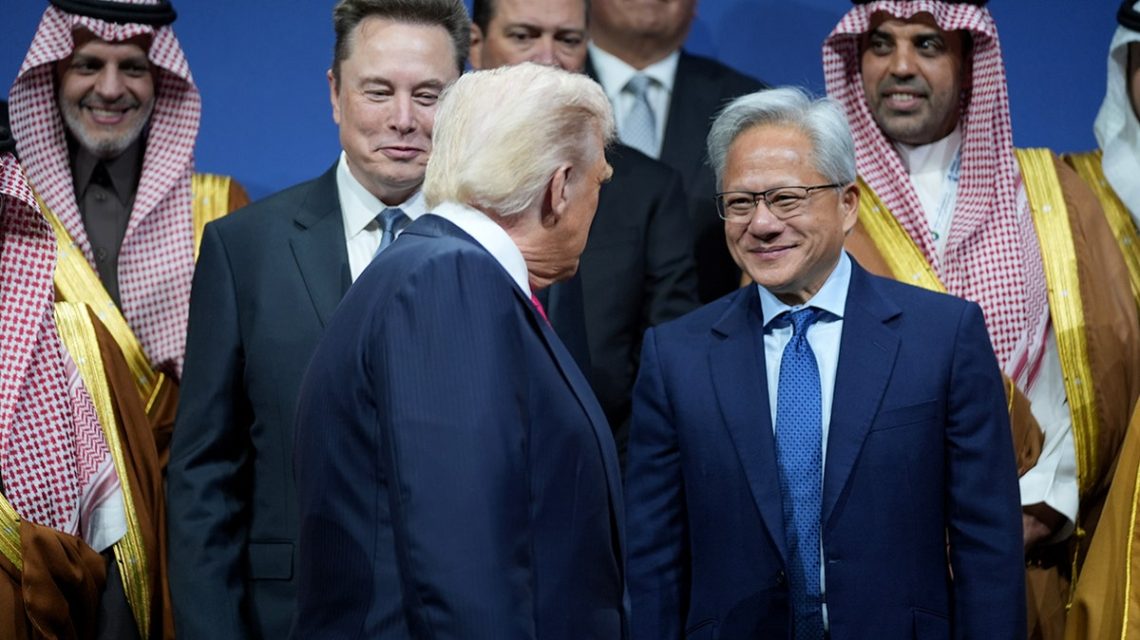
Nvidia CEO Jensen Huang believes that artificial intelligence will transform the workforce in a way similar to the Industrial Revolution. He foresees AI creating new jobs and altering how Americans work.
In a recent interview, Huang stated that young people should embrace AI instead of fearing it. He emphasized that AI will enhance workers’ capabilities across various fields. The expansion of AI is driving demand for skilled labor, such as electricians, welders, and construction workers, as companies establish chip manufacturing facilities, computer plants, and data centers nationwide.
“We’ve created about half a million,” Huang remarked. “We’re likely to create many more.”
Earlier, Huang showcased a manufacturing plant in Sherman, Texas, during an interview with Fox News host Will Cain. Nvidia has partnered with Coherent, a software company, and invested $2 billion in their collaboration. Coherent manufactures lasers and optics for advanced technologies.
Coherent CEO Jim Anderson stated that production at the Sherman facility is anticipated to quadruple in the next 12 to 18 months.
“Productivity leads to more jobs,” Huang explained. “History confirms this trend.”
Huang highlighted that AI is accessible to individuals without technical expertise, as it enables interaction with complex systems using natural language.
“If you don’t know how to use AI, tell the AI,” he said.
He envisions AI as a tool for enhancing skills rather than replacing them. Huang encouraged students and young workers to pursue their passions while learning how to incorporate AI.
“If you’re drawn to culinary arts or philosophy, study them with AI,” Huang advised.
He likened AI to calculators, noting that technology changes how work is done instead of eliminating skilled labor.
“We no longer need to perform algebra or calculus manually as computers handle these tasks,” he stated.
Huang asserted that work’s purpose remains unchanged, although AI affects its execution. He predicts that AI will increase U.S. productivity, strengthen the economy, and boost energy demand as AI infrastructure grows.
“The future will be largely optimistic,” Huang concluded, “though caution is essential for specific applications.”
Despite concerns about AI-induced job losses, the government has expressed caution regarding advanced models’ potential security threats. Recently, the Trump administration prohibited certain Anthropic models from foreign use after cyber capabilities were unveiled.
Huang dismissed the notion of AI as a competition, noting its longevity without a definitive end.
“AI has no finish line; it is ongoing,” he said.
Huang emphasized that the U.S. should take a leading role in technology development.
“We must lead,” he declared.
 Pump.fun’s Marketplace and its Surreal Impact
  Divisive Architectural Icons in the United States
  Ubisoft Co-Founder Claude Guillemot Dies in Plane Crash
  Navigating the Risks of Public Wi-Fi
 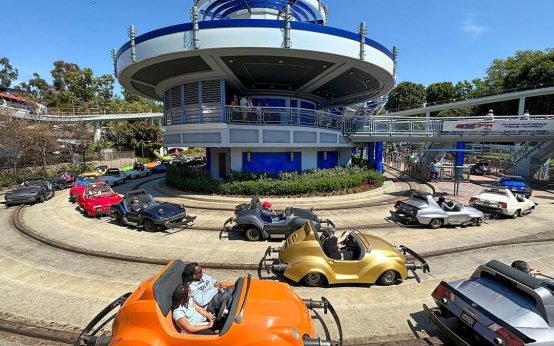 Disneyland’s Autopia Ride to Transition to Electric
  The High Stakes of Investing in SpaceX