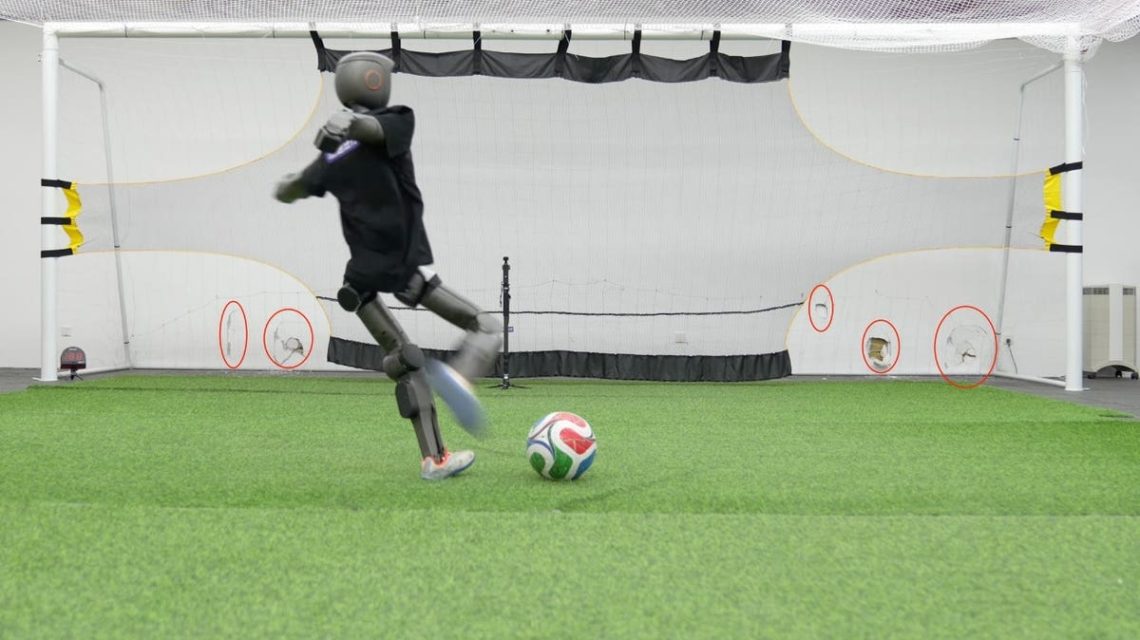
The advent of robotic soccer players heralds a new era in humanoid robotics, yet it also brings new concerns for those in goal. Booster Robotics recently spotlighted its T1 humanoid in a YouTube video titled “Try Stopping This Robot.” The video illustrates the T1’s significant power, as it propels soccer balls towards the goal with force sufficient to damage walls.
Impressive Skills and Safety Concerns
While the video appears viral at first, the visible dents left by the ball impacts shift the narrative. It prompts the question: What happens if someone is in the path of these powerful kicks?
Based in Beijing, Booster Robotics developed the T1 humanoid to stand 3 feet, 10 inches tall and weigh 66 pounds. Depending on its configuration, the T1 boasts between 23 and 41 degrees of freedom, enabling it to walk, balance, and make athletic moves. It can operate for around two to four hours on a single charge, depending on the activity.
Booster Robotics tailors the T1 for schools, labs, and robotics teams, facilitating the development and testing of humanoid robots. It supports various software frameworks, which enhances adaptability for different tasks. Currently, over 50 robotics teams and institutes incorporate the T1 in researching and developing new robotic capabilities.
Robot Soccer: A Key Training Ground
Soccer challenges robots with movement, balance, and quick decision-making, providing rigorous tests under dynamic conditions. Such challenges teach robots to adjust to moving targets and rapidly changing environments, critical for their potential future roles in warehouses and disaster zones.
Booster T1’s Role in RoboCup
The T1 is also a part of RoboCup, an international robotics soccer competition. RoboCup aims to develop robots that can eventually compete with and surpass human soccer champions under official rules. These competitions push teams to enhance their robots’ balance, vision, and decision-making abilities.
Implications for Everyday Robotics
Although robot soccer might seem trivial, it holds significant implications for the future of robotics. Robots like the T1 demonstrate advanced balance and power, suggesting potential in fields such as elder care, warehouse operations, and disaster response.
However, there are important safety considerations. Companies must establish robust safety protocols to manage these robots’ power, especially as they transition from labs to public spaces. Force limits, emergency stops, and clearly defined operational zones are crucial for safe interaction with humans.
As technology evolves, discussions on safety, transparency, and accountability will be vital. The development and testing of humanoid robots must ensure they operate safely and responsibly, particularly in environments shared with people.
 AI-Driven Docudrama ‘Dreams of Violets’ Debuts at Tribeca Festival
  U.S. Government Restricts AI Lab Anthropic Amid Security Concerns
  U.S. Government Orders Suspension of Anthropic’s A.I. Models
  Students Use Glucose Monitors to Understand Their Health
  SpaceX’s Historic IPO: Breaking Records and Creating Billionaires
  Welder’s Journey to Wealth: From Joining SpaceX to IPO Payday