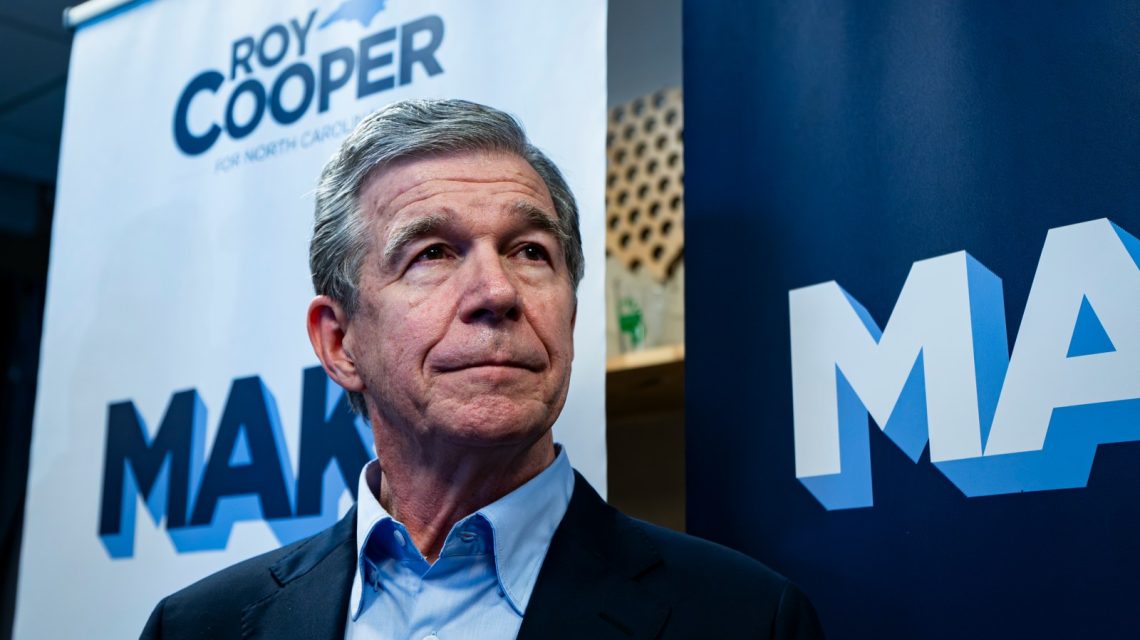
Former Governor Roy Cooper, representing the Democrats, has taken a substantial lead over Michael Whatley, the former Republican National Committee Chair, in North Carolina’s latest U.S. Senate race poll. This poll was released on Tuesday, highlighting Cooper’s significant position.
The Democrats are closely monitoring this race as the North Carolina seat becomes a crucial target. The seat, currently held by retiring Republican Senator Thom Tillis, represents a promising opportunity for the Democrats to gain control in the 2026 midterm elections. North Carolina narrowly favored President Donald Trump in the 2024 elections, making it a key battleground state almost equally split between Democrats and Republicans.
Despite not having won a Senate seat in North Carolina since 2008, Democrats find confidence in the dynamics of the current political climate and Cooper’s renowned status. Favorable conditions are seen as advantageous for a Democratic win. Newsweek reached out to both Cooper’s and Whatley’s campaign teams for comments via email.
Catawba College Poll Shows Cooper’s Lead
The latest Catawba College poll indicated Cooper ahead by 14 points, with 48% support among respondents compared to Whatley’s 34%. About 15% of those surveyed remained undecided. This finding mirrors an earlier survey by the same pollster conducted in March.
Michael Bitzer, director of Catawba College’s Center for North Carolina Politics & Public Service, mentioned that Cooper’s advantage is particularly pronounced among independents, who prefer him over Whatley at a rate of more than two-to-one. Bitzer also noted that this year looks to follow typical mid-term patterns where the electorate evaluates the ruling President’s performance. Many North Carolinians disapproving of the current President appear to lean towards supporting Cooper.
This poll surveyed 1,000 voters in North Carolina from June 1 to June 10. It has a margin of error of plus or minus 3.83 percentage points.
Additional Poll Indicators
A Harper Polling/Carolina Journal survey also reflected Cooper’s solid lead, showing him 11 points ahead, backed by 49.8% of the polled individuals. Whatley garnered 38.7% in this poll conducted on May 10 and 11, with a margin of error of plus or minus 4 percentage points.
In another survey by High Point University/YouGov, Cooper led by 8 points, securing 50% of likely voters’ support, while Whatley was favored by 42%. This poll engaged 703 people between March 26 and April 6 and had a 4.3 percentage point margin of error. A closer race was suggested by Quantus Insights, showing Cooper with 49% to Whatley’s 44%, surveyed on March 31 and April 1, with a margin of error of plus or minus 3.5 percentage points.
Prediction Markets Favor Cooper
Prediction markets reflect strong confidence in Cooper’s chance of success, with an 85% probability on Kalshi and 86% on Polymarket as of Tuesday. These markets allow participants to trade based on anticipated political outcomes, using real-money bets to generate probability estimates. Although indicative of trader sentiment, these predictions do not always accurately forecast future results.
Challenges and Opportunities for Democrats
The race presents a major opportunity for the Democrats, who have had successes in the state’s gubernatorial elections but faced challenges in federal contests. The last Democratic Senate victory was in 2008 with Senator Kay Hagan. In 2022, Democrat Cheri Beasley fell by approximately 3 points to Republican Ted Budd. Similarly, in 2020, Democrat Cal Cunningham lost to Tillis by under 2 points.
Though Democrats have maintained control of the governor’s office—evidenced by Democrat Josh Stein’s recent victory following Cooper—they face challenges in rural regions where Obama did well in 2008. Suburban areas around Charlotte and Raleigh have shown more Democratic support.
Democrats see North Carolina as a crucial potential gain given the current Senate composition. With Republicans holding a 53-47 majority, Democrats need to gain at least four seats. Besides North Carolina, the seat in Maine held by Republican Susan Collins is another target due to its Democratic-leaning nature.
Next Steps and Ongoing Trends
Voter sentiment in North Carolina will be under close examination as the election approaches. Polling agencies like Cook Political Report and Sabato’s Crystal Ball currently see the race as slightly tilting towards Democrats, though they acknowledge the competitiveness remains significant.
 Trump’s Plan for AI Company Stakes
  Bipartisan Housing Reform Bill Faces Unexpected Setback
  Progressive Victories in New York Signal Potential National Shifts
  Understanding the Save America Act and Its Impact
  Darializa Avila Chevalier’s Historic Win in New York Primaries
  Controversy Over Alaska’s Senate Race Ballot Decision