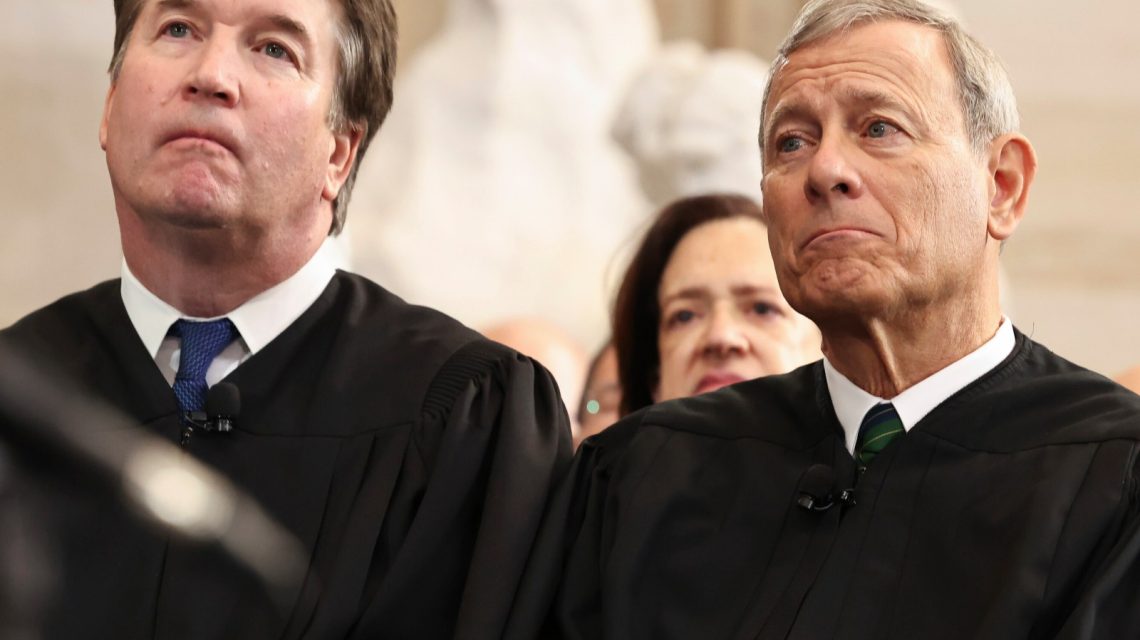
The Supreme Court ruled that Terry Pitchford, a Black death row inmate in Mississippi, can renew challenges to his conviction. The decision saw Chief Justice John Roberts and Justice Brett Kavanaugh join the court’s liberal wing in a 5-4 ruling.
The decision underscores ongoing debates within the conservative-majority court regarding racial bias in jury selection. It reinforces established laws against discrimination in jury selection, providing Pitchford another chance to contest his conviction and death sentence.
“Mr. Pitchford is now entitled to a fair trial in the state court,” said Joseph Perkovich, who represented Pitchford at the Supreme Court.
A Divided Conservative Approach on Racial Bias
The question centered on the actions of prosecutors during Pitchford’s 2006 trial for capital murder, where he received a death sentence for his part in the robbery and killing of Reuben Britt. Prosecutors dismissed four out of five eligible Black jurors, resulting in objections from defense attorneys claiming racial motivation.
The 1986 Batson v. Kentucky decision plays a crucial role in this case. It prevents excluding jurors based on race and necessitates court examination of prosecutors’ justifications. Pitchford’s defense argued that the opportunity to challenge these justifications was insufficient, a point affirmed by a federal district judge in 2023, leading to the initial overturning of his conviction.
This ruling was reversed by the 5th U.S. Circuit Court of Appeals, which upheld the Mississippi Supreme Court’s finding that Pitchford’s attorneys did not adequately preserve objections during the trial. The Supreme Court’s decision now allows for a reconsideration of Pitchford’s claims.
Justice Kavanaugh, writing for the majority, noted that Pitchford’s counsel wasn’t given ample chances to counter the prosecutor’s race-neutral explanations, saying, “… the ordinary trial-court procedure for resolving Batson claims at step three never occurred.”
Justice Neil Gorsuch dissented, arguing the prosecutors gave valid reasons for dismissing jurors, stating, “One prospective juror… had returned late to court after lunch break and had a history of mental problems. Two had brothers who had been convicted of violent offenses. Another ‘had no opinion on the death penalty.’”
The Return of Doug Evans and Implications of Flowers v. Mississippi
This case echoes Flowers v. Mississippi, a 2019 decision where the same prosecutor, Doug Evans, was found to have eliminated Black jurors persistently. Evans, who also prosecuted Pitchford, is again under scrutiny along with trial judge Joseph Loper, both involved in Pitchford’s and Flowers’ trials.
Who is Terry Pitchford?
Terry Pitchford, now 40, was 18 at the time of the 2004 robbery leading to Reuben Britt’s death. Although his partner, who fired the deadly shots, was a minor and ineligible for the death penalty, Pitchford was tried for capital charges. His 2006 jury conviction and death sentence have been subjects of extensive appeals, with claims of racial bias during jury selection.
Pitchford has spent almost two decades on death row at the Mississippi State Penitentiary at Parchman. His legal team argues his rights were compromised during jury selection, a recurring issue in Mississippi cases of alleged racial bias. The Supreme Court agreed that the claims required more extensive judicial review.
This article includes information sourced from the Associated Press.