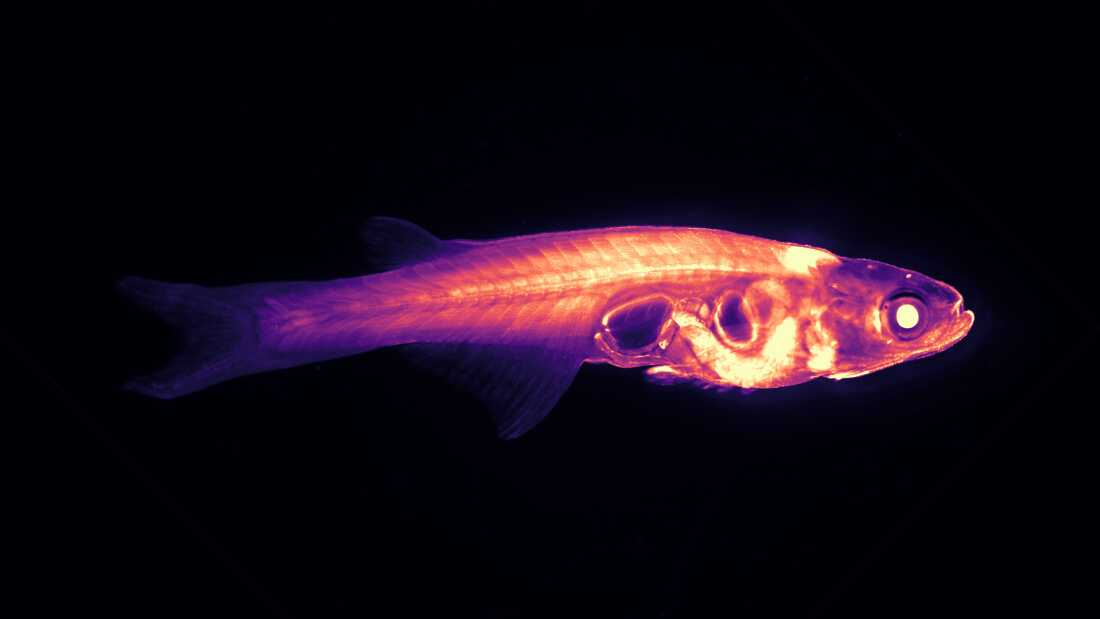
Fluorescent proteins within transparent Danionella fish empower scientists to observe brain and body processes. At a prominent brain science center, experts aim to explore the connection between brain and behavior through Danionella fish studies.
New Venture at Janelia Research Campus
The Janelia Research Campus, part of the Howard Hughes Medical Institute near Washington, D.C., is investing significantly in a small, transparent fish species. The aim is to understand how brains control complex behaviors using artificial intelligence and Danionella fish.
“It’s a big, risky bet,” remarks Gerry Rubin, Janelia’s founding executive director and head of biology.
But that’s what makes it interesting.
Plans include expanding fish space to 6,000 square feet to house numerous new tanks. Scientists focusing on Danionella are expected to grow from about 10 to over 100. Observing a complete fish brain in real time may unravel how brains drive behaviors across species, even humans.
Nelson Spruston, Janelia’s executive director, points out, We all evolved from fish, and our brains share many features of the brains of fish.
Advantages of Danionella Fish
Danionella offers advantages over standard lab animals such as rodents. Unlike most species, where the brain is hidden by a skull, Danionella fish lack the upper part of their skull and have transparent skin. This transparency aids direct observation.
Despite their benefits, Danionella is not as well studied as other models like zebrafish. The species Danionella cerebrum was recognized only in 2021.
Matt Lovett-Barron from the University of California, San Diego, notes, Having an animal that has a clear head and a clear body [is] extremely useful for neuroscience.
From Flies to Fish
Janelia’s work is renowned for mapping 54.5 million connections in fruit fly brains. Now, they’re embracing a new challenge that could unravel fundamental biology mysteries. The brain-behavior question examines how processes, like neuron firing, lead to memory and decision-making.
According to Rubin, understanding brain function requires examining all neurons simultaneously. A transparent fish aids this pursuit, although the Danionella presents three times the neurons of fruit flies.
“This is going to produce so much data that we’re going to need something like artificial intelligence to analyze it,” Rubin says.
Innovating Scientific Tools
Creating tools to facilitate Danionella research is part of Janelia’s agenda. Mapping every brain connection in Danionella, as done with fruit flies, is essential. Integrating artificial intelligence into research processes will expedite discovery.
Janelia aims to perform experiments in freely swimming Danionella, tackling considerable engineering challenges. Lovett-Barron describes how they place fish in virtual reality settings to study their brain activity during social interactions.
Advancing tools would enhance these investigations significantly.
A Long-Term Endeavor
Answering the brain-behavior question remains a long-term ambition. HHMI President Erin O’Shea expresses enthusiasm about potential insights.
“I would be ecstatic if in 10 years we [understand] just one complex behavior in the fish, like schooling,” she says.
Janelia scientists are advancing in areas like monitoring neuron activity in larval zebrafish. They aim to scale up for Danionella, which have around 650,000 neurons, compared to the 80,000 in zebrafish. Human brains have about 86 billion neurons.
 Bilingual Brain Research Reveals Shared Grammatical Processing
  Gad Saad Shares His Surreal Meeting with Elon Musk
  Federal Investigation at GKN Aerospace Following Chemical Tank Incident
  Whale Graveyard Hosts Thriving Marine Ecosystems
  Understanding Ghost Particles: JUNO’s Initial Findings
  What Science Learns from Emma Mazzenga’s Extraordinary Athleticism