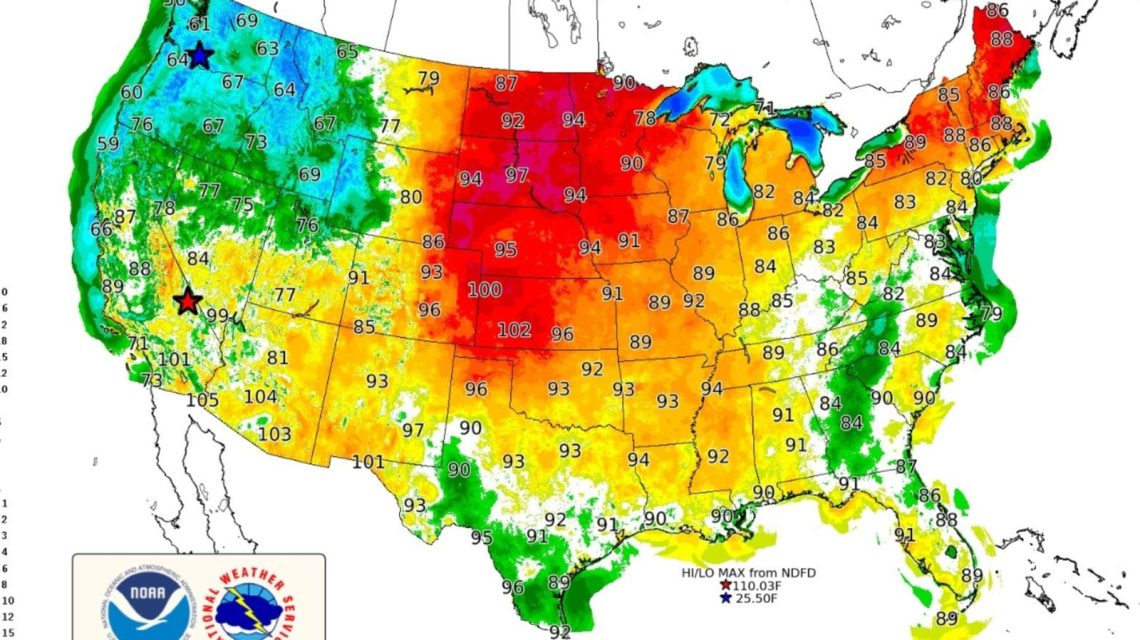
The United States is facing a widespread heat wave with dangerously high temperatures across many regions. The National Weather Service (NWS) has issued a warning about the building of ‘dangerous’ conditions as heat alerts span from the Plains to the Midwest and South.
NWS maps released on Tuesday depict the progression of the heat wave, which is set to impact over 20 cities in the coming days. Extreme heat warnings are already in effect, with forecasts predicting heat index values to reach as high as 110 degrees in parts of Texas and exceed 100 degrees in states including Missouri, Kansas, Iowa, Arkansas, and Tennessee.
The NWS advises that these conditions can greatly increase the risk of heat-related illnesses, particularly during peak afternoon and evening hours. It is crucial to stay hydrated, limit outdoor activities, and seek air-conditioned environments.
According to the NWS, the heat wave will intensify across the central U.S. through midweek before shifting to the East Coast, peaking on Friday, and gradually easing over the weekend. This is noted to be the most significant heat event of the summer for many areas, urging preventative measures like hydration and breaks from the heat.
U.S. Heat Wave Maps
Numerous states might experience record-breaking daily high temperatures this week, as forecasted by the NWS Weather Prediction Center. Meteorologist Peter Mullinax highlighted the most unusual heat will strike the Upper Midwest/Great Lakes on Wednesday, with temperatures in Michigan and the East expected to be 10 to 20 degrees above normal by Thursday and Friday.
NWS maps indicate concentrated significant temperatures in the Northern Plains and upper Northeast on Tuesday, with North Dakota and South Dakota potentially reaching the 90s, and Kansas possibly hitting the low 100s. Maine, New York, Vermont, and Massachusetts are forecasted to see mid- to high-80s temperatures.
On Wednesday, the Northern Plains temperatures may moderate slightly, but the Southern Plains, including Texas, Oklahoma, and Kansas, will remain elevated. Michigan could experience oppressive temperatures in the upper 80s or low 90s, similar warmth is expected in Maine and Vermont. California’s temperatures will rise, with mid- to upper-90s in Central regions and mid-100s in Southern areas.
By Thursday, California may feel the hottest temperatures with coastal areas in the upper 60s and 70s, while inland areas might reach 100s. Michigan will maintain high temperatures, and warmer conditions are anticipated in several Eastern states, including Maine, Vermont, New Hampshire, Massachusetts, Rhode Island, New York, Connecticut, Delaware, and Virginia.
The South and Midwest will remain in the 90s. By Friday, central U.S. temperatures will start to lower, with high temperatures hitting the low 80s across several states. Conversely, the West will stay hot, with California again reaching the 100s and Oregon experiencing upper-80s to mid-90s.
Along the East Coast, temperatures will continue in the 90s and 100s stretching from Florida through Connecticut, while states further north, such as Maine, Massachusetts, and New Hampshire, may see highs in the 80s.
Heat Illness Symptoms to Watch Out for
Health officials indicate early symptoms of heat-related illness include heavy sweating, fatigue, dizziness, headaches, nausea, muscle cramps, and excessive thirst. These signs often suggest heat exhaustion when the body struggles to cool down and loses fluids. Cool, pale, or clammy skin and possible weakness or fainting are additional symptoms of heat exhaustion.
Severe symptoms can indicate heat stroke, a life-threatening emergency requiring immediate medical care. Warning signs include confusion, slurred speech, loss of consciousness, very high body temperature, and hot skin that may feel dry or lightly sweating. Immediate treatment is essential as heat stroke can quickly become fatal if the body’s temperature regulation fails.
What Happens Next: Temperature Outlook
The high temperatures across numerous states will persist through at least Friday, offering relief in the central U.S., while Western and Pacific Northwestern temperatures will continue to climb over the weekend into early next week. The NWS Climate Prediction Center projects below-average temperatures for much of the central US and parts of the Upper Midwest from June 14 to June 18.
 Tragic Incident as Police Shoot Dog During Unrelated NBA Celebration
  Ohio Man Charged in Thwarted White House Attack Plot
  Search for Missing Woman in South Carolina Continues
  Goodyear Blimp Crash in Coral Springs
  Economic Effects of Iran War Tentative Peace Agreement
  Guide to Visiting the Obama Presidential Center