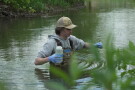
Hannah Ray J Childs enjoys whitewater kayaking on Iowa’s Maquoketa River. She performs acrobatics that submerge her body and give her a sense of flight. Her love for the water is strong, but she has experienced its drawbacks. She has become ill from the river’s water and now uses nose and ear plugs for protection. Despite the challenges, she values the community she has found through the sport, including meeting her husband while kayaking.
Iowa is grappling with water pollution. As one of the top producers of corn, soybeans, and hogs, the state’s agricultural activities contribute significantly to this issue. Fertilizers and manure introduce nitrates and phosphorus into the water, making Iowa a major source of pollution for areas like the Gulf of Mexico. The largest city faced water restrictions last summer due to nitrate contamination in tap water.
The problem affects both public health and recreational activities. Many lakes and streams in Iowa do not meet swimming, drinking, or aquatic life standards. Algal blooms and bacterial contaminations, often from human sewage, deter people from enjoying natural water bodies. Over half of Iowa’s monitored rivers, streams, and lakes did not meet state quality standards in 2024.
The state has favored voluntary measures to tackle water contamination, focusing on reducing nitrate and phosphorus runoff. Despite investments, including a $320 million package pushed by Governor Kim Reynolds, results remain limited. Improved farming practices and conservation efforts have been implemented, such as cover crops and no-tillage methods.
Iowa’s waterways, including the Missouri and Mississippi rivers, shape the state’s identity. Childs grew up farming near the Maquoketa River and cherishes memories of fishing and exploring the outdoors. She now tests water for chemicals and promotes water-related recreational initiatives in her hometown of Manchester.
“If we don’t get people invested in their local river, their local community, how are we ever going to ask them to take care of it?” she said.
Mary Swander, a theater director, has fond memories of swimming and canoeing as a child. However, she now avoids water due to past negative experiences. Bacteria from various sources, including livestock, pose the biggest threat to water safety. Heavy rainfall and climate change exacerbate these issues by increasing runoff.
Lake Darling, located in southeast Iowa, illustrates the pollution struggle. Despite past efforts to restore its health, the lake frequently suffers from E. Coli and algal issues. Local experts noted that new agricultural activities contribute to these problems.
Concerns about water quality impact summer activities, as seen in declining lake visits. Nearby tennis camp attendees have shifted away from swimming due to algae and other concerns.
The broader Midwest, especially Iowa, struggles with balancing agriculture and environmental health. Legal actions and legislative gaps persist. While states like Minnesota implement stricter measures, Iowa relies on voluntary strategies and cooperation between state departments, universities, and farmers. Federal and state assistance remains crucial to drive environmentally-friendly practices.
Successful local efforts provide hope. Conservation and sewage improvements have preserved the Iowa Great Lakes, maintaining their allure for residents and tourists.
The stakes are high. Effective policies and local initiatives are vital to protect Iowa’s waterways and ensure their enjoyment for future generations.
Associated Press provides environmental coverage with support from the Walton Family Foundation. For more, visit their climate and environment hub.
 Limited Interest in Arctic National Wildlife Refuge Oil Auction
  Confronting the Truth Behind Sustainability Buzzwords in the Food Industry
  The Aftermath of Santa Rosa Island’s Fire
  Largest Seizure of Illegal Cockroaches in Australia
  Flesh-Eating Fly Returns to the United States Causing Concern
  Australia’s Largest Seizure of Exotic Invertebrates: Over 100,000 Cockroaches Confiscated