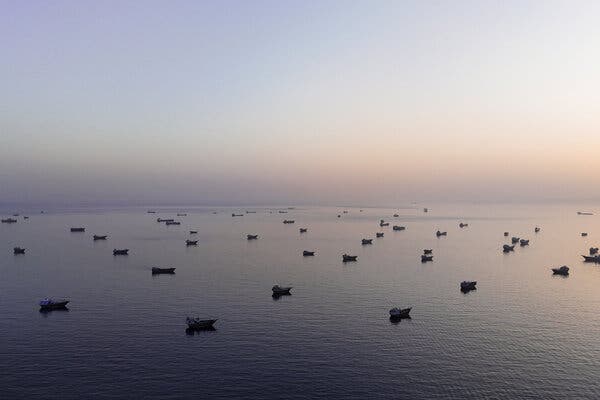
A U.S. Army Apache helicopter gunship went down near the Strait of Hormuz on Monday. Fortunately, the two crew members were safely rescued. Two sources familiar with the situation provided this information.
The reason behind the Apache’s crash is currently unclear. Speculation includes the possibilities of being shot down by Iranian forces, mechanical failure, or another issue. The investigation is ongoing according to one of the sources, who requested to remain anonymous.
This incident follows a period of fluctuating hostilities in the area, marked by military exchanges between Israel and Iran before a tentative cease-fire. The situation underscores the fragile nature of peace in the region.
The Trump administration had not disclosed the news of the helicopter’s downing when The New York Times inquired with the White House press office on Monday night. A spokesman for President Trump didn’t issue an immediate statement, and the military’s Central Command also did not respond to a request for comment.
The U.S. military utilizes Apache helicopters along with armed MQ-9 Reaper drones, as well as F/A-18 and F-35 attack planes. These efforts are part of Central Command’s strategy to counter Iran’s effective blockade of the Strait of Hormuz to most commercial traffic.
To date, Iran has shot down about 30 unmanned Reaper drones, and a few U.S. fighter jets have faced losses due to both hostile and friendly fire since the conflict began on February 28. The incident marks the first loss of an Apache helicopter in the ongoing conflict.
Last month, imagery was released by Central Command showing Adm. Brad Cooper, head of the command, flying over or near the strait before a U.S. Navy operation called Project Freedom. This initiative aimed to assist commercial ships through the strait.
The AH-64 Apache gunship, armed with Hellfire missiles, is among the most formidable aircraft in the area. These helicopters deterring small-boat attacks and intercepting drones, are increasingly approaching Iranian territory. This aggressive posture persists, despite U.S.-Iran discussions aimed at reopening the strait.
In response to Iran’s blockade, the United States initiated its own blockade on April 13, preventing commercial vessels from accessing Iranian ports. Since then, 134 vessels have been turned away by U.S. military ships.
The Navy has also disabled seven vessels that ignored American warnings, including a Palau-flagged oil tanker headed towards Iran through the Gulf of Oman.
In April, an F-15E Strike Eagle fighter jet crew, shot down by Iran, was rescued after ejecting from their aircraft, finding themselves deep in hostile territory.
Eric Schmitt, Maggie Haberman, and Jonathan Swan contributed to this report.
 Talks to End Iran War Initiate Amid Tensions
  Vice President JD Vance Engages in Iran Negotiations in Switzerland
  Paraguay’s Almiron Ejected from World Cup Match for Rule Violation
  Bolivia’s President Declares State of Emergency Amid Widespread Protests
  Japan Dominates Tunisia 4-0 in World Cup Match
  Pink Boots Make a Statement at the World Cup