A plan to auction over 100 artifacts salvaged from the Titanic’s wreckage is facing opposition from the U.S. government. According to court documents, RMS Titanic Inc., which has exclusive salvage rights to the famous North Atlantic wreck, intends to sell artifacts despite previous agreements to display them in museums and traveling exhibitions.
Proposed Auction Details
RMS Titanic, based in Georgia, plans to auction the artifacts and showcase them on a global tour across four cities. The locations for this tour are yet to be disclosed. The artifacts up for auction include a bronze cherub, a necklace of gold nuggets, and a heart-shaped pendant, as revealed in U.S. court documents.
The National Oceanic and Atmospheric Administration (NOAA), tasked with safeguarding U.S. interests at the wreck site, argues that selling these artifacts would breach RMS Titanic’s legal obligations. Court documents reveal the government believes the proposed auction should not proceed.
RMS Titanic representatives did not respond to inquiries for comments. However, their attorneys assert in federal court filings that the auction doesn’t violate existing agreements regarding the artifacts.
Efforts to Sell Titanic Artifacts
Since 1987, thousands of items have been salvaged from the Titanic by RMS Titanic Inc., which exhibits them for profit. Past attempts to sell artifacts faced opposition from U.S. courts, preservation groups, and families of the victims.
Salvaged items that belonged to the ship’s passengers and crew cannot be sold, according to legal agreements. Meanwhile, artifacts rescued by survivors or retrieved from the water are permitted for sale. For example, a life jacket worn by a survivor sold for $906,000, while a lifeboat seat cushion fetched $527,000 at auction.
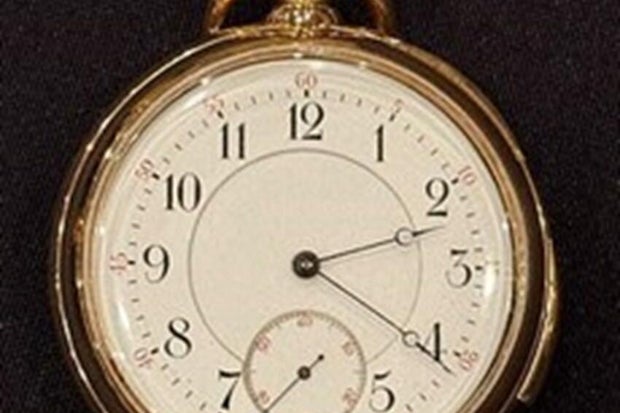
In 2025, a collector purchased a gold pocket watch linked to Titanic’s Isidor Straus for over $2 million. This watch was gifted to Straus by his wife, Ida, for his birthday. Other significant sales include a menu, a launch ticket, and a letter written by passenger Oscar Holverson. A violin believed to be played during the Titanic’s sinking fetched $1.45 million in 2013.
International Dispute
RMS Titanic obtained initial artifacts from France, which granted ownership to the salvager. These items were recovered in cooperation with the French oceanographic institute IFREMER and Woods Hole Oceanographic Institution, leading to a salvage claim in the U.S. District Court of Norfolk, Virginia.
NOAA insists that all 5,000 items, irrespective of their recovery location, should remain as a single collection, according to conditions set by the U.S. court. NOAA also notes that a French court requires the artifacts to remain together and not be sold individually.
RMS Titanic maintains that U.S. courts have no jurisdiction over items claimed in France. Responses from French government representatives were not available.
Position on Artifact Sales
Some underwater explorers oppose selling Titanic artifacts, advocating for public displays in the interest of preserving history. Greg Stone, an ocean explorer, believes that recovering artifacts is acceptable if done with proper archaeological methods. Professor Richard Daynard emphasizes that displaying artifacts intended for public benefit shouldn’t become exclusive possessions for wealthy individuals.
If it’s something where someone can walk through their house and say ‘Yes, I bought this for $5 million and it’s original from the Titanic,’ that’s not a good thing,” Daynard remarked.
 Operation Planned to Recover Victim from Mount Everest
  Iran-US Negotiations and Diplomatic Developments
  NATO Jets Shadow Russian Bombers in Arctic Flight
  Democratic Primaries and Global Affairs: Key Updates
  Close Encounter Between Chinese and Japanese Forces in the Western Pacific
  Heat Wave Causes Drownings and Fatalities in France