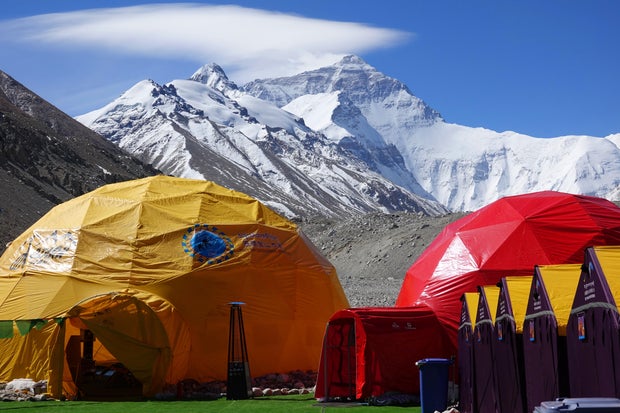
Indian authorities are planning a mission to recover the frozen body of a climber who died on Mount Everest almost 30 years ago. This climber was part of one of the most fatal events ever experienced on the highest peak in the world.
Tender for High-Altitude Recovery
The Indo-Tibetan Border Police (ITBP) is seeking bids from high-altitude recovery agencies to undertake the task. The aim is to retrieve the remains of a climber known only as “Green Boots” from the northern slope of Everest. A tender document indicates that the designated team must deliver the body to Delhi by October.
Expert Tshiring Jangbu Sherpa, founder of the Everest Sherpa Expedition based in Nepal, describes this operation as highly dangerous, equating it to “double the danger of normal climbing.” He emphasizes the risks for the rescue team.
Sherpa, who has summited Everest multiple times and led recovery expeditions in 2024, estimates that a skilled 10-person team might need up to a week to complete the mission. He cautions that current weather conditions make it impractical to attempt any operation before spring, conflicting with the June-October timeline specified in the tender document. The ITBP declined to provide any comments on the recovery plans.
The Identity of “Green Boots”
The nickname “Green Boots” originates from the climber’s distinctive green footwear. The body is located at around 27,000 feet and serves as a reference point for climbers approaching from the Tibetan side. This area known as the “death zone” sits above 26,200 feet where low oxygen levels pose serious risks to climbers.
Green Boots was believed to be Tsewang Paljor, an ITBP member who died during a storm while attempting to summit the peak on May 10, 1996. His story was documented in Jon Krakauer’s book “Into Thin Air.” Despite worsening weather, Paljor and two others continued towards the summit but never returned. Only Green Boots’ body has been found.
Recent reports identify the remains as those of Dorje Morup, an Indian soldier and one of Paljor’s climbing partners. British newspaper The Guardian and AFP news agency confirm this with DNA evidence.
The Necessity of Recovery Missions
One of the most recognized cases on Everest concerns Francys Arsentiev, who died during her descent in 1998. Despite becoming the first American woman to summit without oxygen, her body was visible to others along a primary route until 2007 when it was moved out of sight by a team of Sherpas.
Over 200 bodies remain on Everest, left due to the danger or cost of recovery. This ongoing issue spurs debate among climbers worldwide. Some argue that the dead should be respected and retrieved, while others contend that the risk is not justified. Some climbers opt to remain on the mountain in death.
However, Tshiring strongly supports recovery efforts to return deceased individuals to their families. “My opinion is we must bring them down,” he asserts.
 China’s Naval Flotilla Arrives in Vladivostok for Joint Exercises
  Switzerland’s Population Cap Referendum and Its Implications
  Norway’s Resurgence in the World Cup Spotlight
  Iran-US Negotiations and Diplomatic Developments
  NATO Jets Shadow Russian Bombers in Arctic Flight
  Democratic Primaries and Global Affairs: Key Updates