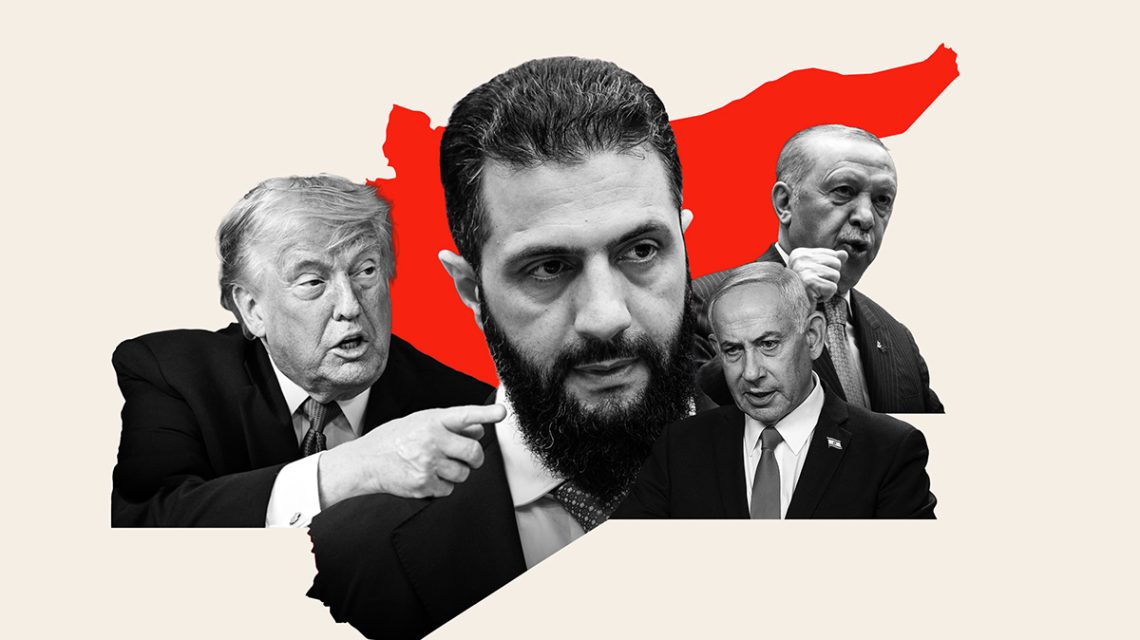
The United States and Iran have achieved an uneasy truce, marking a significant moment in Middle Eastern geopolitics. In this context, Syria’s leadership under President Ahmad al-Sharaa finds itself in a precarious position. Following Sharaa’s rise to power after the insurgent attacks in December 2024, Syria has managed to steer clear of deeper regional conflicts, focusing instead on rebuilding and internal stabilization post-Bashar al-Assad’s ousting.
Sharaa’s government now faces intensified pressure due to rising tensions between Israel and Turkey, two of America’s longstanding regional allies. Israeli Prime Minister Benjamin Netanyahu has consistently challenged Sharaa’s leadership, while Turkish President Recep Tayyip Erdogan, a key regional ally for Syria, has facilitated Sharaa’s consolidation of power.
President Trump has signaled a shift in U.S. policy by backing Sharaa and has hinted at involving Syria in addressing Hezbollah’s presence in Lebanon. Syrian diplomat Bassam Barabandi shared that while Syrians generally oppose Hezbollah, they are wary of engaging in a conflict that could have detrimental outcomes. “We want Lebanon to be stable. We need Syria to be stable,” Barabandi emphasized, stressing the importance of maintaining peaceful relations with neighboring countries.
Trump proposed Syria’s involvement in Lebanon during a recent interview, suggesting a more targeted approach to countering Hezbollah than what Israel offers. The U.S. pivot in policy reflects the evolving dynamics since Sharaa toppled Assad, transitioning from his former designation as a U.S.-listed terrorist to a leader advocating for inclusivity and peace.
The ongoing conflict between Israel and Hamas has further complicated regional stability, prompting a U.S.-Iran understanding that calls for a temporary cessation of hostilities. Despite this, Trump’s criticism of Israel’s handling of the Hezbollah situation has led to suggestions that Syria might be a more suitable candidate for intervention in Lebanon.
President Sharaa has made attempts to clarify Syria’s position, stating that Trump’s remarks were misunderstood and that Syria seeks peaceful solutions rather than military engagement. Sharaa promotes strengthening Lebanese governance and institutions as an alternative approach.
Barabandi mentions Sharaa’s strategic balancing act between U.S. expectations and practical realities in Syria. He underscores the importance for Syria not to overpromise actions beyond its capacity, as maintaining confidence from the U.S. is crucial.
Historical entanglements also weigh heavily on Syria’s stakes in Lebanese affairs. Syria’s prior engagement in Lebanon’s civil war and subsequent dominance until 2005, coupled with repercussions from Syria’s conflict, highlight the complexity of the situation.
James Jeffrey, a former U.S. representative to Syria, advocates for Syrian neutrality concerning Lebanon. He warns that any intervention could rally Lebanese factions behind Hezbollah, negatively impacting U.S. interests and perceptions from Israel.
Israel’s adversarial stance towards Sharaa is not solely focused on Lebanon. Netanyahu has persistently questioned Sharaa’s commitments to peace. Following Assad’s overthrow, Israel launched significant military campaigns against Syria, under the guise of supporting Druze communities amidst local clashes.
Despite U.S. advocacy for Syria’s leader, Israeli campaigns remain a source of tension. Erdogan has voiced concerns, suggesting Israel’s actions are not only destabilizing Syria but also threatening Turkey.
Syria continues a delicate diplomatic process with Israel while reinforcing ties with Turkey, aiming to maintain regional tranquility. However, maintaining this balance may prove challenging.
Nicholas Heras, senior director at New Lines Institute, highlights Sharaa’s precarious political maneuvering, balancing U.S. support to limit Israeli aggression while strengthening defenses against internal threats.
Frederic Hof, former U.S. ambassador, underlines Sharaa’s priorities of maintaining favorable relations with Trump and Erdogan, seeing them as pivotal in countering Israeli interventions and garnering Gulf reconstruction aid.
Hof acknowledges Netanyahu’s domestic motives in keeping regional tensions high, a potential risk as Sharaa seeks to avoid provoking Israel and anticipates future leadership shifts that could offer more stability. Navigating these diplomatic channels remains crucial for Syria’s strategic interests and regional peace.
 Congress Faces Challenge with $87.6 Billion Request for Iran War Funding
  Senator Lisa Blunt Rochester Discusses New York Socialist Wins
  D.C. Council Utilizes Reserves and Plans Tax Increase
  Record-Breaking Heatwave Sweeps Europe
  Protesters Face Extended Sentences in Federal Courts
  Dr. Nasser Mohamed: Campaigning for Love and Freedom