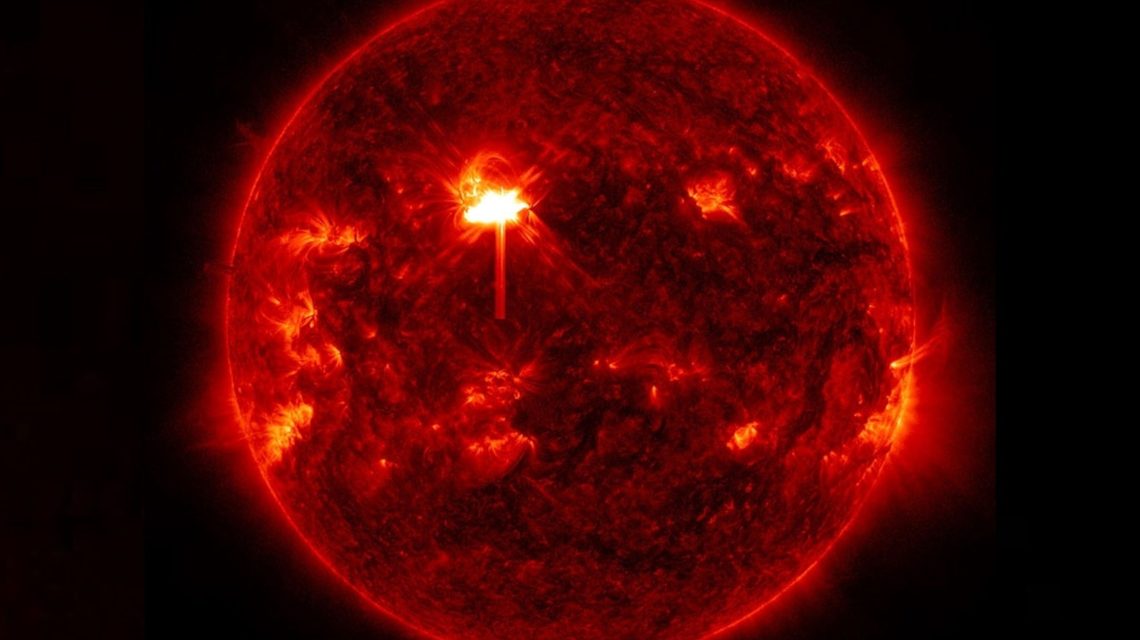
Solar flares are generated when the sun emits powerful bursts of electromagnetic radiation, and they have been particularly active recently. In the past few days, the sun has unleashed several flares, prompting space-weather experts to anticipate possible northern lights and potential disruptions to satellite technology.
Observed on Sunday, the sun emitted three significant solar flares: the first at 7:33 a.m. ET, the second at 6:37 p.m. ET, and the third at 7:36 p.m. ET, as reported by NASA. A subsequent flare occurred on Monday morning at 3:14 a.m. ET.
Understanding Solar Flares
According to the National Oceanic and Atmospheric Administration’s Space Weather Prediction Center (SWPC), solar flares are substantial eruptions of electromagnetic radiation from the sun, with durations ranging from minutes to hours. These flares commonly take place in active sun regions characterized by heightened magnetic fields, often associated with sunspots.
Solar flares are often precursors to Coronal Mass Ejections (CME) — a massive burst of solar material and magnetic field from the sun’s outer atmosphere.
The Solar Dynamics Observatory (SDO) of NASA captured compelling images of these solar flares, distinguished by bright flashes in the upper half of the sun. The images reveal a subset of extreme ultraviolet light, showcasing the extremely hot materials in flares, and the color is enhanced in red.
Intensity and Impact
Classified within the “X-class,” the flares emitted this week are among the most intense types, according to NASA. Such powerful flares are relatively rare, as noted by the Space Weather Prediction Center. On Sunday, the second flare was a massive X8.1 flare, marking the strongest in recent years. Due to the instantaneous travel of electromagnetic energy at light speed, it affects high-frequency communication bands across the sunlit side of Earth. This can lead to communication signal loss or significant disruptions for several minutes to hours in impacted regions.
Northern Lights Phenomenon
Northern light displays, spectacular natural phenomena, occur when solar flares interact with Earth’s atmosphere. As the flares collide with upper atmospheric atoms, they emit light, forming dynamic spectrums. Notably, whether auroras become visible relies on the arrival of CMEs, the magnetic orientation of their fields, and local weather conditions.
Since the sun’s magnetic field hit its solar maximum phase in October 2024, part of its 11-year cycle, there have been persistent strong solar flares and geomagnetic storms. This activity has amplified the frequency of northern lights, with expectations of continued intense magnetic activity due to sunspots extending through 2026, reports NOAA.
 Flesh-Eating Fly Returns to the United States Causing Concern
  Australia’s Largest Seizure of Exotic Invertebrates: Over 100,000 Cockroaches Confiscated
  Gene Editing in Human Embryos at Columbia University
  NASA Declares MAVEN Spacecraft Dead After a Decade of Mars Observations
  Blue Origin Recovers from New Glenn Rocket Explosion
  WHO Reports Reduction in Suspected Ebola Cases in Central Africa