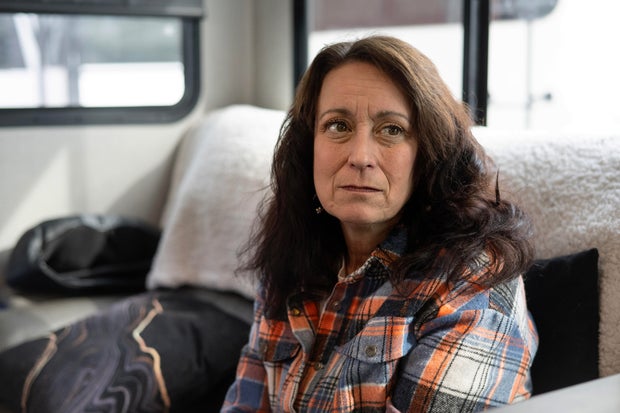
Lori Kelley, a 59-year-old resident of Harrisburg, North Carolina, has faced a series of setbacks due to her worsening vision. Once a proprietor of a nonprofit circus arts school, her diminished sight made it impossible for her to manage the necessary paperwork, leading to its closure last year. Currently, she works sorting recyclable materials at a local concert venue, a job that provides significant, albeit seasonal, income.
Living on less than $10,000 annually in a camper, Kelley relies heavily on her Medicaid coverage. This vital support pays for essential medications to manage arthritis and anxiety and covers doctor visits necessary for controlling her high blood pressure. However, Kelley is worried about her future as she faces the possibility of losing this coverage due to new Medicaid work requirements taking effect next year.
“I’m scared right now,” Kelley expressed, reflecting apprehension shared by many in similar situations.
The new rules mandate that millions of Medicaid recipients must engage in work, volunteering, schooling, or other qualifying activities for a minimum of 80 hours a month starting January 2027. Republican lawmakers had earlier critiqued what they considered exploitation of Medicaid by young, unemployed males. However, experts, including Jennifer Tolbert from KFF, a health information nonprofit, highlight that the new requirements will likely impact adults aged 50 to 64, especially women, more significantly.
Tolbert warns that these work requirements could be a major hurdle, causing many to lose Medicaid coverage, thus jeopardizing their health and finances. Approximately 20 million low-income Americans across 42 states and Washington, D.C. will need to comply with these requirements to retain their health coverage. States like Alabama, Florida, Kansas, Mississippi, South Carolina, Tennessee, Texas, and Wyoming, having not expanded their Medicaid coverage, will not implement the work rules.
The nonpartisan Congressional Budget Office forecasts a decrease of at least 5 million Medicaid beneficiaries over the next decade as a result, which is expected to occur mainly due to the work rules. Critics argue that these measures, part of larger budget cuts amounting to nearly $1 trillion, mainly serve to offset costs associated with tax breaks for the wealthy and increased border security investments.
Jane Tavares, a gerontology researcher, emphasizes the human cost of these budgetary savings, pointing out that the initiative puts vulnerable lives at risk. Meanwhile, Andrew Nixon, spokesperson for the Department of Health and Human Services, justifies the requirements as necessary for Medicaid’s sustainability. However, exemptions are slated for individuals with disabilities, caregivers, pregnant and postpartum individuals, and veterans with total disabilities.
Despite these exemptions, researchers at Georgetown University note that Medicaid is a critical safety net for those aged between 50 and 64, particularly for women who may face higher hurdles in maintaining their coverage due to caregiving responsibilities or personal health issues, which limit work opportunities.
Tavares and others have found that a small fraction of the Medicaid population, about 8%, is considered “able-bodied” yet not working. This group is largely comprised of very poor women who have assumed caregiving roles. Among them, one in four is over 50, highlighting they are not simply young, able individuals avoiding work.
Compelling these individuals to meet work requirements, critics argue, could exacerbate health issues, thereby inhibiting their ability to work. Without continued Medicaid coverage, managing chronic health conditions becomes more challenging, potentially increasing healthcare costs when these individuals later qualify for Medicare.
Many adults in their 50s or early 60s provide care for family members, thus classified as the “sandwich generation.” While some caregivers may receive exemptions from work requirements, these are described as overly restrictive.
“You’re going to see family caregivers getting sicker, continuing to forgo their own care, and then you’re going to see more and more families in crisis situations,” noted Nicole Jorwic of Caring Across Generations.
Paula Wallace, a 63-year-old from Chidester, Arkansas, echoes these concerns. Spending her days caring for her husband, who suffers from advanced cirrhosis, she recently gained Medicaid coverage through an expansion in her state. With the new work requirements on the horizon, Wallace frets about meeting them without the ability to leave her caregiving duties.
Although caregivers for individuals on Social Security Disability Insurance should technically be exempt, federal guidance on the exemptions remains vague. Past experiences in Arkansas and Georgia show that many struggle with navigating these systems, leaving Wallace and others uneasy about their future coverage.
KFF Health News is part of a national newsroom focused on producing detailed journalism on health matters. It operates under KFF, known for its health policy research, polling, and journalism efforts.
 Mount Sinai Health System Faces Subpoena on Gender-related Care
  Potential Ebola Outbreak in Central Africa Raises Concerns of Rapid Spread
  Researchers Escorted Out of Diabetes Conference for Criticizing Trump Administration
  Ebola Outbreak in Africa: A Serious Concern
  Gold and the Ebola Outbreak in Congo’s Mining Towns
  House Passes Bill for Veterans’ Benefit Increase