The trial between Elon Musk and OpenAI CEO Sam Altman highlighted their shared view: building artificial intelligence requires vast resources and substantial financial investment. Today, an AI-focused market funds a global rise in chip factories and energy-heavy data centers to power chatbots. Testimonies revealed private discussions about AI’s costs that began nearly a decade ago.
In a 2018 email to Altman and other OpenAI founders, Musk stressed the need for billions annually to compete with Google, doubting the sufficiency even of several hundred million dollars. These high costs influenced OpenAI’s transition from a nonprofit in 2015, aimed at AI for the public good, to a for-profit enterprise now valued at $852 billion.
OpenAI and other AI firms eye significant Wall Street appearances. The trial questioned if anything besides commercial interests could guide AI’s progression. According to Karan Girotra, professor at Cornell Tech, AI investments were once speculative but no longer are. He likened it to building cars; the factory must be ready before demand.
Musk’s lawsuit accused OpenAI of abandoning its charitable mission for personal gain by Altman and Greg Brockman. OpenAI contended that Musk sanctioned forming a for-profit entity and filed the lawsuit to hamper his own AI venture, xAI. The jury did not address AI’s future, dismissing Musk’s suit as it missed a statutory deadline.
The trial unveiled details of internal conflicts that echo today’s debates on AI’s costs and impacts. Kevin Scott, Microsoft’s chief technology officer, recounted how doubts existed before the advent of ChatGPT. Scott explained Microsoft’s skepticism prior to ChatGPT and how OpenAI’s needs for more data and computing would make their AI systems potent. Microsoft sought to challenge Google in AI research, collaborating with OpenAI to undertake capital-intensive projects like creating data centers full of costly computers and networks.
The driving force for OpenAI’s shift to a for-profit model remains debated. The company, not yet profitable, is likely heading for a public offering soon. The costs involved clearly shaped OpenAI’s decisions. Before unveiling ChatGPT, OpenAI’s significant achievement included training AI to outperform professional Dota 2 players, a milestone demonstrating their tech’s capabilities using reinforcement learning.
OpenAI’s 2017 victory against a top Dota 2 player raised its competitive standing versus Google, prompting introspection about competing as a nonprofit. Musk was impressed but urged for more capital post-Dota win, pushing the idea of a stronger financial foundation.
For co-founder Ilya Sutskever, the victory led to the notion that substantial progress in AI required powerful computing resources. He illustrated the need with the brain’s complexity, having billions of neurons and trillions of synapses.
A power struggle ensued, with Altman and Musk vying for OpenAI’s leadership; Musk aimed to merge the AI lab with Tesla, but others resisted, leading to his departure.
AP Technology Writer Barbara Ortutay contributed to this story.
 The Urgent Need for AI Regulation Amid Rapid Advancements
  AI-Driven Docudrama ‘Dreams of Violets’ Debuts at Tribeca Festival
  Robot Soccer: Testing the Limits of Humanoid Machines
  U.S. Government Restricts AI Lab Anthropic Amid Security Concerns
  U.S. Government Orders Suspension of Anthropic’s A.I. Models
 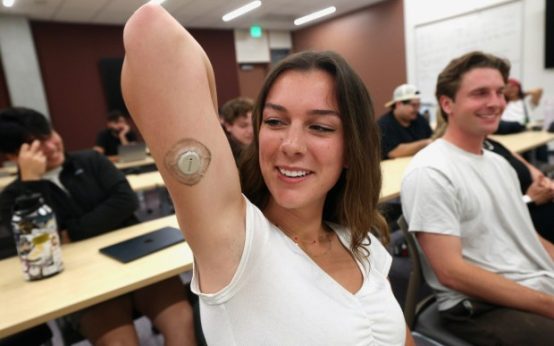 Students Use Glucose Monitors to Understand Their Health