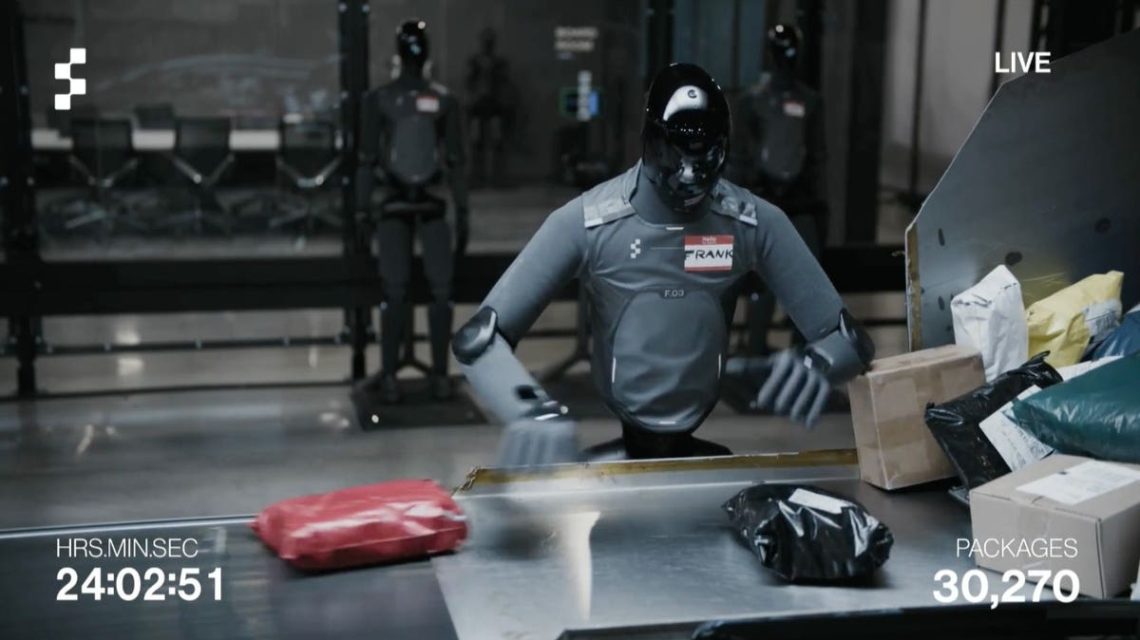
Humanoid robots from Figure AI have surpassed expectations by operating autonomously for over 24 hours, despite an eight-hour test duration. This operation involved sorting small packages without human intervention using Figure AI’s artificial intelligence system, Helix-02. Three of these robots have gained names through online viewers: Bob, Frank, and Gary.
Figure AI, a robotics startup based in California, showcased its Helix-02 powered robots, which efficiently sorted packages around the clock. The robots utilized onboard cameras and AI reasoning for detecting barcodes and managing the package sorting process. Figure AI emphasizes that the robots functioned independently, without remote human steering.
“The robots sorted over 28,000 packages at speeds comparable to human workers,” stated CEO Brett Adcock.
Helix-02, the in-house AI system, is a neural network integrating vision, touch sensing, body awareness, and movement control. It enables humanoid robots to balance, grip packages, adjust posture, and respond dynamically to awkwardly positioned objects.
The livestream event offered viewers a unique chance to witness humanoid robots handling warehouse tasks in real time. As the test exceeded the initial eight-hour target, viewers began referring to the robots as Bob, Frank, and Gary, making them seem more approachable. Figure AI responded by adding visible name tags.
Beyond the demonstration, Figure AI claims its technology includes an automatic reset feature to enhance recovery. This ability allows robots to self-correct when facing unexpected situations, making them more valuable for practical use. The system can also enable robots to leave the work floor for maintenance, ensuring continuous operation with replacements.
The competition in warehouse automation is growing. Tesla, Agility Robotics, and Apptronik are exploring similar AI-powered humanoid technologies for industrial applications. Figure AI has already trialed its robots at BMW manufacturing sites, indicating potential early adoption in industrial settings.
While the package-sorting task demonstrated endurance, scaling the technology to real-world, chaotic environments poses challenges. Businesses aim to understand failure rates, maintenance demands, and performance in messy conditions before broader implementation. Independent verification is essential for reliability.
Although humanoid robots may seem distant from everyday life, their impact could be visible soon. Faster package processing could improve delivery times, while automation could shift warehouse staffing strategies. Concerns about job displacement linger as machines take over repetitive roles traditionally staffed by humans.
Figure AI’s extended run signifies a shift from demonstration clips towards practical implementation, adjusting expectations for warehouse operations. If they achieve reliability, safety, and affordability, the future of package sorting and automation could be transformed.
 SpaceX Secures $920 Million Monthly Deal with Google
  Meta and YouTube Ordered to Pay Damages in Landmark Social Media Lawsuit
  60 Minutes Correspondents Decide to Stay Amid Crisis
  AI Impact: How AI Search is Transforming Professional Services and IT Budgets
  The Critical Role of Magnets in Modern Drone Warfare
  Rising Energy Demands Drive Innovative Solutions