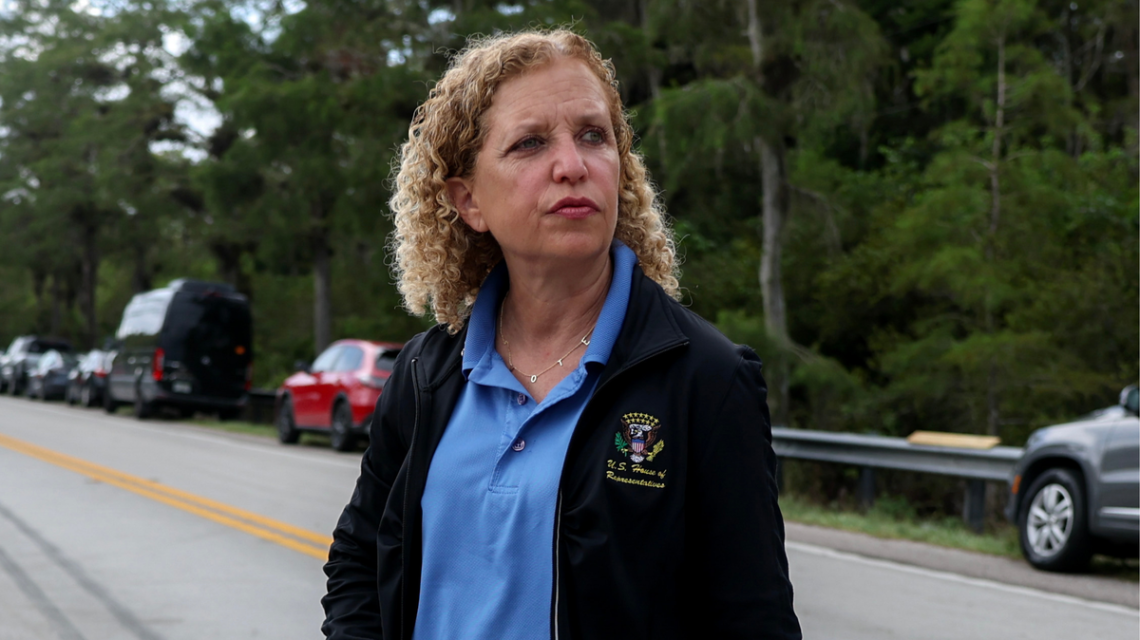
Debbie Wasserman Schultz, a seasoned Congressional Democrat, has announced her candidacy for Florida’s District 20 post-mid-decade redistricting. Her potential election would position her as the representative for areas including southern Coral Springs, North Lauderdale, Lauderhill, Tamarac, and nearby cities.
Almost all Democratic National Committee members elected in Florida strongly oppose Congresswoman Wasserman Schultz’s move to run for re-election in a district originally drawn to assure Black voters’ representation, but targeted for redistricting by Governor Ron DeSantis this year. A dozen elected Florida DNC members released a statement condemning her decision.
“Our party cannot credibly denounce the dismantling of Black political power by Republicans while treating one of Florida’s few remaining majority-Black districts as a political opportunity for an incumbent seeking a safer seat,” the statement read.
Among the party’s 11 non-officer, elected members, nine signed the letter alongside the first vice chair of the Florida Democratic Party, Daniel Henry. This letter trails Wasserman Schultz’s announcement to run for Florida’s 20th District, impacted by new congressional boundaries set by DeSantis and the state Legislature, leaving only three left-leaning districts in a region previously held by five Democratic incumbents.
Wasserman Schultz, who has served in Congress for more than two decades, opted for a secure blue seat where a Democrat is highly likely to win in the general election, rather than competing in the surrounding districts now drawn to favor the Republican party.
Previously, Wasserman Schultz resided in Florida’s newly formed 22nd District extending from Coral Springs to Marco Island. Her historical voter base was divided into five sections under the latest voting maps, with only a minor portion incorporated into the 20th District. Critics accuse her of exploiting a $2.5 million campaign fund to secure her political future in an easier, Democratic-leaning district.
“We cannot claim to defend voting rights, racial justice, and representation while undermining Black political power when it becomes politically convenient,” the Florida DNC members stated.
In a Miami Herald interview, Wasserman Schultz dismissed criticisms from her political adversaries. Black candidates had previously raised concerns over her intentions for the 20th District race.
“It’s not surprising that such criticism comes from those already running for the position,” she remarked.
Nevertheless, the DNC members’ statement represents the most vehement opposition from within her own party. Wasserman Schultz served as DNC chair from 2011 until 2016.
Florida’s 20th District was among three Black-majority districts established by a federal judge under the Voting Rights Act in 1992, ensuring Black voters could elect representatives meeting their interests, leading to Florida’s first Black congressional representatives since Reconstruction. Initially represented by Alcee Hastings and recently by Sheila Cherfilus-McCormick, who resigned her seat last month but is campaigning to return.
DeSantis’ office intentionally targeted the 20th District. This strategy was revealed by his map drawer to state legislators, aligning with the Supreme Court’s ruling last month in Louisiana v. Callais, which weakened the longstanding application of the Voting Rights Act as a remedy for racial discrimination.
Wasserman Schultz defended against claims of benefiting from an attack on Black voters’ political power by highlighting Broward County was, in fact, the focus of DeSantis’ efforts.
“Ron DeSantis and Donald Trump came in and intentionally disrupted, or essentially demolished Broward’s congressional districts to diminish Broward’s power,” she stated in the Herald interview, emphasizing her longstanding representation for Broward County and the necessity to remain due to her experience.
For the Florida DNC members, the decision represents a broader political agenda aimed at undermining Black voters.
“This decision reinforces the same message Republicans have pushed for years: that Black representation does not matter. It does matter. Representation matters. Lived experience matters,” they asserted.
Claire Heddles, the Miami Herald’s senior political correspondent, has previously reported on national politics and Congress from Washington, D.C. at NOTUS. Her career encompasses work as a public radio reporter covering local government and education in East Tennessee and Jacksonville, Florida.
 Judge Overturns Trump-Era Immigration Policies
  Lawsuits Against Federal Government Following Pennsylvania Rally Shooting
  New Jersey Struggles with Protests Near Immigration Detention Center
  Newark Scales Back Police Presence at Detention Center Protests
  Investigation into Bus Company’s Network and Safety Violations
  Inflation’s Rise Challenges Economists’ Claims