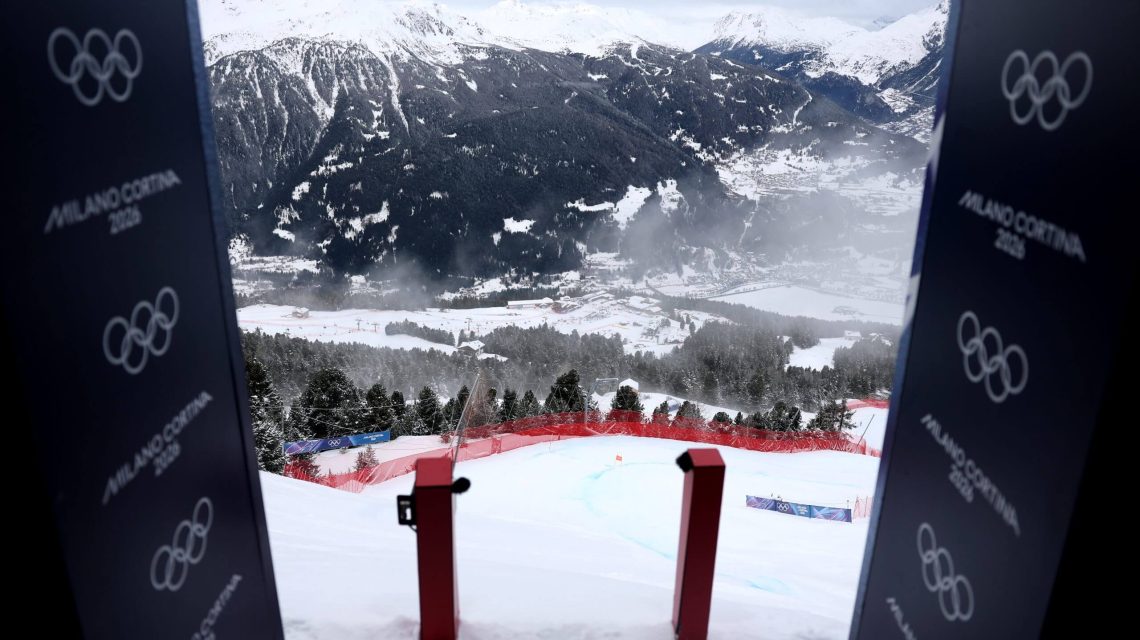
The tranquility atop a mountain in Bormio, Italy, contrasts starkly with the intense anticipation felt by skiers about to commence their descent at the 2026 Winter Olympics. At 2,000 meters above sea level, nestled away from the excitement of the cheering spectators below, stands a small wooden cabin. This retreat offers skiers a moment of serenity and shelter from the harsh elements. For some athletes, it represents a moment of calm before the impending challenge. Yet, for others, it is a space where introspection can lead to rising anxiety.
“It is like a funeral at the top,” said Kyle Negomir, a member of Team USA’s Alpine skiing team.
As skiers prepare to launch themselves down the hill, they experience a ritual familiar to racers: the countdown timer. This ingrained process begins with beeps at 30 seconds, narrows to 10, and ends with a five-second countdown.
“If you hear those beeps in the middle of the summer, it’ll give you anxiety,”
explains American skier Sam Morse, who ranked 19th in the men’s downhill and is competing in the super-G.

General view of the Stelvio track from the start gate before the men’s downhill. (Christian Petersen / Getty Images)
As they prepare for their runs, skiers typically ascend by chairlift, with some warming up by practicing free skiing, without the pressure of gates. Other skiers, like Frenchman Maxence Muzaton and Switzerland’s Alexis Monney, physically prepare themselves in unique ways, such as by engaging in exercises like side planks or self-motivating chest beats.
Even those further up the ranks, such as silver medalist Giovanni Franzoni, can feel the tension rise in their muscles during a warmup. Kyle Negomir acknowledges the challenge of managing elevated heart rates before even beginning a race, noting how exhausting it can be.
Breathwork specialist Hannah Nedas explains that a lift in heart rate, quicker breath patterns, and muscle stiffness are natural reactions to stressful situations, often heightened by adrenaline. While adrenaline enhances focused awareness, an excessive spike may impair bodily coordination and decision-making. To counteract this, techniques like focusing on tactile sensations—like boot pressure, clothing texture, or facial temperature—help athletes to maintain a relaxed nervous system.
Some athletes prefer using these calming techniques alongside music, while others ground themselves in the moment, attuned to their surroundings. As Olympians like Franzoni feel the pressure, they nonetheless try to savor the experience. As he aptly said, “Pressure is a privilege.”
Marco Odermatt prepares for his run before the second official training for the men’s downhill. (Fabrice Coffrini / AFP via Getty Images)
Events leading up to the race force a stark realization upon skiers. As Negomir describes, “Oh, s—, I’m going to have to risk my life today!”
This is a substantial burden, particularly for Negomir, who sustained significant injuries at the 2022 Olympics, yet here he stands again, reminding that returning in one piece is as crucial as avoiding slowness.
The start hut remains a sanctuary for athletes and key personnel, fostering a unique, international camaraderie among competitors. Despite half a year spent racing together on the World Cup circuit, a sober mood permeates the lead-up to each race.
“You don’t see guys chatting and shooting the s—,” Negomir said.
Instead, skiers find solace in reflective moments, perhaps focusing on their breath to reign in their nerves. Coach Nedas imparts similar breathing strategies to top English Premier League players, emphasizing the importance of remaining present with techniques like nasal diaphragmatic breathing and extended exhales.
Such mindful breathing helps regulate the nervous system, enabling athletes to maintain clarity and connectivity between body and mind, critical to executing a fluid performance. This balance is indispensable in extreme sports, where focus and efficiency supersede distractions.
Other mental exercises include maintaining a steady mantra. For Nils Allègre, it’s about staying smooth and calm,
while Morse adopts a more hands-on approach, energized at the sound of encouragement from his trainer within the final 12 seconds before his run. The final moments involve skiing over a mechanical wand, similar to a sprinter’s block, which starts the timer upon launching.
Sam Morse leaves the start gate during men’s downhill training at Stelvio Alpine Skiing Centre. (Christian Petersen / Getty Images)
However, racers like Negomir engage in visualization techniques. For him, envisioning detailed images, such as a tennis ball suspended in mid-air with rich texture and color detail, pulls focus and steadies emotions. As he approaches his descent, he lets these images fade with the countdown, poised for the challenge of racing.
As the race begins and the countdown reaches its final moments, skiers channel their mental and physical preparation, knowing they’re
ready to go to war.
 Chicago Cubs Struggle Despite Brief Optimism After Rally
  Knicks Fans Rally Across the Nation for NBA Finals Glory
  FIFA World Cup 2026: Enhanced Security Measures for Drone Activity
  Samantha Busch Expresses Gratitude Following Kyle Busch’s Passing
  Trump’s Attendance at NBA Finals Sparks Mixed Reactions
  Weekend Sports Highlights and NIL Debate