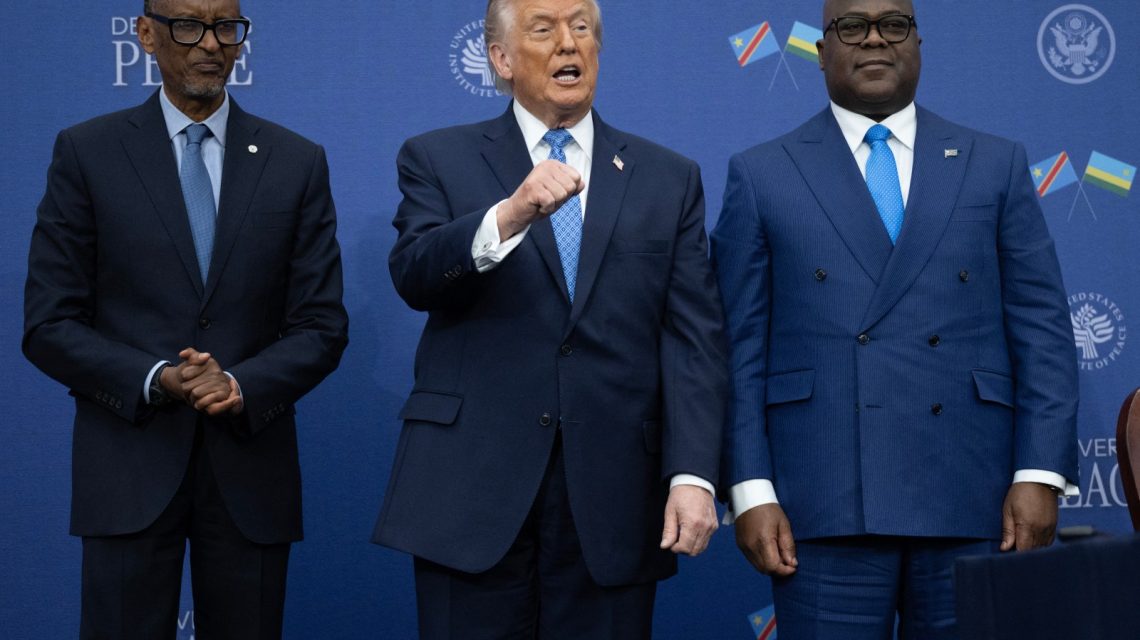
Nearly a year has passed since Congo and Rwanda signed a U.S.-backed peace agreement aimed at resolving conflicts in Africa’s Great Lakes region. Washington’s efforts to foster peace and prosperity there remain challenged. The Trump administration’s key to securing the Washington Peace Accords lies in ensuring that Congolese allies fulfill their commitments.
The United States recently intensified pressure on Rwanda and its M23 allies due to military actions that undermined peace efforts. Rwanda supported an M23 offensive in Uvira just as negotiations were underway in Washington, resulting in U.S. sanctions and visa restrictions on senior Rwandan officials. The Rwandan army faced sanctions, marking it as only the second African national army to receive such U.S. action. Former Congolese President Joseph Kabila also faced sanctions for supporting M23.
In contrast, President Félix Tshisekedi and the Congolese government gained favor with the Trump administration by signing a strategic partnership with the U.S. This agreement grants U.S. companies access to Congo’s Copperbelt and redirects mineral exports via a U.S.-funded railway. Additionally, Congo aligned with U.S. immigration policies by accepting deportees from other regions.
Despite some positive steps, Congo’s commitment to peace is questionable. While M23 has retreated in specific areas, the Congolese army remains active, often causing civilian casualties. Kinshasa has stalled negotiations and continues its support for nonstate armed groups, including the Democratic Forces for the Liberation of Rwanda (FDLR), which poses a security threat to Rwanda.
The U.S. risks undermining its peace plan by not exerting pressure on Kinshasa. President Tshisekedi, emboldened by U.S. support, shows little willingness to negotiate sincerely and sees military solutions as viable. This stance is reinforced by U.S. backing, leading to a lack of meaningful progress with M23.
Conversely, Rwanda and M23 view the process as unbalanced, reducing their incentives to engage constructively. Rwandan President Paul Kagame criticized the U.S. approach, interpreting international pressure as hostility. Without Rwandan cooperation, neither military actions by Congo nor diplomatic efforts by the U.S. will effectively counter M23.
The broader implications of U.S. actions could affect the long-term relationship with Congo. Tshisekedi has leveraged the conflict to delay elections and seek extended terms, invoking the Washington Accords to suppress political dissent by branding opponents as allied with M23. This strategy risks alienating future Congolese leaders and destabilizing partnerships.
The United States must increase pressure on Congo, prioritizing adherence to the Washington Accords. Ending support for groups like the FDLR should be an immediate action item. U.S. officials should consider sanctions on obstructionist Congolese officials and suspend defense cooperation until compliance is achieved.
Separately, the Qatari-mediated talks between Congo and M23 fall within the broader peace initiative. Here, too, U.S. involvement is crucial. Washington should press for good-faith negotiations, addressing core concerns such as temporary M23 control over its territories. Supporting President Tshisekedi with tangible benefits in the minerals partnership could ease domestic resistance.
The path to peace and prosperity requires accountability from all participants. U.S.-backed agreements offer significant incentives, mixing rewards with necessary pressure. While action against Rwanda was pivotal, Congo’s actions now threaten the peace achieved. U.S. officials must act promptly to sustain the promise of peace in the region.
Authors Liam Karr and Yale Ford are affiliated with the American Enterprise Institute. Their views are their own.
 Latin American Deportees in Congo: Return to Home Countries Amid Challenges
  Controversy Surrounds Stabbing Incident of British Student
  Royal Cottages and Controversies: Financial and Legal Revelations
  Oak Lawn Librarian Supports Library Projects in Zimbabwe
  World Cup Anticipation: US Men’s National Team and Norway’s Viking-Themed Campaign
  Family Searches for Missing Auburn Student in Japan After Disagreement Over AI