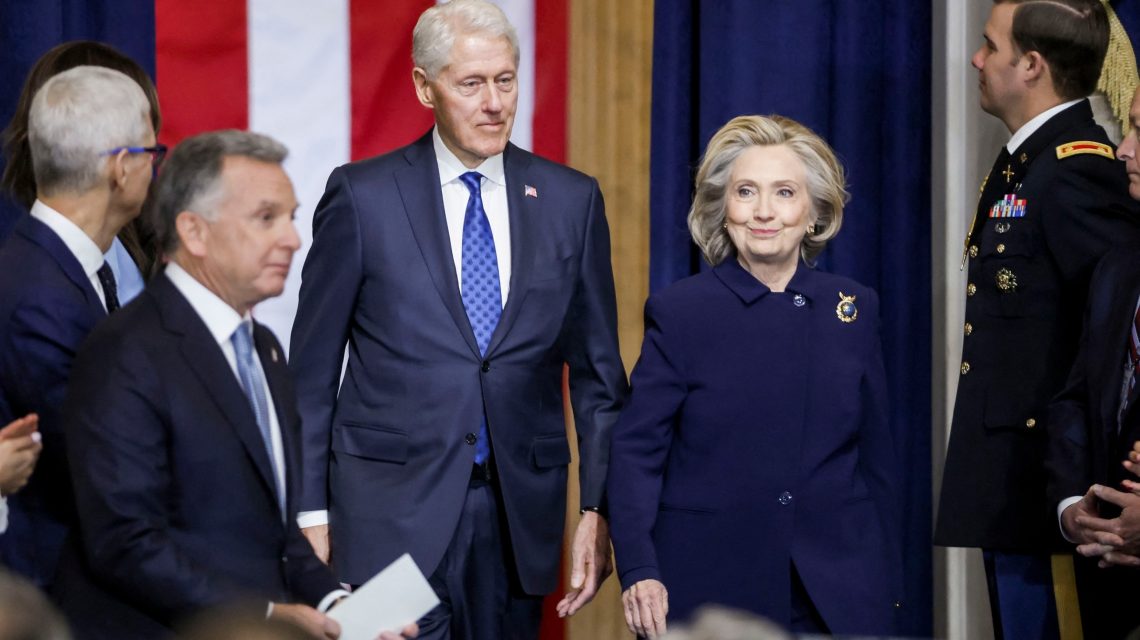
The chairman of the House Oversight Committee, a Republican, is reevaluating his decision to proceed with contempt resolutions after former President Bill Clinton and former Secretary of State Hillary Clinton agreed to conduct closed-door depositions in connection with the committee’s investigation into Jeffrey Epstein.
Originally, the House planned to vote on two contempt of Congress resolutions against the Clintons by Wednesday. However, the Clintons accepted the Republicans’ terms on Monday night. According to a statement by Clinton spokesperson Angel Ureña, “They negotiated in good faith. You did not,” indicating that both the former President and the former Secretary of State will be present, eager to establish a precedent that applies universally.
Last month, the House Oversight Committee moved forward with two bipartisan resolutions to hold the Clintons in contempt of Congress for not complying with subpoenas related to Epstein. Despite these proceedings, the Clintons have maintained their stance that the subpoenas lacked legal justification. Oversight Committee Chair James Comer expressed the need for a clearer agreement regarding the Clintons’ participation, as specifics were still ambiguous and no dates had been set for the depositions.
Beyond defying subpoenas, neither Bill nor Hillary Clinton has been accused of any wrongdoing, and both deny knowledge of Epstein’s criminal activities. No survivors or associates of Epstein have publicly accused them of inappropriate behavior concerning Epstein.
In a letter dated January 31, the Clintons’ attorneys outlined the parameters for a proposed interview and requested the withdrawal of the subpoenas and contempt resolutions. They suggested a four-hour transcribed session, instead of a deposition, to occur in New York City with all committee members present. The questioning would focus solely on matters related to Epstein’s investigations and prosecutions. The Clintons requested to use their own transcriber alongside a House court reporter.
Comer rejected parts of their offer, especially restrictions on the interview’s scope, predicting President Clinton might avoid answering questions about his personal ties to Epstein and Ghislaine Maxwell. He further objected to the proposed time limit of four hours and scheduling format, that divided questioning between Republicans and Democrats in 30-minute segments instead of 60-minute blocks. Comer explained that such a format could encourage witnesses to evade direct answers by giving unnecessarily lengthy responses.
Comer also criticized the suggestion for a voluntary transcribed interview rather than a sworn deposition. He noted, “A transcribed interview is voluntary, meaning that the subject may refuse to answer questions absent any assertion of privilege or constitutional right.” He warned that if granted, this could allow President Clinton to skip questions altogether, prolonging the process.
Regarding Hillary Clinton, her attorneys reiterated her previous statements, asserting she had no role in the Department of Justice’s (DOJ) handling of the Epstein matters. They requested the withdrawal of her subpoena to continue working toward a mutually agreeable solution. However, Comer insisted on in-person testimony rather than simple written declarations, denouncing potential special treatment for the Clintons.
 Clarity Sought on U.S. Troop Levels in Europe Amid Policy Changes
  Xavier Becerra Advances in California Governor Race
  Pentagon Reduces Recognized Religious Affiliations
  U.S. Military Awaits Pentagon’s Clarification on Troop Levels in Europe
  Xavier Becerra Advances in California Governor Race
  Graham Platner’s Campaign Amid Controversy