By Ahmed Shawkat
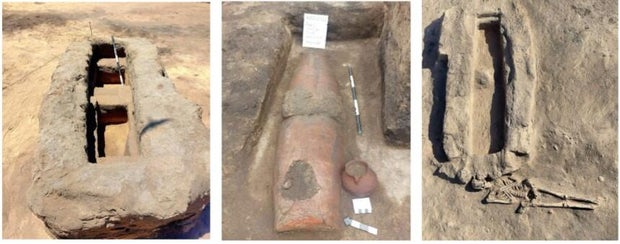
CAIRO — Egyptian archaeologists have unveiled significant findings from a Greco-Roman cemetery that highlight evolutions in funerary practices over approximately six centuries. The site, Tell Kom Aziza, located in Egypt’s northern Beheira province near the Mediterranean coast, dates back more than 2,300 years.
Discoveries at Tell Kom Aziza reveal the site’s transformation from a settlement into a cemetery used from about 332 B.C. to 395 A.D. The burial practices varied, indicating its long period of use. Nevine El-Aref, media adviser to the Minister of Tourism and Antiquities, emphasized the discovery’s importance, noting its unique insight into the site’s historical transformation.
Burials at Tell Kom Aziza range from simple pit burials to elaborate graves lined with mudbricks and painted plaster coffins. Dr. Hisham El-Leithy, Secretary General of the Supreme Council of Antiquities, mentioned varied orientations and hand positions of interred bodies, which might reflect social differences or ritual practices. Some individuals were buried with arms crossed over the chest, while others had arms aligned alongside the thighs.
Khaled Abdel Ghany Farhat, head of the archaeological team, highlighted the diversity of burial practices. This diversity could represent social differences, ritual variations, or changes within the same funerary tradition.
“This diversity can be interpreted in several ways,” Farhat told CBS News.
Among the discoveries were the complete skeletal remains of two wild boars. These animals are associated with Seth, the ancient Egyptian deity linked with chaos and violence. Mohamed Abdel Badi, Head of the Egyptian Antiquities Sector, explained the uncertainty regarding the boars’ presence, suggesting several interpretations including ritual significance.
Pottery fragments from as far back as the Egyptian Old Kingdom, during the pyramids’ construction between 2686 and 2181 B.C., were also found alongside Greco-Roman period items at the site. The artifacts, such as amphorae and bread molds, indicate prolonged use of the area.
Excavation work continues at Tell Kom Aziza. The goal is to uncover more details about the location’s history and decipher human activity patterns over millennia, according to El-Aref.
 Europe Leads in Rapid Warming Due to Fossil Fuels and Local Factors
  Climate Change Alters the Swiss Experience
  Vatican’s Raphael Loggia Undergoes $5.5 Million Restoration
  Viking Age Textile Production Site Uncovered in Denmark
  Lincoln Memorial Reflecting Pool Renovation and Controversy: Arrests, Environmental Concerns, and Repairs
  FOX One Teams Up with USO to Offer World Cup 2026 Coverage to U.S. Military Overseas