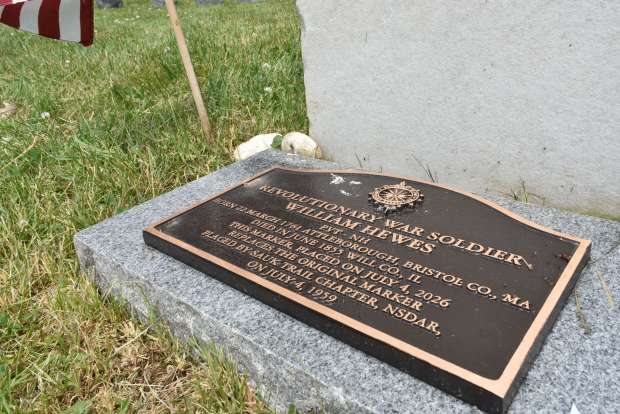
William Hewes, born in 1761, lived through a transformative era. When he was born, the United States did not exist, and by his death in 1855, the nation faced deep divisions over slavery. Throughout his 94 years, Hewes played a significant role in American history.
Hewes fought in the Revolutionary War, opposing British forces as part of the movement to establish a new nation. Afterward, he journeyed with his family to the west, finally settling in Crete, Illinois. Today, 29 of his descendants live there, keeping his legacy alive in Will County.
Recently, a group of around three dozen people, including some descendants, local historians, and members of the National Society Daughters of the American Revolution (DAR), gathered at Hewes’ grave in Crete. They came to rededicate a memorial plaque in his honor. The original plaque, dedicated in 1959, had aged over time, leading to the decision for a replacement. DAR regent Melody Paris-Rush cited the country’s 250th anniversary and the condition of the old plaque as reasons for the ceremony. “Over time, with weather exposure and contact with mowing equipment, the old marker had discolored and lost letters,” Paris-Rush noted. “So, for the 250th anniversary, the chapter decided to replace it to honor his service.”
The new metal marker at Hewes’ grave provides minimal information. It notes his service in the Revolutionary War, along with his birth and death dates and places. However, his contributions go beyond what is inscribed.
Tim DeMuth, a descendant of Hewes, spoke at the rededication ceremony held at the First Congregational Church near the grave. DeMuth shared that Hewes was a private during the Revolutionary War, enlisting at age 18 for six months. His service included witnessing the execution of John Andre, who was instrumental in Benedict Arnold’s betrayal, and serving at the significant military post of West Point. While not a famed soldier, DeMuth emphasized the importance of every soldier’s role in securing liberty.
“They all made it possible to enjoy the blessings of liberty as we celebrate our 250th anniversary as a nation,” he said.
Post-war, Hewes traveled via the Erie Canal and Great Lakes, eventually reaching Detroit. From there, he walked westward with his son, settling in Crete. Of his 12 children, five moved to Illinois, establishing roots in Crete and contributing as politicians, ministers, farmers, and shopkeepers. Their deep connections to the land persist. DeMuth noted that some family members still reside in a house they have occupied for five generations in Crete.
“It’s just part of our soul, the land,” DeMuth expressed.
 A Journey of Hope: A Refugee’s Story and The Power of Humanitarian Support
  Navigating Complex Relationships with Therapeutic Insights
  Dorotha Finds a New Home After Losing Her Owner
  Gen Z’s Concerns and Usage of AI
  ICE Officer’s Heroic Rescue of Child in Florida Pool
  Attending the New York Knicks Championship Parade with Kids: What Parents Need to Know