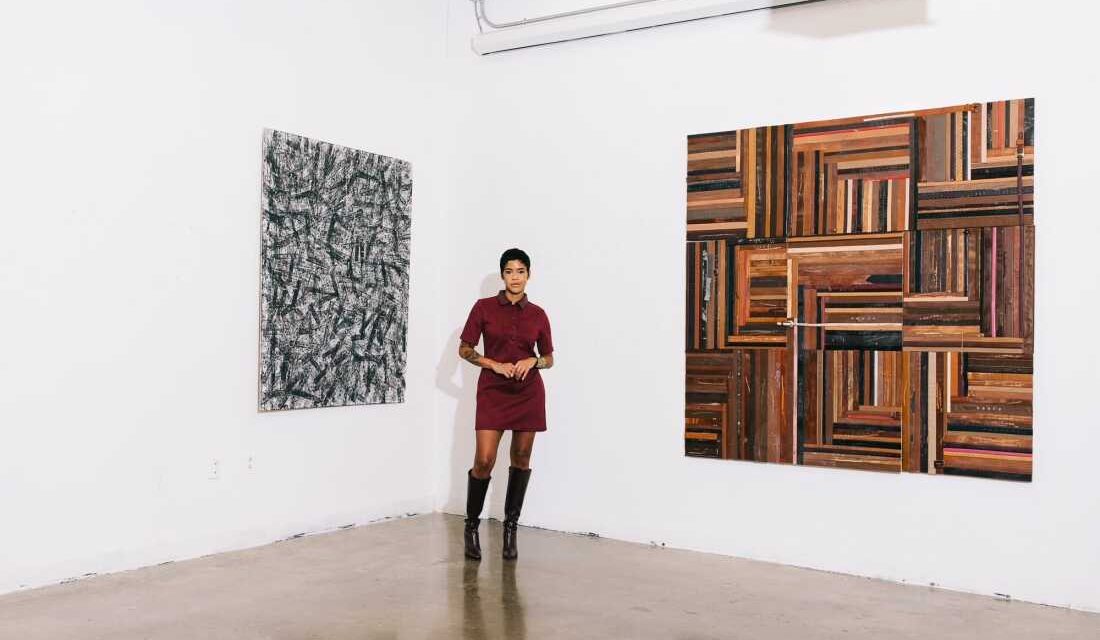
Multidisciplinary artist Lex Marie has gained popularity on TikTok and Instagram through her art, which addresses discipline in Black households. At her studio in Washington, D.C.’s American University’s Katzen Arts Center, Marie transforms belts into symbols and tools for her narratives.
Marie uses belts in artworks by arranging them meticulously on canvases or by dipping them in paint to create bold strokes on white surfaces. Her works delve into childhood, discipline, survival, and the complex expressions of love, focusing on a topic many families recognize but rarely discuss openly: corporal punishment in Black homes.
I’m critiquing discipline in Black households specifically. But I’m trying to tackle the history behind discipline in black households, behind spankings and whippings, and speak to the difference in how millennials are raising their children as well.— Lex Marie
Marie, a 33-year-old mother, finds that her art often draws from her parenting experiences. Through motherhood, she reflects on her own childhood, comparing and contrasting her experiences with spankings to current parenting ideas.
One significant piece, “Watch Your Tone,” is a six-by-six-foot canvas covered with belts of various colors, symbolizing different skin tones and representing how punishment links to American history. The artwork’s title echoes a common phrase children hear: “Watch your tone when talking to me.” For historians, conversations about corporal punishment in Black American households often connect to the legacy of slavery.
Yohuru Williams, of the University of St. Thomas, highlights how discipline practices have evolved from violent control methods used during slavery into modern parenting approaches. Williams explains that physical punishment’s roots extend beyond slavery but were reinforced by it, affecting Black parenting traditions.
Marie’s “Because I Love You” demonstrates the act of enforcing punishment using a belt dipped in paint. Repeatedly striking a wooden panel, she left marks resembling scars. The piece’s title refers to phrases children hear after punishment: “This hurts me more than it hurts you.” Marie found creating this art both cathartic and challenging.
As her videos gained traction online, discussions around her art included thousands sharing their childhood stories. Some responses were painful or defensive, while others appreciated the dialogue. Marie insists the aim of her work is not to shame but to foster conversations often left unspoken.
Williams suggests Black families need to rethink discipline’s historical legacy, aiming for communal and dignified practices. He emphasizes understanding historical contexts and embracing restorative practices is essential.
Marie believes her art helps spark conversations about childhood trauma, particularly for those who find such discussions difficult. Her work, planned for a fall exhibition, includes nearly 20 pieces, two of which filmmaker Spike Lee purchased. For Marie, the goal is recognition and understanding—not agreement.
 Historian Eddie Glaude Jr. Explores America’s Complex Past and Present
  Preservation Groups Challenge Statuary Garden Project
  America250: Documenting U.S. Identity with a Time Capsule
  The Evolution of Cultural Events in Washington During Trump’s Presidency
  Inspired Team USA Performance and the Impact on Soccer in America
  Notable Events in Chicago’s History: June 13