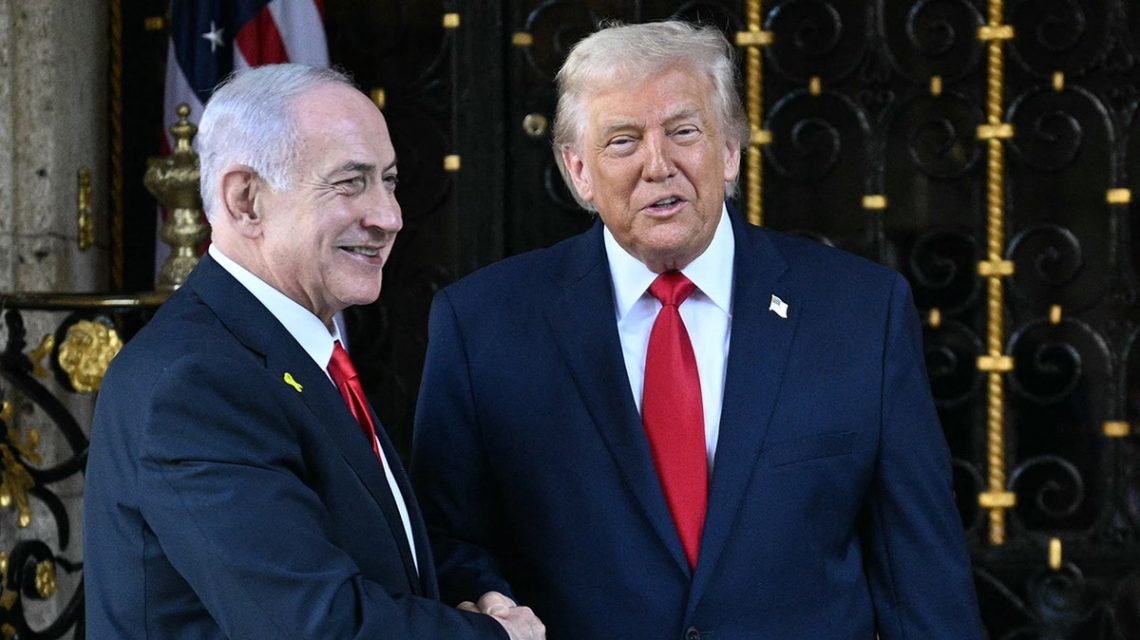
Israeli Prime Minister Benjamin Netanyahu is scheduled to meet with President Donald Trump at the White House on Wednesday. This visit is expected to focus primarily on Iran, as the United States considers diplomacy versus the potential for military action. Israel aims to influence the framework of ongoing negotiations with Iran.
President Trump has emphasized that discussions about Iran will be at the forefront of the agenda. In an interview with Axios, he remarked that Tehran is eager to make a deal, but he cautioned, “Either we make a deal, or we’ll have to do something very tough — like last time.”
“I will present to the president our concept regarding the principles of the negotiations—essential principles important not only to Israel but to anyone who wants peace and security in the Middle East,” Netanyahu stated before flying to Washington.
Recent talks between U.S. and Iranian officials have been held in Oman, marking the first such dialogue since last summer’s 12-day conflict. Meanwhile, the U.S. continues to maintain a substantial military presence in the Gulf, serving as both a deterrent and a tool for negotiation leverage with Tehran.
From a U.S. perspective, Iran is not simply a regional concern; it’s regarded as a global security challenge, according to Jacob Olidort, chief research officer at the America First Policy Institute. He noted, “Iran is not so much a Middle East issue. It’s a global issue affecting U.S. interests around the world.” He described the Iranian regime as “probably the world’s oldest global terror network…with thousands of Americans killed through proxies.”
The U.S. administration combines diplomacy with visible military pressure. “The president has made it clear that the military option cannot be off the table if talks do not succeed,” Olidort emphasized. “Military assets in the region are part of the negotiation strategy with Iran.”
Israel’s primary concerns include not only Iran’s nuclear ambitions but also its ballistic missile capabilities and regional influence through armed groups. President Trump indicated that the U.S. shares this perspective, asserting that any agreement should address Iran’s ballistic missile program, in addition to its nuclear activities.
Israeli intelligence expert Sima Shein warned that negotiations limited to nuclear issues could pose a risk to Israel. “The visit signifies a lack of confidence that American envoys can fully represent Israel’s interests. Netanyahu seeks a direct dialogue with Trump to ensure no ambiguity exists regarding Israel’s stance,” she said.
She suggests Iran might be delaying talks to see if the U.S. will limit discussions to the nuclear dossier while avoiding missile-related constraints. An agreement that eases sanctions without addressing Iran’s broader capabilities could stabilize the regime during internal struggles, potentially preserving its military strength. “An agreement now would effectively save the regime at a time when it lacks solutions to internal problems,” Shein argued.
Should an agreement be reached, Shein advises that the U.S. must insist on the release of detainees and demand humanitarian measures, including medical aid for the severely injured.
Beyond Iran, Netanyahu plans to discuss the situation in Gaza, where U.S.-backed efforts for a postwar framework and ceasefire remain unresolved. Israeli sources report that Netanyahu intends to inform Trump about stalled progress on the Gaza peace plan, reflecting ongoing disputes over disarmament, governance, and security issues.
The timing of Netanyahu’s visit might also let him skip returning to Washington for the initial session of the contentious Board of Peace. Shein noted that the initiative has sparked controversy in Israel’s parliament. Hamas’s continued control of Gaza and its influence on international disarmament commitments also remain significant issues for Israel.
“Hamas’s control of Gaza remains strong, while international commitments to disarm Hamas have appeared to weaken,” stated Dan Diker, president of the Jerusalem Center for Security and Foreign Affairs. “Israel’s concerns focus on both the Iranian threat and developments in Gaza. Timing is critical, and Israel is wary of losing its window of opportunity for action,” he concluded.
 U.S. Military Awaits Pentagon’s Clarification on Troop Levels in Europe
  Xavier Becerra Advances in California Governor Race
  Graham Platner’s Campaign Amid Controversy
  South Carolina GOP Primary Heats Up as Trump Endorses Evette
  Potential Ebola Outbreak in Central Africa Raises Concerns of Rapid Spread
  Federal Judge Overturns Trump-Era Immigration Policy